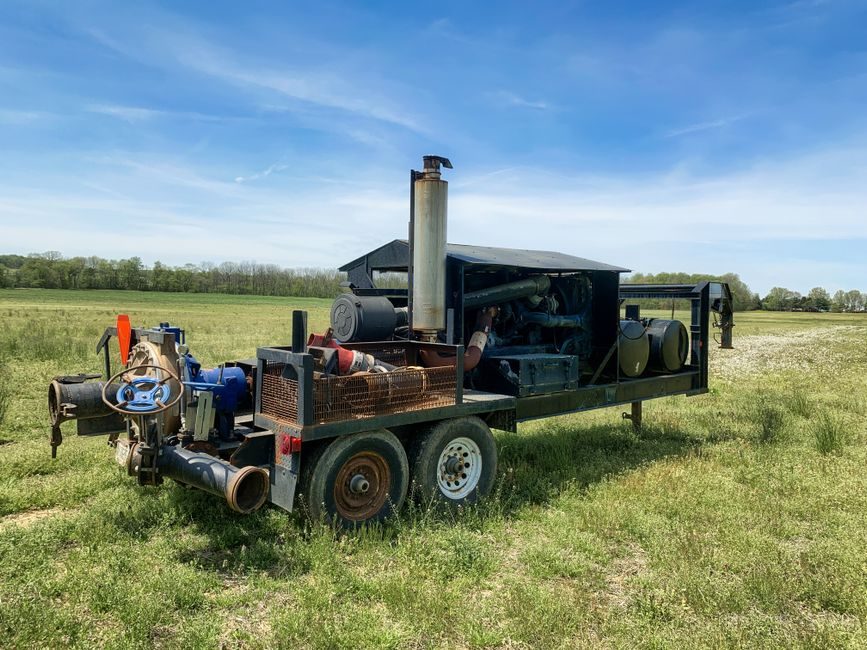
Multistage centrifugal pumps mount two or more impellers in series on a common shaft so each stage adds incremental head, with the final discharge pressure scaling roughly with stage count at constant flow [S4][S6].
Selection pivots on three numbers: required head (m or bar), required flow (m³/h), and the fluid's NPSH, temperature and chemistry. Commercial vertical inline units such as the AMT MSV series are rated to 1600 kPa (232 psi, ~165 m) casing working pressure, 4–82 °C liquid temperature, and 3450 RPM continuous-duty TEFC motors (2850 RPM at 50 Hz) [S1].
Head and Flow Envelope: Horizontal vs Vertical Inline
Horizontal multistage designs reach up to 1000 m head (100 bar) and 1200 m³/h flow, made possible by dedicated thrust bearings and a long-coupled shaft that absorbs axial load across many stages [S5].
Vertical inline multistage units cap out around 450 m head (45 bar) and 500 m³/h, because the vertical shaft housing has no room for a thrust bearing of the size used in horizontal builds [S5]. If the duty demands more than 45 bar or 500 m³/h, horizontal is the default; if the duty is a clean booster service below those limits, vertical inline saves footprint and piping [S3][S5].
Stage Count, Throat-Ring Leakage, and Efficiency
Adding stages raises head at roughly the cost of compounded throat-ring leakage; numerical work on Tesla-valve-inspired auxiliary blades cut throat leakage by up to 28.99% and lifted head and overall efficiency by about 8.1% and 8.7% near best efficiency point, with gains of 116.45% (head) and 110.84% (efficiency) reported at high-flow off-design points [S2].
That figure matters at the quotation stage: a higher-efficiency optimized impeller can justify fewer stages to hit the same duty, cutting seal faces, bearings, and shaft length on the bill of materials. For boiler-feed or high-pressure washdown where every bar counts, request throat-ring leakage curves and BEP head/efficiency from the OEM rather than relying on nameplate head alone [S2][S4].
Materials, pH Window, and Fluid Compatibility
Stainless-steel vertical multistage pumps are commonly rated for pH 5 to 8 in standard builds, with industrial-cleaning, HVAC, aquaculture, cooling-tower, and water-treatment duty cycles flagged in the OEM catalog [S3]. pH 6.5 to 8.5 is the narrower band most BL-series stainless specs are validated against; outside that window, upgrade to duplex, super-duplex, or alloy 20 stages.
AMT's MSV vertical inline manual states the units are for clear, non-flammable, non-abrasive liquids compatible with wetted materials, are NOT investigated for potable-water use, and explicitly exclude petroleum-based liquids [S1]. If the fluid is a hydrocarbon, glycol, or anything with flash point below the local fire code, switch to an API 610 or ATEX-classified build, not a general-purpose stainless multistage.
Seal, Suction Piping, and Installation Gates
Mechanical seal replacement on AMT MSV units is possible without full disassembly, and an optional ANSI/ASME flange kit is offered for drop-in replacement of legacy boosters [S1]. Inlet piping must include a minimum 4-pipe-diameter straight run immediately upstream of the suction flange, must not be reduced below pump port diameter, and must avoid throttling valves that starve the pump [S1].
Flange bolts on the casing must be re-torqued evenly to 33 ft-lbs (45 N-m) to avoid gasket failure, and the pump must be mounted with motor shaft plumb on a level surface shimmed at all four feet [S1]. For comparison shopping, treat 3450/2850 RPM TEFC motor, 1600 kPa casing rating, and 4–82 °C liquid window as the baseline gate — anything missing one of these three should be questioned before purchase [S1].
Who Should NOT Pick a Multistage Centrifugal Pump
Multistage centrifugal pumps are the wrong tool when the duty is high-viscosity (above ~200 cSt), high-solids slurry, or self-priming suction lift above 6 m — those point to positive-displacement plunger pumps or diaphragm pumps instead. [S2]
For low-flow / very-high-head (above 100 bar) chemical dosing, a metering pump is a better fit than a multistage centrifugal, because the centrifugal's efficiency collapses sharply off its best-efficiency point. Conversely, on a clean-water booster below 16 bar, a single-stage centrifugal pump is usually cheaper to buy and to maintain than a multistage — only go multistage when the head math forces it.
Comparison Snapshot: Multistage Pump Architectures
Four common configurations line up against decision criteria: horizontal end-suction multistage (max 1000 m, 1200 m³/h, thrust-bearing duty, long-coupled serviceability) [S5]; vertical inline multistage (max 450 m, 500 m³/h, compact footprint, no thrust bearing) [S1][S5]; vertical cantilever / submersible multistage (deep-well borehole, solids-tolerant, no shaft seal in the wetted section); and split-case horizontal multistage (large flow, easier impeller access, heavier foundation).
For a 80 m head / 60 m³/h chilled-water booster, a vertical inline stainless unit sits in the AMT MSV or BL-series envelope; for a 600 m head / 200 m³/h boiler-feed, only horizontal end-suction multistage or barrel-casing designs clear the head gate [S1][S3][S5]. When flow exceeds 500 m³/h and head exceeds 45 bar, horizontal multistage is the only architecture on the shortlist [S5].
Sourcing and Standards Discipline
For hazardous-area or hydrocarbon service, request ATEX/IECEx classification on the nameplate — the AMT MSV manual does not list any hazardous-area rating, and treating it as if it had one is a common spec error [S1]. Forged-stage and stainless-stage multistage pumps should ship with a hydrostatic test certificate at 1.5× the casing working pressure of 1600 kPa, plus a material test report on wetted parts.
Shortlist logic that survives audit: confirm head × flow falls inside horizontal vs vertical envelope [S5]; confirm fluid pH 5–8 for standard stainless or specify an alloy upgrade [S3]; confirm 4-pipe-diameter straight suction run, 33 ft-lbs (45 N-m) flange torque, and TEFC motor speed rating per installation manual [S1]; require throat-ring leakage and BEP efficiency curves when stages exceed six [S2]. For related high-pressure positive-displacement work, the plunger-pump selection map covers duties where a multistage centrifugal pump hits its efficiency wall [S2].
Component reference pages worth checking: diaphragm pump.