Multistage centrifugal pumps and self-priming centrifugal pumps are two of the most-specified workhorses in industrial water, chemical, and process lines, yet they fail in completely different ways when the suction runs dry. The decision rarely comes down to flow or head alone — it comes down to whether the pump can survive the next interlock failure, tank-empty event, or valve closure.
On the spec sheets reviewed for 2026-07-19, multistage stainless-steel vertical models (e.g. Wilo Helix FIRST VE, up to 88 m³/h and 25 bar [S6]) are consistently paired with an "intelligent protector" to prevent dry-running, out-of-phase and overload [S7], whereas self-priming models such as the Pompes Japy GMP35 (78 m³/h, 7 m suction lift, 35 mm solids passage, ATEX-rated [S2]) and the zehnder Garden 1000M (3.6 m³/h, 50 m head, 8 m self-prime lift [S3]) list dry-tolerant priming as a baseline capability rather than an add-on.
Two architectures, two failure modes
A multistage pump stacks multiple impellers in series on a single shaft, multiplying head without multiplying flow; a self-priming pump re-uses a portion of discharged liquid to evacuate air from the suction casing and re-establish flow after a lost prime. The mechanical consequences of dry running diverge sharply: in a multistage the close radial and axial clearances between stages lose their hydrodynamic lubrication within seconds, the thrust balance collapses, and a single event can score the bowl in under a minute; in a self-priming unit the liquid-rings the seal and the open impeller passage tolerates air for the 30-120 s it normally takes to re-prime, after which it simply idles on air without mechanical contact damage. [S1]
For this reason, the Okorder datasheet on stainless-steel vertical multistage centrifugal pumps explicitly states the unit "can be equipped with an intelligent protector to effectively prevent it from dry-running, out-of-phase and overload" [S7] — the protection is external, electronic, and sold as an option, not built into the hydraulic geometry. The Wilo Helix FIRST VE series, in turn, is offered with pressure ratings of 10 bar, 16 bar and 25 bar (145.04 / 232.06 / 362.59 psi) on a stainless-steel in-line vertical seal construction with IP55 ingress protection [S6].
Selection criteria: head, suction lift, fluid, and dry-run exposure
Specifying engineers should weight four decision criteria in this order: (1) required head and flow point, (2) maximum suction lift and air-handling requirement, (3) fluid cleanliness and solids content, and (4) frequency and consequence of prime loss. A centrifugal pump in single-stage form rarely delivers more than 50-60 m of head economically; the Wilo Helix FIRST VE reaches 25 bar (≈250 m head) precisely by stacking stages [S6], while the zehnder Garden 1000M tops out at 50 m (164 ft) in a single-stage self-priming layout [S3].
On suction lift, the Pompes Japy GMP35 quotes a 7 m maximum suction lift with 35 mm solids passage and ATEX protection [S2], the zehnder Garden 1000M quotes 8 m self-priming lift with a thermoplastic injector/diffusor [S3], and the ZW self-priming sewage pump accepts liquids up to 120 °C and ambient temperatures up to 45 °C while passing long-fibre waste without a foot valve [S8]. Multistage pumps, by contrast, generally require flooded suction or a foot valve, and tolerate essentially zero air ingestion before losing prime. The IWAKI NRD canned-motor self-priming unit illustrates the chemical-process corner: 5.1-70 l/min flow, 4.1-15 m head, 6-72 W power, 0-80 °C fluid temperature, 24 V DC, seal-less and PWM-controlled [S1] — a flow regime where the dry-run concern shifts from mechanical damage to seal face overheating and chemical attack.
Comparison matrix: multistage vs self-priming on dry-run risk
The decision matrix below lines the two architectures up against the criteria that actually drive dry-run damage: (a) tolerance to prime loss, (b) recovery after prime loss, (c) solids handling, (d) head reach, (e) typical protection strategy, and (f) representative model and source. On tolerance, the multistage scores poorly — it needs an external protector to even be specified for variable-level suction [S7] — whereas the self-priming architecture is built around air handling and re-primes in 30-120 s without intervention [S2][S3][S8]. On recovery, the multistage must be stopped, re-filled, and re-started, while a self-priming unit does it on the next demand cycle. On solids, multistage close-tolerance stages exclude trash, while self-priming trash pumps (GMP35) pass 35 mm particles and ZW units pass long fibre [S2][S8]. On head, multistage wins decisively — the Helix FIRST VE reaches 25 bar / 250 m [S6] — and on protection the multistage relies on a current-sensing or level-based cut-out [S7] while the self-priming unit relies on its own hydraulic geometry.
The corollary, frequently missed in specification, is that a self-priming pump is not a universal replacement for a multistage: at 88 m³/h the Wilo Helix FIRST VE outclasses every self-priming model in the source set on both flow and head simultaneously [S6]. Conversely, putting a multistage on a solids-laden or air-ingesting suction source is a near-guaranteed mechanical failure within hours, irrespective of how well the external protector is tuned.
Who each architecture is FOR — and who it is NOT for
The multistage centrifugal pump is for: clean, cold-to-warm water; high-pressure booster duty (boiler feed, reverse-osmosis feed, HVAC risers, washing systems at 16-25 bar); flooded or positive-suction installations; and process plants where the suction source is mechanically guaranteed and instrumented. It is NOT for: suction lifts above 2-3 m, fluids with entrained air, dirty water with fibrous solids, applications where the source tank can run dry between batches, and any duty where an electronic dry-run protector cannot be wired in. The Pompes Japy GMP6 (7.7 m³/h, combustion-engine drive) and GMP35 (78 m³/h, HONDA 4-stroke petrol, Ni Hard cast-iron vortex turbine, watertight mechanical seal, 3″ and DN75 orifices) [S2][S4] are representative of the opposite end of the duty spectrum — site work, solids-laden water, ATEX zones, manual or engine-driven deployment.
The self-priming pump is for: intermittent duty, suction lifts of 5-8 m, fluids that contain dissolved or entrained gas, solids up to 35 mm, and any installation where the operator cannot guarantee a flooded suction. It is NOT for: very high head beyond 50-60 m, ultra-clean high-pressure boiler feed, or fluids that chemically attack the elastomers and seals in the re-priming chamber. The IWAKI NRD series — seal-less, canned-motor, 24 VDC, PWM or 1-5 V analogue flow control, hose-barb / NPT / R-thread port options [S1] — shows that self-priming can also be specified for fine chemical and analytical duty where leakage is unacceptable, in which case the dry-run risk reduces to thermal damage of the canned-motor stator rather than mechanical seal failure.
Lubricant, coolant, and machine-tool duty: a third category
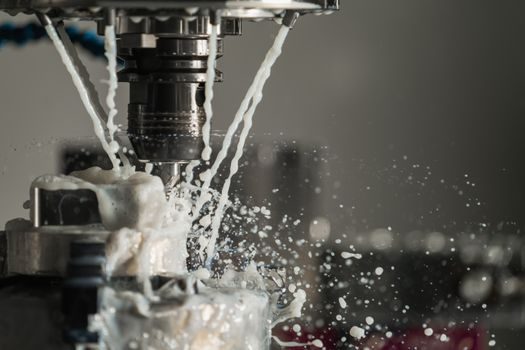
Machine-tool coolant and lubricant service is a special case where neither a true multistage nor an open-impeller self-priming unit is ideal, and the source set instead shows dedicated compact centrifugal units such as the Brinkmann Pumpen SBG801…803 series for cutting fluid, coolant and lubricant suction on machine tools [S5]. These pumps are short-coupled, electric, and sized for the 1-10 bar / 5-30 m³/h range typical of emulsion cooling; dry-run behaviour in this duty is dominated by seal face lubrication and emulsion aeration, not by the stage-to-stage contact seen in a clean-water multistage.
The takeaway is that "centrifugal pump" is too coarse a category for dry-run risk: a 25-bar multistage high-pressure booster [S6], an 8 m self-priming garden unit [S3], a 35 mm-solids ATEX trash pump [S2], and a 1 kW canned-motor chemical pump [S1] are four different hydraulic systems with four different dry-run signatures, and the supplier-level specifications reviewed for 2026-07-19 reflect that division clearly.
Sourcing, standards, and what to verify on the datasheet
ATEX certification is explicitly listed on the Pompes Japy GMP35 (3″ / DN75 orifice, 30 m max TDH, 8 hp) [S2], and IP55 is listed on the Wilo Helix FIRST VE [S6] — both worth checking against the actual zone classification on the datasheet rather than the marketing blurb. On the multistage side, the Okorder datasheet flags the protector as optional [S7]; the engineering question is not whether to buy it but how it is wired (current-sensing relay, conductivity probes, or dedicated thermal cut-out in the motor windings). On the self-priming side, the IWAKI NRD's 50 V-or-less supply classification as compliant with UL, CSA, CE and GS [S1] is the safety baseline; the zehnder Garden 1000M's stainless-steel and thermoplastic wetted-end materials are drinking-water-approved [S3], which is the right material call for domestic boosting but is not necessarily a chemical-duty combination.
The most reliable signal to track over the next sourcing cycle is whether suppliers are starting to publish explicit dry-run tolerance times (in minutes) on the datasheet for self-priming models, and whether the multistage suppliers are starting to ship the intelligent protector as standard rather than as an option. A 2026-07-11 supplier listing from Anhui Tenglong Pump & Valve Manufacture on Made-in-China lists both pipeline pumps, self-priming pumps and centrifugal pumps as production lines, alongside ISO 9001 registration [S9] — typical of a manufacturer that will quote against any of the three architectures, and a useful confirmation that all three remain active product categories rather than a single dominant type.
Related analysis: Safety Interlock Switch TCO: 10-Year Cost Drivers, Hidden Spend Lines, and Sourcing Levers.