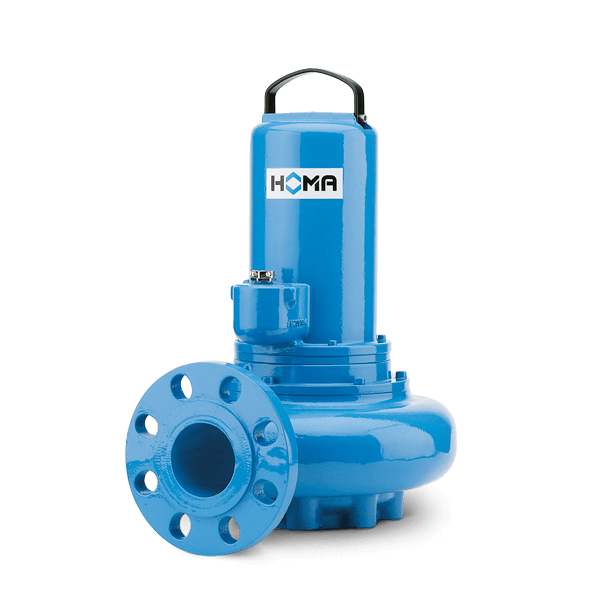
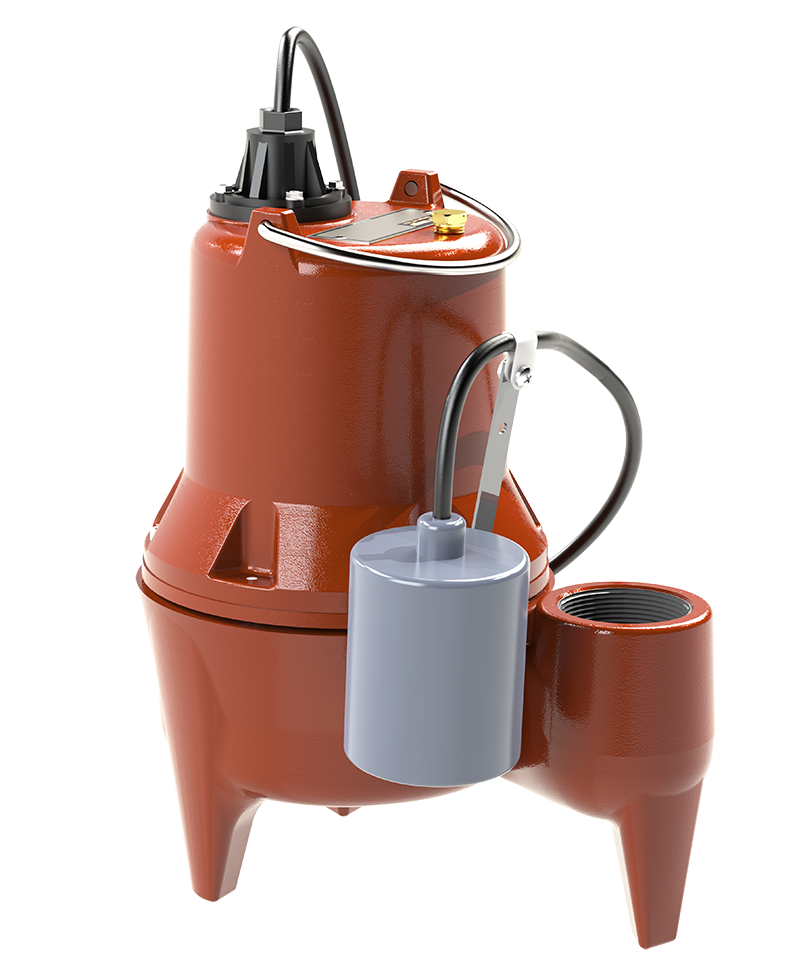
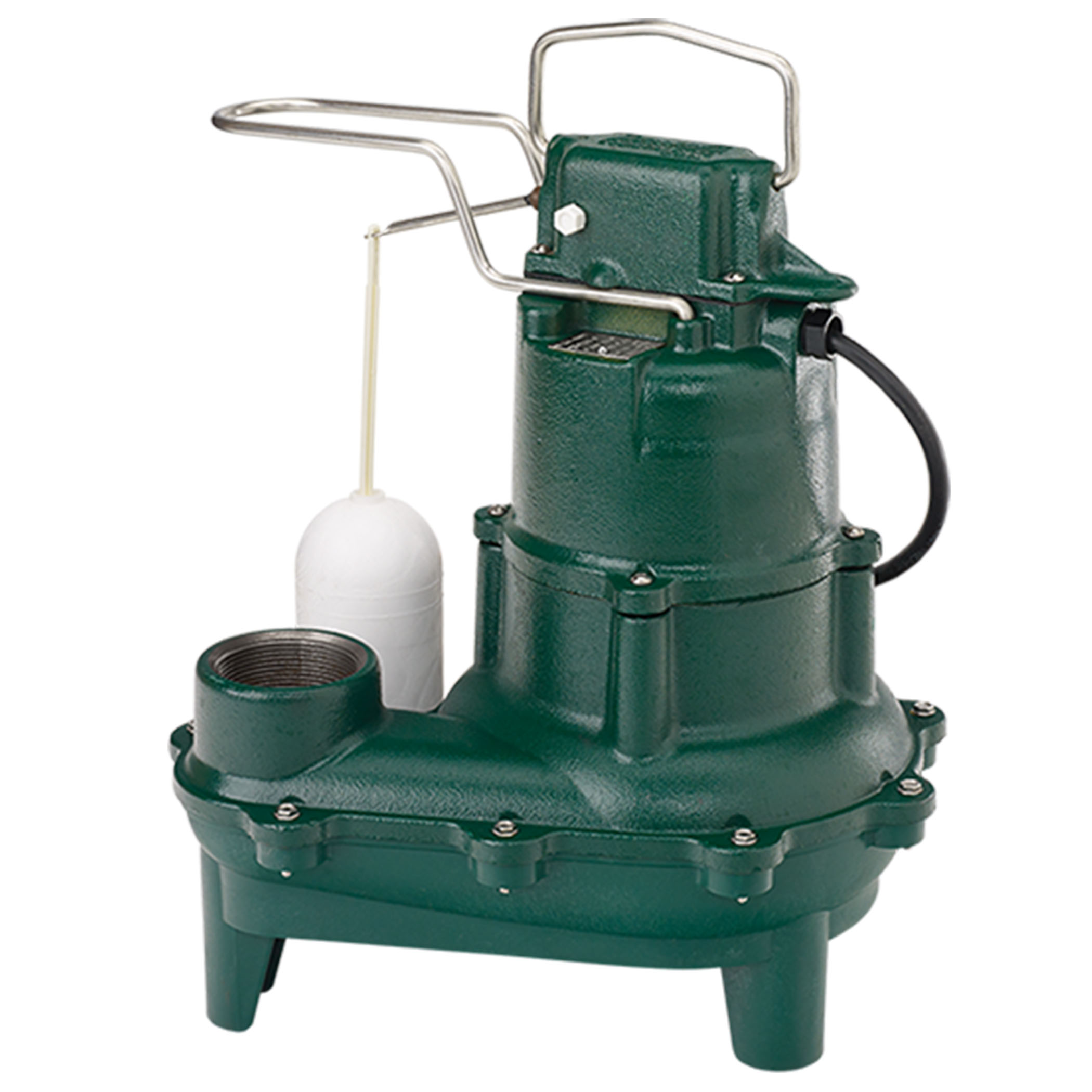
A sewage pump is a solids-handling rotodynamic pump built to move raw, unscreened wastewater, sludge, and entrained debris without clogging. It is the workhorse of municipal lift stations, building basements below the sewer line, and industrial effluent plants. Where a clean-water centrifugal pump assumes a particle-free fluid, a sewage pump is engineered around the opposite assumption: that rags, wipes, grit, plastics, and fibrous matter will arrive continuously, and the hydraulic design exists to pass or shred them while still delivering the required flow and head.
Two families dominate. Solids-handling (non-clog) pumps pass intact solids through a large free passage using vortex, channel, or self-cleaning impellers. Grinder pumps macerate solids into a slurry first, then push that slurry through a small pressurized line. This guide treats both, decodes the spec sheet, and walks the selection sequence used by lift-station and plant engineers.
This guide is written for procurement engineers and design engineers specifying lift stations and effluent systems. Across 6 chapters it covers what defines a sewage pump, the impeller and pump-type taxonomy, solids-handling technologies, wetted materials and seals, the spec-sheet parameters that drive selection, and the decision sequence itself, plus 7 selection FAQs and manufacturer comparisons. Performance and certification references draw on ISO 9906 pump acceptance grades, EN 12050-1 for faecal lifting plants, the EN 12056 installation series, IEC 60034 motor standards, and the IEC 60079 hazardous-area series.
Chapter 1 / 06
What is a Sewage Pump
A sewage pump is a centrifugal pump whose hydraulics are designed for liquids carrying suspended and entrained solids, fibers, and grit rather than clean water. Functionally it does what any centrifugal pump does: an impeller spins, centrifugal force throws the liquid outward into a volute casing, and the volute converts velocity into pressure to push the flow up the discharge line. The difference is everything around that core. The impeller has fewer vanes and a wider gap, the casing has a smooth large-radius volute, and the whole flow path is sized so that a defined sphere of solid matter can pass through without lodging. This defined sphere, the free passage, is the single number that most distinguishes a sewage pump from an ordinary water pump.
Most field sewage pumps are submersible: the motor and hydraulics form one sealed unit that sits in the sewage itself, with the surrounding liquid carrying away motor heat. The pump drops onto a guide-rail auto-coupling so it can be hoisted out for service without anyone entering the wet well, which removes the confined-space hazard from routine maintenance. The alternative dry-pit arrangement places the pump in a separate dry chamber beside the wet well, keeping the motor accessible; this is common in large municipal stations. A third form, the vertical-column or long-shaft pump, drives a submerged impeller from a dry motor above the pit.
The grinder pump is a distinct sub-family. Instead of passing solids, it shreds them. A hardened cutter wheel and stationary cutting ring sit at the suction and macerate incoming solids into a fine slurry before the impeller, so the slurry can be forced through a small-bore pressurized line at high head. Environment One, which pioneered the low-pressure sewer, builds its reference grinder as a semi-positive-displacement (progressing-cavity) unit running at 1,725 rpm on a 1 HP motor, delivering roughly 15 gpm at 0 psig and still 7.8 gpm at 80 psig, so a single small pressurized service can climb long uphill runs that gravity sewers cannot.
Historically, sewage pumping grew out of municipal sanitation in the late 19th and early 20th centuries, but the modern submersible sewage pump dates to the 1950s and 1960s, when sealed-motor designs let the pump live in the wet well. The decisive later advance was clog resistance. Rising volumes of disposable wipes and synthetic textiles in the 2000s and 2010s made conventional channel impellers clog far more often, which drove patented self-cleaning hydraulics such as the Flygt N-pump and the Grundfos S-tube that sweep fibrous matter through without ragging.
Four engineering metrics govern a sewage pump over its life: free passage (clog resistance), hydraulic efficiency at the duty point, motor and seal reliability under continuous wet operation, and serviceability. These map directly to total cost of ownership. A cheap pump with a small free passage and a single seal may cost less to buy, but if it clogs weekly and floods a basement, or if a failed seal lets sewage into the motor, the cost of call-outs, downtime, and overflow penalties dwarfs the purchase saving within the first year.
Chapter 2 / 06
Pump Types and Impeller Classes
Sewage pumps split first by how they treat solids (pass them or shred them) and then by impeller geometry. The impeller class is the most consequential single choice because it sets the trade-off between clog resistance and efficiency. The table below compares the main impeller classes by free passage, typical efficiency, and best-fit media. Efficiency figures are indicative of the class, not of any single model, and are read from manufacturer ranges.
Impeller class
Typical free passage
Indicative efficiency
Best-fit media
Vortex (free-flow, recessed)
50 to 100 mm
40 to 55%
Stringy, fibrous, abrasive, large soft solids
Single-channel closed
65 to 100 mm
60 to 75%
Raw municipal sewage, continuous duty
Multi-channel (2 to 3 vane) closed
50 to 80 mm
65 to 80%
Clearer effluent, higher head
Self-cleaning (N-pump, S-tube)
75 to 100 mm
65 to 84%
Unscreened sewage, heavy rag load
Grinder / chopper
macerated slurry
low (head-priority)
LPS networks, long uphill runs
Vortex (free-flow) impellers sit recessed in the casing so that solids ride the spinning column of liquid (the vortex) rather than touching the vanes. This gives the largest practical free passage for a given pump size and the lowest clog risk on stringy and fibrous waste, which is why it is the safe default for small lift stations and intermittent duty. The penalty is efficiency: because the solid never contacts the vanes, much of the energy goes into the rotating liquid, so vortex hydraulics typically run 10 to 15 efficiency points below a closed channel impeller of the same size.
Channel impellers are closed, with one, two, or three curved vanes forming continuous passages from eye to periphery. A single-channel impeller offers the best clog resistance within the closed family because the one passage is as large as the geometry allows, and it is the workhorse for raw municipal sewage. Adding vanes raises efficiency and head capability but narrows the passage, so multi-channel impellers suit clearer effluent. The classic Tsurumi B-series, for example, uses a single-channel cast-iron impeller across discharge bores from 50 to 300 mm with motor outputs of 0.4 to 75 kW and free passage up to 100 mm.
Self-cleaning impellers are the modern answer to wipes and synthetic textiles. The Flygt N-pump uses a backswept vane leading edge and a relief groove with a guide pin in the insert ring: a solid that catches on a vane slides outward along the backsweep and is pushed out through the groove rather than wrapping the eye, so the pump holds high efficiency across the whole curve even on unscreened sewage with up to 8 percent solids. The Grundfos S-tube achieves a similar result with a single smooth tube-like passage. These designs command a price premium but cut clogging call-outs sharply on rag-heavy networks.
Grinder and chopper pumps trade flow for head and clog immunity by cutting solids first. A grinder pump macerates into slurry for low-pressure sewer service; a chopper pump (for example the Flygt F-pump series) chops long fibers at the impeller while still moving substantial flow. The distinction from a solids-handling pump is the discharge: grinders feed small pressurized lines, often 32 to 50 mm, where a non-clog pump needs 50 to 150 mm to pass intact solids.
Chapter 3 / 06
Solids-Handling Technologies
Beyond the impeller, several hydraulic and mechanical features determine how a sewage pump survives real wastewater. The governing requirement is to pass or process solids while keeping the flow velocity high enough that the solids stay in suspension. A widely cited rule is to maintain at least 0.6 to 1.0 m/s (about 2 ft/s) in the discharge and rising main so that grit and rags do not settle and build a plug. The table below summarizes the main solids-handling technologies and where each fits.
Technology
Mechanism
Free passage / output
Typical use
Recessed vortex
Solids ride the liquid vortex, clear of vanes
up to 100 mm
Fibrous, abrasive, intermittent duty
Single-channel non-clog
One wide passage, smooth volute
65 to 100 mm
Raw municipal sewage
Self-cleaning relief groove
Backswept edge sweeps rags outward
75 to 100 mm
Heavy wipes and textiles
Chopper at impeller
Cutting edges shred long fibers
macerated, high flow
Sludge, long fibers, scum
Grinder macerator
Cutter wheel plus ring make fine slurry
slurry to 32 to 50 mm line
Low-pressure sewer (LPS)
The free passage rating, also called spherical solids size or ball passage, is the diameter of the largest sphere the pump can pass through impeller and volute without jamming. For raw municipal sewage the usual minimum is 80 to 100 mm, because that is the band that reliably passes rags, wipes, sanitary products, and plastics. A practical constraint links it to the discharge: the free passage should not be smaller than the bore of the rising main it feeds, otherwise the pump can pass a solid that then lodges downstream. Building-drainage faecal lifting plants under EN 12050-1 are specified around their ability to pass faecal matter and the debris of normal sanitary use.
Self-cleaning and chopper hydraulics address the dominant modern failure mode, ragging. Conventional channel impellers accumulate fibrous material on the vane leading edge until the passage chokes; a self-cleaning impeller continuously sheds that material, and a chopper severs long fibers before they can wrap. For sludge above a few percent solids, or for scum and grease layers, chopping is often mandatory because no practical free passage will pass a coherent mat of fiber.
Grinder maceration is the enabling technology of the low-pressure sewer. By reducing solids to a fine slurry, a grinder lets a whole street drain through small-diameter pressurized service lines that follow the terrain, with no need for the deep gravity trenches and lift stations a conventional sewer demands. The cutter set is the wear part: it is typically hardened stainless steel, and on a true macerator design the cut depends on close clearance rather than blade sharpness, so the pump keeps grinding even as edges dull.
Abrasion handling is the quiet determinant of life in sandy or gritty service. Grit acts like a slow lathe on the impeller and casing, opening clearances and dropping efficiency. The countermeasure is harder metallurgy (high-chrome iron) and, for vortex hydraulics, the fact that solids avoid the vanes at all. Coastal stations that take infiltrating seawater compound abrasion with chloride corrosion, which pushes material selection toward duplex stainless or protective coatings, covered in the next chapter.
Chapter 4 / 06
Wetted Materials, Seals and Motor
Material and seal choices decide whether a sewage pump survives years of abrasion, corrosion, and continuous submersion. The wetted hydraulic parts (casing, impeller, discharge elbow) face grit erosion and the mildly corrosive, sometimes septic and sulphide-bearing chemistry of wastewater. The seal and motor face the harder requirement: keeping sewage out of the windings for the whole service life while the unit runs underwater. The table below lists common wetted material choices and where each fits.
Component / duty
Common material
Why
Casing and impeller, general sewage
Grey cast iron EN-GJL-250 (ASTM A48 Class 35B)
Low cost, good castability, adequate for typical effluent
Cast iron remains the default hydraulic material. EN-GJL-250 (grey iron, roughly 250 MPa tensile) and its near North American equivalent ASTM A48 Class 35B give the right mix of low cost, good castability for complex volutes, and acceptable corrosion and wear life in ordinary effluent. The major Tsurumi B-series, for instance, casts casing, impeller, and discharge elbow from grey cast iron to ASTM A48 Class 30B. Where grit is heavy, the upgrade is high-chrome white iron at around 25 percent chromium, which trades toughness for a dramatic gain in abrasion resistance; some makers offer a hardened-iron impeller specifically for sand, grit, and seawater-mixed wastewater.
The double mechanical seal is the heart of submersible reliability. Two seals run in tandem with an oil-filled chamber between them: the lower (wet-side) seal faces the sewage, the upper (motor-side) seal protects the windings, and the oil lubricates both face pairs while serving as a leakage buffer. Should the lower seal begin to leak, oil and a moisture probe give early warning before sewage reaches the motor. The wet-side faces are commonly silicon carbide against silicon carbide because grit would quickly score softer carbon, while the motor side can use carbon against silicon carbide or aluminium oxide. Silicon carbide is selected for its high wear, corrosion, and heat resistance relative to carbon.
The motor is rated IP68 for continuous submersion, with insulation class F (155 degrees Celsius limit) or class H (180 degrees Celsius) and built-in thermal protection that trips on overheating from dry running or excessive starts. Continuous-duty submersible motors increasingly meet IE3 premium-efficiency minimums under IEC 60034-30-1; Grundfos SL and many competitors build on IE3 motor components, which over a station running thousands of hours a year repays the premium through energy savings. Maximum handled-liquid temperature is typically 40 degrees Celsius for standard units.
Two further details matter for life. Cooling: a fully submerged pump is cooled by the surrounding sewage, but pumps that must run dry or partly exposed need a closed-loop cooling jacket, or the motor overheats. Cable entry: the power-cable gland must be a sealed, strain-relieved, anti-wicking entry, because a poor gland lets water travel along the conductor strands into the motor even when the seal holds.
Chapter 5 / 06
Key Specification Parameters
Sewage-pump data sheets list many numbers, but only a handful drive selection. The essential set is flow rate, total dynamic head, free passage, motor power and speed, efficiency at the duty point, ingress and insulation ratings, and discharge bore. Each is explained below, with the testing standard that governs how the headline numbers are obtained.
Flow rate (Q) is the volume delivered per unit time, in m3/h, l/s, or US gpm. Size to peak inflow, not average, because a lift station must clear the morning and evening peaks without the wet well overflowing. Solids-handling submersible families span a wide range, from a few l/s in a basement ejector to 1,760 l/s (about 26,600 gpm) in the largest municipal pumps such as the Flygt N-pump range, which runs motors from 1.3 to 680 kW.
Total dynamic head (TDH or H) is the total resistance the pump works against, in metres or feet, equal to static lift (geometric rise to the discharge point) plus friction head in the pipe and fittings plus any pressure at the outlet. The large self-cleaning ranges reach pumping heads up to 100 m (about 350 ft). The pump must be selected so its curve crosses the system curve at the required Q and H, and ideally near best efficiency.
Free passage (see Chapter 3) is the largest sphere the pump passes, commonly 50, 65, 80, or 100 mm. It is the clog-resistance number and should be matched to both the waste stream and the rising-main bore.
Motor power and speed: rated power in kW or HP and rotational speed in rpm. Most municipal sewage pumps run at 2-pole (about 2,900 rpm at 50 Hz) for higher head or 4-pole (about 1,450 rpm) for higher flow and gentler wear; large pumps may run 6- or 8-pole. Lower speed reduces abrasive wear and noise but needs a larger impeller for the same head.
Efficiency at the duty point is where the lifecycle cost lives. A pump run far off its best efficiency point (BEP) wastes energy and suffers radial-thrust wear; selection should place the duty point roughly between 70 and 120 percent of BEP flow. Self-cleaning hydraulics are valued because they hold near-peak efficiency across the curve instead of degrading as rags accumulate.
Ratings and connection: ingress protection IP68 for submersion, insulation class F or H, hazardous-area marking (ATEX or IECEx) where required, and discharge bore (DN50 to DN300, or 2 to 12 inch). The table below collects the headline spec parameters and typical ranges.
Parameter
Symbol / unit
Typical range
Notes
Flow rate
Q (l/s, m3/h, gpm)
1 to 1,760 l/s
Size to peak, not average
Total dynamic head
H (m, ft)
up to 100 m
Static + friction + outlet
Free passage
mm
50 / 65 / 80 / 100
Match to rising main
Motor power
kW (HP)
0.4 to 680 kW
Family-dependent
Speed
rpm
1,450 to 2,900
4-pole flow / 2-pole head
Discharge bore
DN (mm)
DN50 to DN300
2 to 12 inch
Liquid temperature
deg C
up to 40
Standard submersible
Ingress / insulation
IP / class
IP68 / F or H
Continuous submersion
Headline flow, head, and efficiency must be read against a test standard, or numbers from two makers are not comparable. ISO 9906 defines the acceptance test for rotodynamic pumps with tolerance grades 1, 2, and 3, where grade 1 is tightest. A curve quoted to ISO 9906 grade 2 or 3 carries a known tolerance band; a curve with no stated grade should be treated with caution. Procurement should require the curve grade alongside the headline numbers.
Chapter 6 / 06
Selection Decision Factors
Translating the preceding chapters into a model number follows the ordered sequence below. Most selection mistakes are sequencing errors: choosing an impeller before knowing the waste stream, or a curve before knowing the true system head. Work top to bottom and the sequence doubles as an RFQ template.
Define the waste stream: raw unscreened sewage, settled effluent, sludge with a stated solids percentage, stormwater, or industrial effluent. This fixes whether you need solids-handling, chopper, or grinder, and the minimum free passage (80 to 100 mm for raw municipal sewage).
Establish the duty point: peak flow Q and total dynamic head H. Compute static lift, then friction head for the rising-main length, diameter, and fittings, adding margin for future pipe roughening. Pick the curve so the duty point sits near BEP, ideally 70 to 120 percent of BEP flow.
Select impeller and pump type: vortex for fibrous and abrasive intermittent duty, single-channel for raw sewage, self-cleaning for heavy rag load, chopper for sludge and long fibers, grinder for low-pressure sewer. Confirm free passage is not smaller than the rising-main bore.
Choose materials: cast iron EN-GJL-250 for general duty, high-chrome iron for grit, duplex or coatings for chloride or seawater-mixed flow. Specify a double mechanical seal with silicon carbide wet-side faces and an oil chamber with a moisture probe.
Set the installation: wet-pit submersible on a guide-rail auto-coupling for most stations (no confined-space entry for service), or dry-pit for large stations and pumps above roughly 100 kW where access and heat dissipation dominate. Provide duty-plus-standby so one pump covers the system if the other is down.
Fix electrical and control: voltage and phase, IP68 motor, insulation class F or H, thermal protection, IE3 efficiency where available, level control (float switches or hydrostatic level transmitter), and a control panel that limits starts to 6 to 10 per hour.
Confirm certifications: ISO 9906 curve grade for performance, EN 12050-1 for building faecal lifting plants, EN 12056 for installation, and ATEX or IECEx to the IEC 60079 series for any hazardous-area duty such as digester gas or solvent-bearing effluent.
Cost the lifecycle (TCO): purchase plus civil works plus energy (efficiency at the real duty point times annual hours) plus maintenance (clog call-outs, seal and cutter replacement) plus the cost of an overflow event. A self-cleaning or correctly sized pump that costs more upfront usually wins on TCO in rag-heavy or high-runtime service.
One dimension is routinely underweighted at purchase and decisive in operation: serviceability. Confirm local spare-part stock for impellers, seals, and cutters; a guide-rail design that lifts out without dewatering the well or entering a confined space; clear access for the lifting chain and crane; and field calibration or service support from the maker. Xylem (Flygt), Grundfos, Sulzer, KSB, and Wilo maintain service and spares networks for municipal projects, while Tsurumi, Liberty, and Zoeller are widely stocked for contractor and light-commercial duty. The pump that is easiest to pull and re-seat at 2 a.m. during an overflow is often the right pump, even at a higher list price.
FAQ
What is the difference between a sewage pump and a grinder pump?
A sewage pump (solids-handling or non-clog pump) passes intact solids through a large free passage, typically 50 to 100 mm, using a vortex, single-channel, or self-cleaning impeller. It moves high flow at moderate head and discharges into a gravity sewer through a 50 to 150 mm line. A grinder pump first macerates solids into a fine slurry with a hardened cutter set running near the impeller, then forces that slurry through a small 32 to 50 mm pressurized line at high head. Grinder pumps suit low-pressure sewer (LPS) networks and long uphill runs where a 32 mm discharge can serve a whole street, while solids-handling pumps suit municipal wet wells where free passage matters more than head.
How do I read the free passage or solids passage rating?
Free passage (also called spherical solids size or ball passage) is the diameter of the largest sphere that can travel through the impeller and volute without jamming. Solids-handling submersible pumps commonly offer 50, 65, 80, or 100 mm free passage; discharge-bore families from major makers span 50 to 300 mm. The practical rule is that free passage should not be smaller than the discharge bore feeding a rising main, and for raw municipal sewage 80 to 100 mm is the usual minimum to pass rags, wipes, and plastics. A vortex impeller gives the largest free passage for a given size because the impeller sits recessed and the solid never touches the vanes, at the cost of roughly 10 to 15 efficiency points versus a closed channel impeller.
Which impeller type should I choose: vortex, channel, or self-cleaning?
Match impeller to media. A vortex (free-flow, recessed) impeller handles stringy and fibrous waste and large soft solids with the lowest clog risk but the lowest efficiency, so it suits intermittent duty and small lift stations. A single-channel or multi-channel closed impeller gives high efficiency at moderate free passage and suits clear municipal sewage at continuous duty. A patented self-cleaning impeller, such as the Flygt N-pump or the Grundfos S-tube, sweeps rags off the leading edge through a relief groove so it keeps high efficiency across the curve even on unscreened sewage with up to 8 percent solids. For long fibers, sand, or grit, a chopper or hardened-iron variant is recommended.
What materials and seals do sewage pumps use?
The hydraulic end (casing, impeller, discharge elbow) is usually grey cast iron, EN-GJL-250 in the European designation or its near equivalent ASTM A48 Class 35B in the North American one. Abrasive and grit duty upgrades to hardened high-chrome iron (around 25 percent Cr) or ductile iron; coastal or seawater-mixed effluent may need duplex stainless or coatings. The shaft is stainless steel, commonly EN 1.4021 or 1.4057. Sewage pumps use a double mechanical seal in tandem, typically silicon carbide against silicon carbide on the wet side and carbon against silicon carbide or aluminium oxide on the motor side, running in an oil-filled chamber that lubricates the faces and acts as a leakage barrier. Silicon carbide is chosen for grit because it offers far higher wear and heat resistance than carbon.
What standards apply to sewage pumps?
Performance and acceptance testing follow ISO 9906, which defines tolerance grades 1, 2, and 3 for rotodynamic pump flow, head, and efficiency. Wastewater lifting plants for buildings that handle faecal matter are covered by EN 12050-1, and the installation rules sit in the EN 12056 series for gravity drainage and pumped discharge. Motors carry an IP68 ingress rating for continuous submersion, insulation class F (155 degrees Celsius) or H, and increasingly meet IE3 premium-efficiency minimums under IEC 60034-30-1. Hazardous-area duty, for example digester gas or industrial effluent, requires ATEX or IECEx certification to the IEC 60079 series, commonly Ex db or Ex h for Zone 1 or Zone 2.
How do I size a sewage pump and its wet well?
Start from peak inflow, not average. Size each pump to the peak hourly flow with a duty-plus-standby pair so one unit covers the system if the other fails, and select the curve so the duty point sits near best efficiency, ideally between 70 and 120 percent of BEP flow. Maintain at least 0.7 to 1.0 m/s velocity in the rising main to keep solids in suspension and avoid settling, while staying under about 2.5 m/s to limit head loss. Size the wet well so the pump starts no more than 6 to 10 times per hour, because frequent starts overheat the motor and wear the contactors. Account for static lift plus friction head plus a margin for future pipe roughening when reading total dynamic head off the curve.
Which manufacturers and series are common for sewage pumps?
For municipal and industrial wastewater, Xylem Flygt (N-pump self-cleaning, F-pump chopper), Grundfos (SL and SE with S-tube or SuperVortex), Sulzer (ABS XFP and EN-series), KSB (Amarex and Sewabloc), and Wilo (Rexa and EMU) dominate large lift stations. Tsurumi (B and C cast-iron series, with the C series using a channel-cutter impeller) covers contractor and light municipal duty. For low-pressure sewer grinder systems, Environment One (E/One) makes the reference semi-positive-displacement grinder, alongside Liberty Pumps and Zoeller for residential and light-commercial grinder and effluent duty. Chinese makers such as CNP and Leo supply WQ-series solids-handling pumps at lower price points for non-critical service.
Sewage Pump Manufacturers
Source-backed product routes. Open a company dossier for procurement scope and cited evidence.