A needle valve is a flow-control valve using a long tapered stem moving into a matching conical seat to throttle fluid through a small annular orifice, with typical operating flow below 0.5 GPM or a few SLPM [S1].
Needle valves sit in the small-bore, high-precision corner of the broader globe valve family, sharing the same linear-motion plug-into-seat geometry but shrinking the bore and lengthening the stem to gain gear reduction between handle motion and orifice area [S2].
Classification by Actuation: Manual, Automated, and Pneumatic
Manual needle valves are the default and the most common configuration: a hand knob or T-handle drives a fine-pitch stem thread, typically 32 TPI or 40 TPI on Swagelok S-series instrument valves, giving 6 to 14 full rotations from closed to open [S1][S3]. Automated needle valves replace the handwheel with an electric or pneumatic actuator, and are used when the throttling setpoint must be repeatable from a DCS, PLC, or local loop controller rather than a human operator [S5]. Pneumatically actuated instrument needle valves appear on offshore gas sampling lines and analyser panels where solenoid pilots drive the stem open or closed against a spring return.
For lab and OEM pneumatic panels, miniature needle valves with M5 or 1/8 NPT ports are common, and they are typically specified when the actuation signal is a 3-15 psi or 4-20 mA command rather than a hand turn. The selection rule is simple: if a human is dialing in the setpoint once a shift, use manual; if the setpoint is a control loop output, specify automated [S5].
Classification by Function: Throttling vs Shutoff vs Multi-Port
The dominant function class is throttling (also called metering or fine adjustment), where the valve holds a partial-lift position for hours at a time on a calibration gas line, a corrosion-inhibitor dosing skid, or a gauge bleed port [S1][S3]. A typical setpoint on a refinery analyser feed is around 1.5 litres per minute, held stable long enough to capture a representative sample [S3].
Shutoff-rated needle valves exist but are a secondary function: per Firgelli, a needle valve is a metering valve, not a shutoff valve, and slamming the handle past finger-tight will deform the stem tip, after which repeatable flow is lost [S1]. Where a positive bubble-tight shutoff is required upstream of an instrument, the ball valve remains the standard choice, with well-manufactured instrumentation ball valves achieving leak rates below 0.1 cc per minute at rated pressure [S3].
Multi-port needle valves (3-way and 4-way versions) split or combine flow streams in switching manifolds, often in chemical-injection skids and sampling circuits. The same tapered-stem metering principle applies, but the body carries extra ports and an internal or external cavity layout. They are typically specified when the application needs a single adjustment to direct low-flow process fluid between two destinations without dead-heading the pump.
Classification by Service: Instrumentation, Chemical, High-Pressure, Hydraulic

Instrumentation needle valves are the workhorse class, mounted on gauge isolation, transmitter manifolds, and analyser feed lines, often in 316 stainless steel with PTFE or graphite packing and end connections per EN 1092-1 or EN 10226-1 [S5]. Operating envelopes commonly span -46°C to +250°C with pressure classes to PN 250 on European-built units [S5].
Chemical-service needle valves upgrade the wetted materials to handle aggressive media: petrochemical plants handling chlorine compounds, caustic soda, and organic solvents specify both ball and needle valves in Hastelloy C276 or Monel 400 rather than standard 316 stainless steel, because of the chemical aggressiveness of those streams [S3].
High-pressure service needle valves appear in upstream wellhead panels where control panel isolation points regularly exceed 5,000 PSI; these are typically forged-body, high-cycle trim designs [S3]. Hydraulic and pneumatic service needle valves are the smallest-bore class, often 1/4 to 1/2 inch, used on Parker hydraulic power unit pilot circuits and similar low-flow lubrication lines, with port threads chosen to match standard tube fitting geometry [S1].
Material and End-Connection Variants
Body material selection is driven by fluid chemistry, temperature, and pressure: stainless steel for general instrumentation and corrosive service, brass for low-cost water and air duty, carbon steel for higher-pressure hydrocarbon service, and exotic alloys (Hastelloy, Monel) for severe chemicals [S3][S5]. Stem and seat trim is typically matched 316 stainless steel on stainless bodies, with Stellite or other hard-facing available for high-cycle or erosive service.
End connections split into three families: threaded (NPT, BSP, BSPT per EN 10226-1) for the bulk of small-bore instrumentation, flanged (per EN 1092-1) for chemical and process plants that need bolting integrity on larger or higher-class ratings, and socketweld or butt-weld for high-pressure forged units per ASME B16.34 and API 602 small-bore rules [S2][S5]. Face-to-face dimensions commonly follow EN 558 for European-built valves [S5].
For foundries specifying these bodies, the move toward vacuum-molded castings has tightened dimensional consistency on small-bore valve castings; see this V-Process vacuum molding line spec map for pump and valve foundries for how that supply base is shifting.
Comparison: Needle Valve vs Ball Valve vs Globe Valve
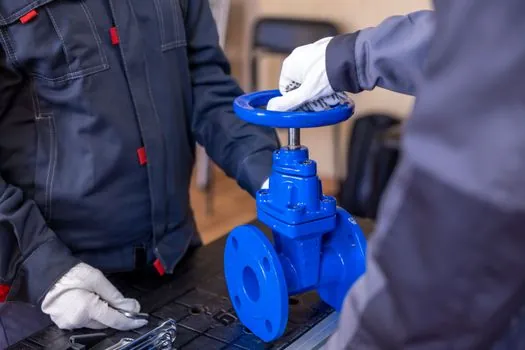
On the four decision criteria that drive most specifications, the comparison lines up as follows [S1][S3][S6][S7]:
1) Flow control precision: needle valves win, with 6 to 14 turns of travel and a stem that moves only a fraction of a millimetre per turn; ball valves are binary (open or shut); standard globe valves sit between, with coarser throttling than a needle but better capacity [S1][S3].
2) Speed of operation: ball valves win, with a quarter-turn from full open to full close; needle valves are the slowest, deliberately so [S3][S7].
3) Pressure rating: needle valves typically carry higher pressure ratings than comparably sized ball valves, but require more turns and produce higher pressure drop at the same flow [S6].
4) Flow capacity: ball valves win at full open with minimal restriction; globe valves come second; needle valves are limited to low flow (under 0.5 GPM or a few SLPM) and are not selected when full-open capacity matters [S1].
For a deeper contrast on quick isolation, see the ball valve reference and the broader balancing valve family for throttling duty in larger-bore systems.
Selection Criteria and Common Failure Modes
The primary selection criteria, in order, are: required flow range and precision, fluid compatibility (chemistry and temperature), pressure class, end connection standard, and actuation type. For a calibration gas line at 1.5 L/min on an analyser feed, a manual 316 stainless needle valve with 1/4 NPT ends, PTFE packing, and PN 250 rating is a typical default [S3][S5].
Three failure modes dominate field experience. First, over-torquing: a needle valve is a metering device, and forcing the handle past finger-tight deforms the stem tip and destroys repeatability [S1]. Second, taper mismatch: if the stem taper and seat taper differ by more than about 0.5°, the valve seals on a line contact rather than a band, the seat galls on first closure, and the valve weeps at zero turns open even with the handle bottomed out at 30 in-lb [S1]. Third, contamination: a single grain of weld slag in the orifice converts a smoothly throttling valve into a binary one, and PTFE or graphite gland packing that is not re-snugged after the first thermal cycle will leak around the stem [S1].
A side note on the related solenoid-actuated throttling family: lifecycle cost on electrically actuated valves is dominated by coil and seal service intervals, not the body; this solenoid valve TCO breakdown gives the cost-shape numbers if the application is migrating from manual needle to solenoid-driven throttling.
Standards, Sourcing, and What to Track Next
Relevant standards for needle valve specification are ASME B16.34 (valve design and pressure-temperature rating), API 602 (small-bore forged valves), BS 1873 and AS 4118 for globe-pattern derivatives, EN 558 for face-to-face dimensions, and EN 1092-1 / EN 10226-1 for flange and thread interfaces [S2][S5]. Material traceability to ASTM A182 (forged) and ASTM A216 (cast) bodies is the norm in process-grade procurement.
Two trackable signals worth watching: first, supply-base consolidation in small-bore stainless instrument valves as European and Turkish mills add capacity through 2026, which is putting mild downward pressure on 316 stainless needle valve list prices; second, increasing specification of Hastelloy C276 and Monel 400 needle valves in chlor-alkali and aggressive organic service, where standard 316 stainless is being replaced on a five-to-ten-year fleet-renewal cycle [S3].