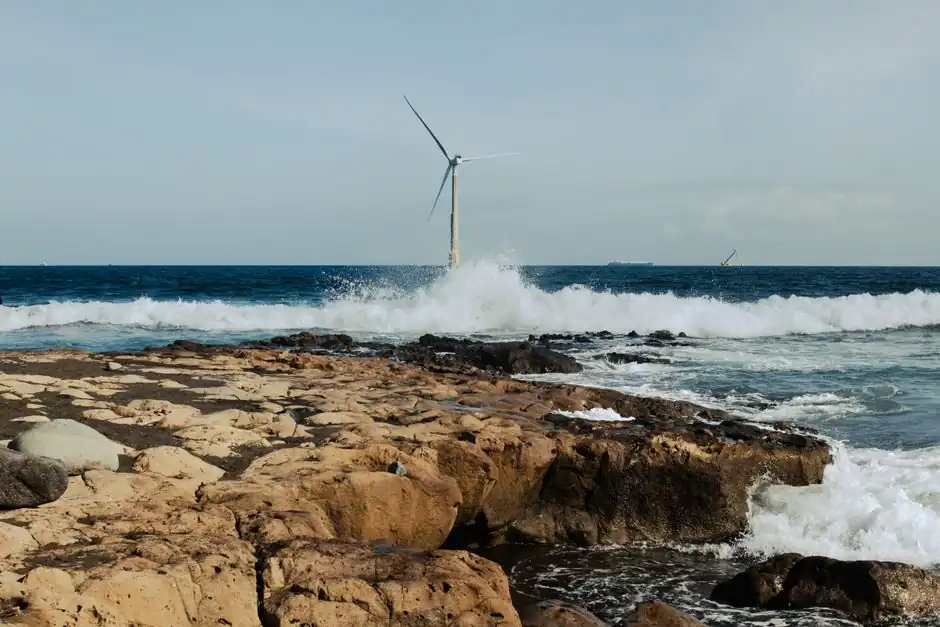
Westwood Energy forecasts that turbine foundations will absorb 19% of global offshore-wind EPC spend on major component orders during 2026-2030, making the substructure the single largest cost block after the turbine itself [S3].
The volume behind that share is set by parallel regional build-outs: Wood Mackenzie tracks US wind installations climbing to roughly 11 GW in 2026 on the way to a 48 GW pipeline through 2030 [S1], WindEurope projects 151 GW of new European wind capacity added 2026-2030 (EU-27 343 GW total by 2030 at 22 GW/yr) [S4], and China's State Council Information Office confirms a 100 million kW (100 GW) cumulative offshore-wind target by 2030, with 47 million kW already installed at end-February 2026 [S5]. For specifiers working on the foundation-vehicle side, the question is no longer whether to size for 15 MW+ turbines, but which substructure geometry each water-depth and soil band actually requires.
Three Foundation Types, Three Water-Depth Bands
Foundation selection for offshore wind is governed primarily by water depth and seabed geology, with monopiles dominating shallow sites, jackets taking over in transitional depths, and floating concepts entering commercial deployment in deep water [S3][S5]. A monopile is a single large-diameter steel tube driven or drilled into the seabed, typically specified for water depths under roughly 30-40 m where soil conditions allow pile driving. A jacket is a welded steel lattice structure with usually three or four legs pinned to the seabed by piles or suction buckets, used in transitional depths of roughly 30-60 m where the lattice geometry reduces steel tonnage per MW versus a scaled-up monopile. Floating foundations (semi-submersible, spar, or tension-leg platforms) are moored rather than fixed and are required once water depth exceeds the practical fixed-bottom limit, generally above 60 m.
China's operating fleet already references this depth logic explicitly: projects with water depths exceeding 50 m are categorized as deep-sea offshore wind, and those over 65 km from shore as far-offshore [S5]. The 504 MW Huaneng project in Shandong sits in 52-56 m of water roughly 70 km offshore, putting it firmly in deep-sea, far-offshore territory and forcing jacket or floating-class substructure design [S5]. By contrast, the Huadian Yangjiang project at up to 89 km offshore (depth not disclosed) is positioned for the same far-offshore category and illustrates the 65 km+ threshold that the State Council Information Office is using to define next-generation Chinese sites [S5].
Steel Tonnage, Concrete, and the Floating Question
For a fixed offshore wind site in 30-40 m of water, a 15 MW turbine on a monopile typically requires on the order of 800-1,200 tonnes of structural steel for the substructure, while an equivalent jacket in 40-60 m water climbs to roughly 1,500-2,500 tonnes per foundation because of the additional bracing members and node castings. Floating concepts shift the material balance toward high-strength steel and mooring chain, with semi-submersible designs commonly requiring 2,500-4,000 tonnes of steel per unit plus concrete ballast. [S3]
On the process-instrumentation side, jacket and floating foundations demand a denser sensor fit than monopiles: the lattice nodes and the floating-platform ballast compartments are continuously monitored with pressure transmitter arrays on hydraulic pitch and ballast systems, and the mooring-line tension is read via pressure sensor strings on each chain leg. Monopile sites typically only need a smaller suite of flow-meter instrumentation on the cable pit and a handful of structural-health sensors, since the structure itself is mechanically simpler. The instrumentation density gap between fixed and floating foundations is one reason EPC cost per MW for floating remains structurally higher than for fixed-bottom designs [S3].
Regional Build-Out and Supply-Chain Routing
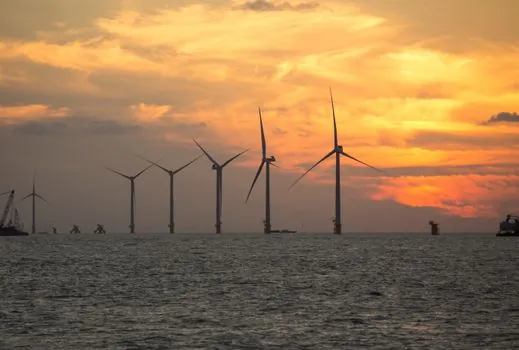
China's offshore-wind build-out is the volume anchor through 2030. The State Council Information Office reports cumulative offshore capacity above 47 million kW at end-February 2026, on the way to a stated 100 GW target by 2030, with the national total wind capacity (onshore + offshore) at 650 million kW, up 22.8% year-on-year [S5]. Recent reporting on China's offshore wind expansion highlights major projects in Guangdong Province (a China Huadian project off Yangjiang, situated up to 89 km offshore) and Shandong Province (a 504,000-kW China Huaneng project, the country's deepest operational offshore wind farm), along with a pilot project in Hainan, as the country scales up capacity for its low-carbon transition [S5].
For European EPC contractors the relevant numbers are different but directionally similar: WindEurope's 343 GW EU-27 wind capacity by 2030 (439 GW pan-European) implies a sustained 22 GW/yr installation rate through 2030, and a 63-69% renewable electricity share by 2030 versus ~49-50% in 2026 [S4]. The US picture is smaller in absolute terms (48 GW pipeline through 2030, with 2026 installations near 11 GW [S1]) but carries a higher offshore-cost-per-MW because the US fixed-bottom fleet is shallower on average and the floating segment is still pre-commercial. A spec map for industrial valve selection on the Balance of Plant (BoP) side is becoming a recurring procurement question, particularly for the high-pressure nitrogen and hydraulic pitch circuits that jacket and floating substructures require. For a related demand-side view of the same 2026-2030 window, the Wind turbine blade demand 2026 to 2030: regional build-out, spec drift, and supply map analysis covers the rotor-side counterpart to the foundation volumes discussed here.
Selection Criteria: Where Each Foundation Type Loses
Monopiles lose first in deep water: once hub height plus water depth pushes the natural frequency of the support structure into the rotor-excitation band (typically 0.25-0.35 Hz for 15 MW turbines), wall thicknesses escalate non-linearly and welded nodes become uneconomical, generally forcing a switch to jacket around 40 m water depth. Jackets lose in very deep water because the lattice still has to be lifted by a heavy-lift vessel; above roughly 60 m water depth the lift mass and the piling campaign duration together push EPC cost per MW above the floating threshold. Floating concepts lose in shallow water because mooring footprint and chain length scale with depth, so a 30 m site on floating would consume orders of magnitude more seabed and mooring steel than a monopile for the same 15 MW turbine. [S3]
The 19% EPC share that Westwood attributes to foundations [S3] is therefore not evenly distributed: in China's near-shore shallow-water sites it skews heavily monopile, in the 50-60 m Shandong-class sites it skews jacket, and in any 80+ m demonstration projects it begins to skew floating. The supply-chain bottleneck follows the same gradient: monopile forging and ring-rolling capacity is concentrated in a small number of European and Chinese yards, jacket node-casting capacity is even tighter, and floating-platform dry-dock slots are limited to a handful of facilities globally. Specifiers should pre-qualify the fabrication yard for the chosen geometry before locking the foundation design, not after.
Standards, Soil Class, and the 15 MW Transition
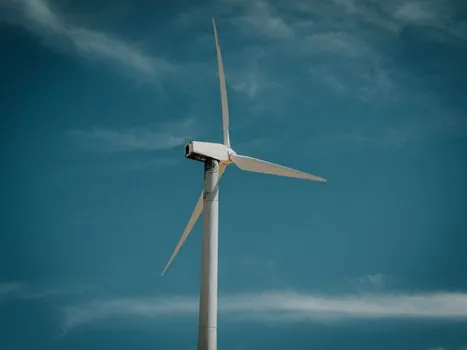
Foundation design is driven by the geotechnical envelope of the seabed more than by any single standard, but the operating envelope is set by the wind class of the turbine it carries. The 15 MW+ turbine class is the relevant design point for any 2026-2030 project because the China Huadian Yangjiang project is sized for 1.6 billion kWh/yr and the Shandong Huaneng project is 504 MW in a single phase, both implying large individual units [S5]. The shift in China's working definition (water depth >50 m = deep-sea, distance >65 km = far-offshore) [S5] is itself a proxy for the depth at which monopile economics break down.
For process-control integration, jacket and floating sites also need a denser PLC layer than monopile sites because more pitch, ballast, and condition-monitoring loops have to be coordinated in real time. Soil class remains the silent specification that determines pile length and wall thickness: a monopile in dense North-Sea sand is fundamentally different from one in soft Chinese clay, and that difference propagates straight into the 19% EPC share that Westwood flags for foundations [S3].
Forecast Summary and What to Watch Through 2030
The headline numbers for foundation planning are: 19% of global offshore-wind EPC major-component spend 2026-2030 on foundations [S3]; China targeting 100 GW cumulative offshore capacity by 2030 from a 47 GW end-February 2026 base [S5]; EU-27 reaching 343 GW total wind capacity by 2030 at 22 GW/yr [S4]; US pipeline at 48 GW through 2030 with 2026 installations near 11 GW [S1]. Cross-checking these against the academic literature, Peng et al. (2026) model offshore wind as supplying 3-18% of China's electricity by 2050 under uncertainty ranges on policy, technology cost, and demand growth [S6], which is consistent with the State Council's 100 GW-by-2030 trajectory but flags that the 2030s decade is where the larger volume sits.
Track three signals through the rest of 2026 and into 2027: first, the first commercial floating-wind project reaching final investment decision outside of pilot scale, because that locks the floating substructure into a real cost-curve datapoint; second, the next Westwood or Wood Mackenzie major-component update for 2026-2030, since the 19% foundation share and the 48 GW US pipeline are both single-source figures [S1][S3]; third, China's first gigawatt-scale deep-sea (>50 m) project reaching full grid connection, because the 504 MW Huaneng Shandong project is the largest currently operational datapoint at that depth band [S5] and a gigawatt-scale follow-on would shift the monopile-to-jacket ratio in the EPC share materially.