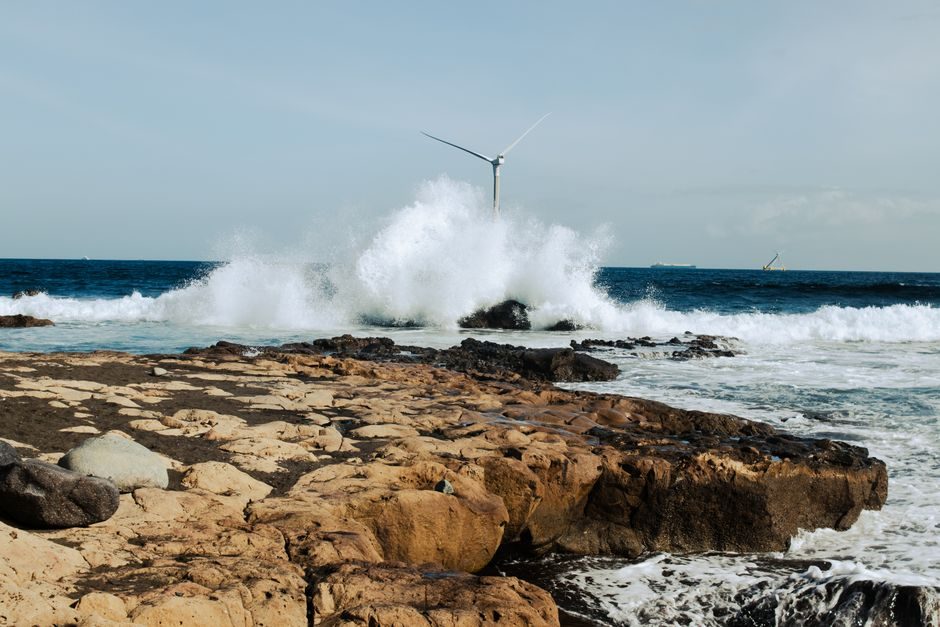
Monopile foundations remain the dominant substructure type for fixed-bottom offshore wind, with diameters now routinely exceeding 8 m and piling into water depths beyond 40 m, pushing designers past the databases of legacy American Petroleum Institute (API) and Det Norske Veritas (DNV) methods [S1].
The supplier base splits into three structural families — monopile, jacket, and gravity base — with floating semisubmersibles and spar-buoys adding a fourth bucket for sites past roughly 60 m water depth. The drive to lower levelised cost of energy has produced a fivefold upscaling of turbine rating over two decades, and that scaling is the single biggest constraint now shaping fabricator choice [S1].
Foundation Types and Where Each Fits
Monopiles carry roughly 80% of installed fixed-bottom offshore wind capacity in shallow-to-mid-depth North Sea sites because steel-pile driving at diameters of 6–10 m is a process the European fabricator base already runs at scale. Jacket substructures, a four-legged steel space frame pinned to the seabed by driven piles or suction buckets, are now the default above ~40 m water depth on sites such as the Taiwan Strait and parts of the US Atlantic, where the lower per-pile diameter lets the same hammer fleet work in harder driving conditions [S1].
Gravity bases (GBS) — large reinforced-concrete caissons ballasted with rock or iron ore — are specified where seabed soils cannot take driven piles, including parts of the Baltic and the French Atlantic coast, but they need nearshore graving docks and are capacity-limited. Floating substructures (semisubmersible, spar-buoy, TLP) are no longer pilot scale: the Provence pilot offshore France reached full power on its floating string on 2026-07-15, per the offshoreWIND.biz daily feed [S2]. The implication for procurement is straightforward — match the foundation family to water depth and soil first, then drive the supplier list, not the other way around.
Selection Criteria: Water Depth, Soil, and Code Fit
Designers increasingly resort to advanced soil-structure interaction models for monopiles because the legacy API and DNV databases were built on oil-and-gas pile diameters one-third the size of current wind monopiles, and direct extrapolation overpredicts pile penetration and underpredicts lateral stiffness [S1]. The two governing reference standards most procurement specs reference are DNVGL-ST-0126 (Support structures for wind turbines) and ISO 19902 (Petroleum and natural gas industries — fixed steel offshore structures), with site-specific CPT-based p-y and t-z curves layered on top [S1].
For procurement, four hard criteria separate the shortlist: (1) water depth and metocean envelope, which sets monopile-versus-jacket boundary near 40 m; (2) soil p-y stiffness from CPT data, which drives wall-thickness and length; (3) fatigue S-N curve class (DNV fatigue class D or E for monopile grouted connections is common above 10 MW); (4) fabricator flange and rolling-mill capacity — mills capable of supplying >8 m diameter, >100 mm wall thickness plate in S355/S420 grades are the practical gate. Specifications should require documentary evidence of mill test certification (EN 10204 3.2) for the plate and the through-thickness Z-grade where the monopile transverse-loads the welds.
Supplier Landscape: Tier-1 Fabricators and Steel Mill Constraints
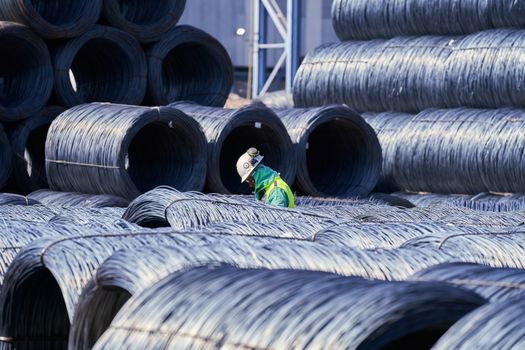
The European monopile supply base is concentrated among roughly five Tier-1 fabricators with the rolling capacity to handle monopiles above 8 m diameter; the bottleneck is plate supply, not assembly bay length. The same 2022 Springer review notes that the design-standards gap is forcing both fabricators and certifiers to invest in large-scale in-situ monitoring campaigns, and the same monitoring toolchain — acoustic emission, vibration-based fatigue tracking, and digital-twin-coupled SCADA — is becoming a procurement differentiator between otherwise equivalent mills [S1].
For jacket substructures the supplier list broadens because the geometry tolerates smaller-diameter pile sleeves (1.5–2.5 m) that fit inside the legacy oil-and-gas fabrication footprint; many shipyards repurposed from offshore service vessels (OSVs) can deliver jackets that a monopile-only yard cannot. Floating foundation supply is still thin and project-specific, with Provence Grand Large and Hywind-type spar suppliers dominating the demonstration pipeline, and the Provence pilot reaching full output on 2026-07-15 [S2]. For projects specifying floating, the risk is serial-production ramp, not concept feasibility — confirm a minimum of two operational reference units before tendering.
Comparison: Monopile vs Jacket vs Floating on Four Decision Criteria
Lining the three main options against the four criteria a procurement engineer actually grades on: (1) Water-depth suitability — monopile ≤40 m, jacket 30–60 m, floating ≥60 m; (2) Fabricator capacity risk — monopile capacity-constrained by plate mills and flange rolling, jacket broadly available, floating limited to ~3 reference suppliers globally; (3) Per-MW installed steel tonnage — monopile typically 150–250 t/MW for 8–10 MW turbines, jacket runs higher at 200–300 t/MW but distributes loads across smaller piles, floating mooring + semisubmersible 250–400 t/MW; (4) Inspection regime — monopile grouted connections need periodic underwater inspection per DNVGL-RP-C210 fatigue planning, jacket node welds are inspectable by ROV but node count is much higher, floating needs mooring-chain and tendon surveillance under class rules [S1]. The trade-off for a 1 GW project is not which type is best in the abstract but which type maps onto the local supply chain — a 1 GW project specified for monopiles in a region with no >8 m plate mill will either fail on schedule or accept a 30–40% cost premium on imported plate.
Failure Modes and Inspection Requirements
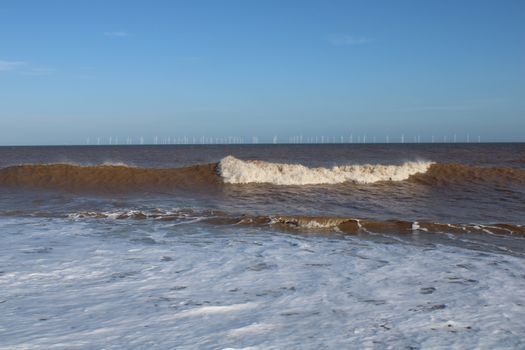
The two failure modes that drive O&M cost in monopile foundations are (a) fatigue cracking at the grouted-connection shear-key region, governed by the bending moment transferred from the tower base, and (b) scour-induced loss of lateral soil stiffness at the seabed, which monotonically increases the natural period and the fatigue duty cycle [S1]. Both are addressable but require in-situ monitoring that legacy oil-and-gas practice did not specify at the same density. Recommended instrumentation for new-build monopile monitoring: strain gauges on the tower-foundation interface, accelerometers on the tower for modal identification, pore-pressure transducers in the surrounding soil for scour detection, and cathodic-protection potential probes on the buried steel. Jacket structures add node-weld fatigue as a third mode, particularly at the brace-to-chord intersections, where DNVGL-RP-C210 probabilistic inspection planning is the working reference [S1].
Standards and Sourcing Reference
For procurement specs the non-negotiable standards list is short: DNVGL-ST-0126 for wind support structures, ISO 19902 for fixed steel offshore structures as a cross-check, DNVGL-RP-C210 for probabilistic fatigue inspection planning, and EN 10204 3.2 mill certificates for the plate [S1]. The Springer review traces this standards stack directly to the industry shift away from oil-and-gas legacy methods and toward wind-specific advanced design and monitoring, with axial and lateral geotechnical models now calibrated against dedicated in-situ monitoring campaigns rather than extrapolated from oil-and-gas pile databases [S1]. Any supplier shortlist that cannot name the DNVGL-ST-0126 revision it designs to and provide matching EN 10204 paperwork for the plate is not yet a serious candidate for an above-8 m monopile order.
For the spec engineer watching the next procurement cycle, the trackable signals are: (1) Provence Grand Large and the wider French floating pipeline reaching continuous full-power operation — the 2026-07-15 milestone confirms the concept, but watch the O&M cost-per-MWh disclosure that follows [S2]; (2) commissioning of the next generation of European plate mills capable of >8 m diameter, >100 mm wall S420 plate — this is the supply-side gate for the 15 MW+ turbine class; (3) revision activity on DNVGL-ST-0126 to formally extend the design envelope above 10 MW turbines, which will shift fabricator selection criteria again. For background on the broader industrial specification mapping this article sits inside, see this 2026 spec map on AS/RS system types and the adjacent weathering steel sourcing trade-off guide, which covers the same plate-grade procurement questions that gate monopile sourcing.
Spec-level background on the components involved: pressure transmitter, flow meter, and industrial valve.