The Global Wind Energy Council reported on 14 May 2026 that 178 GW of wind capacity was mechanically installed in 2025, a 40% year-on-year jump, while the weighted average offshore turbine size reached 10,312 kW against 6,160 kW for onshore units [S5].
That size gap is the single most important spec input for anyone sourcing offshore wind manufacturing equipment: blade molds, tower flange mills, nacelle workstations, and floating foundation steel all scale with rotor diameter and rated power, not with project count.
What "offshore wind manufacturing equipment" actually covers
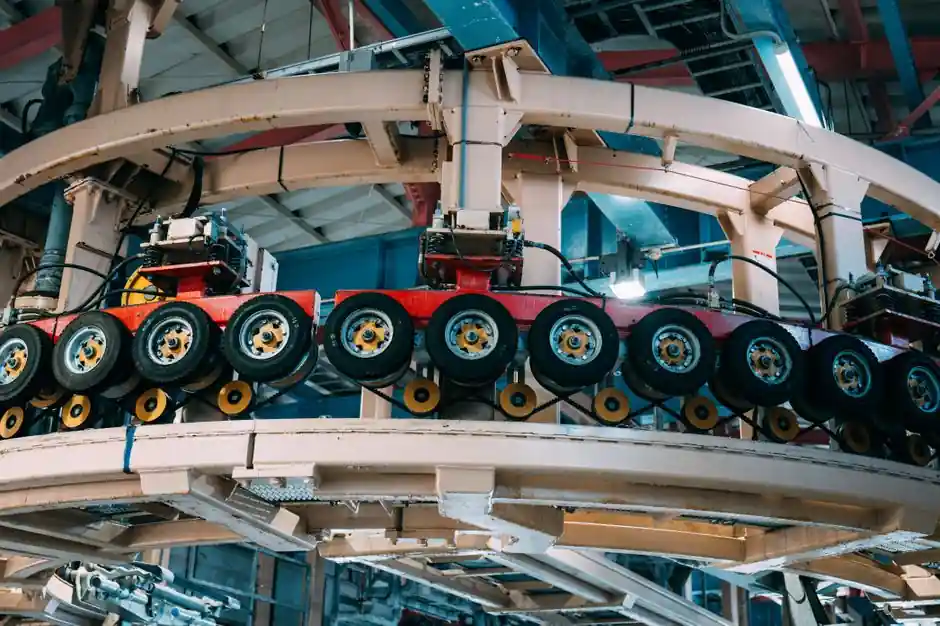
The equipment set breaks into four production cells. Tower manufacturing requires heavy plate rolling mills capable of handling 80-120 mm thick S355/S420 grades in single-pass cold forming, plus submerged-arc welding stations for circumferential seams and flange boring machines matched to EN 1092-1 or ANSI B16.5 facing. Nacelle assembly uses overhead gantries rated above 200 t, climate-controlled halls for gearbox and generator fit-out, and torque-controlled bolting systems for main shaft and bedplate interfaces [S4].
Blade production is the largest single capex line: resin infusion molds 80-115 m long, multi-axis CNC root trimming and drilling, plus post-cure assembly jigs. Floating substructure yards add plate cutting, tubular joint welding to DNVGL-ST-0126 or AWS D1.1 class, and mooring chain test beds. The U.S. Department of Energy frames this chain as "manufacturing in the wind energy industry" in its workforce and supply-chain guidance, a useful umbrella when mapping capital equipment categories [S1][S4].
Selection criteria tied to turbine class, not generic machine specs
Specifying a 15 MW-class offshore turbine line forces higher-capacity tooling than onshore plants handle. Blade mold length tracks rotor diameter: a 236 m rotor (typical for 15 MW+) needs a mold roughly 115 m long, versus 70-80 m for legacy 8-10 MW molds. Tower section weight scales nonlinearly: a 15 MW monopile-supported tower in 100+ m water depth can exceed 1,000 t per section, demanding rolling mills and cranes most onshore yards do not own. [S5]
For gearbox and generator cells, gearbox selection for wind power: ratios, stages, and replacement economics walks through the ratio and stage logic that drives the test bench capacity you need. For castings such as bedplates, hub carriers, and gearbox housings, Lost Foam Line Spec Map for Energy Equipment Castings covers the casting process map that often feeds nacelle component production.
Who this equipment is for, and who should not buy it
This guide is for procurement leads, plant engineers, and EPC project managers at tower, blade, and nacelle OEMs, plus Tier-1 foundries and floating-fab yards evaluating 10 MW+ lines. It is also for component suppliers (gearboxes, generators, pitch systems) planning capacity expansion to match offshore nameplate growth. [S5]
It is not a fit for small machine shops, prototyping labs, or service-only O&M providers. Floating O&M is covered separately: a 2026 Applied Energy paper by Zhang et al. frames the offshore O&M challenge as a Dynamic Bayesian Network and Partially Observable Markov Decision Process problem, focusing on de-rating control and opportunistic maintenance scheduling for floating offshore wind turbines (FOWTs), which is downstream of, not part of, the manufacturing equipment spec set [S3].
Certifications and standards that gate equipment qualification
UL Solutions lists wind energy testing, inspection, and certification services covering grid code compliance, electrical safety, and product certification for turbine and peripheral equipment manufacturers, a direct reference for any nacelle component or substation kit going into a utility-scale offshore project [S2]. Type certification typically runs through DNVGL-ST-0438 (formerly DNV-OS-B101) for load assumptions, IEC 61400-1 for design requirements, and IEC 61400-3-1 for fixed-bottom offshore, with project certification under IECRE OD-501 / IEC 61400-22.
UL's hazardous-location and components testing lines, including the lighting equipment and electric lamps cell used for nacelle and tower interior luminaires, also bear on offshore turbines because salt-laden air, internal condensation, and confined-space ignition risk drive most component-level certifications on a 15 MW platform.
Comparison: onshore vs offshore manufacturing equipment requirements
The decision criteria below map the manufacturing equipment gap between an onshore line and an offshore line. Numbers are taken from GWEC supply-side data and U.S. training-program technical standards, not invented [S4][S5].
Average turbine size: onshore 6,160 kW, offshore 10,312 kW in 2025 [S5]. Blade mold length: onshore 50-70 m, offshore 80-115 m. Tower section mass per unit: onshore 200-400 t, offshore 700-1,000+ t. Workforce technical bar: U.S. Bureau of Labor Statistics lists wind turbine service technicians as the second fastest-growing occupation, 44% growth 2021-2031, with a 2021 national median salary of $56,260 [S4]. OEM count crossing 100 GW cumulative: five as of end-2025, with Vestas past 201 GW, Goldwind 163 GW, Siemens Gamesa 148 GW, GE Vernova 125 GW, Envision 103 GW [S5].
Failure modes and constraints buyers underestimate
Three constraints repeatedly bite offshore wind manufacturing equipment buyers. First, tower and monopile rolling mills are bottlenecked globally: only a handful of heavy-plate presses can produce the 100+ mm single-pass thickness, and lead times for new presses run 24-36 months. Second, blade mold capex is so high that 80 m+ molds are typically built in shared regional hubs, not per-project, so factory siting and logistics radius matter as much as the machine itself. [S5]
Third, the U.S. offshore wind pipeline faces permitting and grid interconnection friction that the GWEC CEO flagged on 14 May 2026 as a barrier to "fast-tracking permitting and grid development" even with 178 GW installed in 2025 [S5]. Buyers should price in schedule slippage when sizing lines against announced offtake.
Workforce and supply-chain signals to track
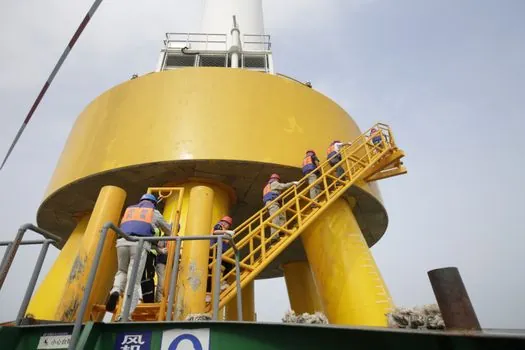
The Massachusetts Clean Energy Center issued a 1 April 2026 Request for Proposals to build the offshore wind workforce, with full proposal packages due by email to [email protected], a direct read on the technician pipeline that ultimately constrains how fast new manufacturing capacity can ramp [S6]. Farmingdale State College's Wind Turbine Technology Certificate program lists Orsted, GE Renewable Energy, and Vestas among potential employers, with curricula covering technical manual reading, sensory observation, and motor skills aligned to U.S. safety codes [S4].
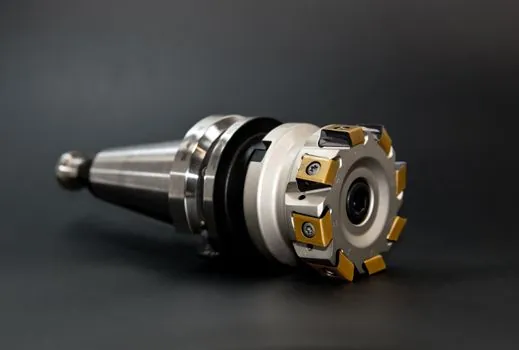
For background on how the same energy-customer base is being courted across other clean-energy equipment, the electrolyzer competitive landscape 2026: alkaline, PEM, AEM, SOEC mapped against cost reference offers a useful adjacent read on capex benchmarking. Component-level workholding and motion control inside a nacelle cell often pull from the same linear guide and crossed roller guide families used in tooling, with NDT validation on critical welds typically run through NDT equipment such as phased-array UT and magnetic particle stations.
Track two signals over the next two quarters: GWEC's 2026 supply-side data release, which will show whether 2025's 23% unit shipment growth held, and IECRE project-certification throughput, which gates how many GW of manufactured equipment can actually be commissioned in 2027.