
An overhead bridge crane is not a "tonnage buy" — it is a duty-cycle buy, and a 10 t crane at CMAA Class D will outlast a 20 t unit at Class B when both run 20 shifts a week, with Konecranes' own wheel-wear data showing the difference is most visible at the running-surface flange and tread [S1].
Selection should start with the heaviest lifted load, the maximum lifts per shift, the building's clear hook height, and the longest span the rails can carry — not the budget [S2][S3]. Buyers who skip this gate pay twice: once at procurement for an under-specified bridge, and again in wheel replacements, motor burnouts and unscheduled stoppages [S1][S6].
1. CMAA Duty Class vs FEM Group: Lock the Service Duty First
CMAA 70/74 duty classifications (A through F) and FEM 9.511 groups (1Bm / 1Am / 2m / 3m / 4m / 5m) are the two reference systems most buyers meet in a quote; both translate "how hard will this crane actually work" into a structural and mechanical design point, and the wrong group can cut fatigue life by an order of magnitude [S2].
For light-tool-room or maintenance work (≤2 shifts, infrequent lifts, no near-capacity picks) Class A/B is fine; for machine-shop parts handling at 4–8 lifts/h, Class C; for warehouse or steel-service-centre work at 10–20 lifts/h including near-capacity picks, Class D; and for scrap-yard, foundry or inter-process coil handling, Class E or F [S2]. Picking the class one notch low is the single most common way buyers under-spec a bridge, because the gearboxes, brake thermal capacity and wheel diameters are all sized off the duty group [S1][S2].
2. Capacity, Headroom and Hook Coverage: Geometry Beats Tonnage
Rated capacity is the gross load the hoist can lift in the worst hook position, and the engineering rule of thumb is to apply a 1.25× service factor on the heaviest expected load before sizing the hoist — Konecranes' quote form explicitly asks for "heaviest load" and "rated capacity" as separate fields, which is the correct workflow [S2].
For a single-girder top-running bridge on a typical 7.5–15 m span, end-truck approach dimensions eat 600–900 mm of hook travel at each end, so an 8 t rated crane with 1 m of dead space per end gives less usable coverage than the catalog diagram implies [S3][S4]. Buyers in low-bay buildings should compare close-approach "C" dimensions on each OEM's drawing — a 200 mm difference shifts what tooling, fixtures or workpieces can actually be picked at the column line [S2][S3].
3. Top-Running vs Under-Running: Choose by Building Steel
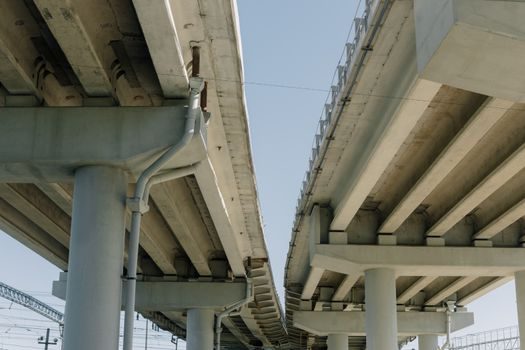
A top-running bridge rolls on rails mounted on top of the runway beams and uses the building column top for vertical reaction; an under-running (suspended) bridge hangs from the bottom flange of the runway beams and is the only option when the existing structure was not reinforced for top-running wheel loads [S3].
For new builds with adequate column capital, top-running gives higher hook height and lower deadweight on the runway; for retrofits into existing warehouses, under-running preserves headroom and avoids foundation work, at the cost of lower capacity per bridge (commonly capped around 10 t) and reduced lateral stiffness [S3]. Single-girder top-running units from Chinese OEM clusters start around US$ 2,000/set at MOQ 1 (LD-type, light duty) per Made-in-China's 2026 listings, but those entry prices assume CMAA A/B duty, not production lines [S4].
4. Hoist Type: Wire Rope vs Chain vs Electric Chain
Electric wire-rope hoists dominate the 5 t+ class because of headroom efficiency and duty-cycle thermal rating; electric chain hoists are the default below 2 t where low headroom loss matters more than continuous-duty thermal capacity; air-powered hoists are still preferred in paint booths, foundries and any classified hazardous area where spark risk is unacceptable [S3][S4].
A practical rule: specify wire-rope above 5 t, electric chain below 3 t, and only use air hoists where the hazardous-area classification (e.g. ATEX/IECEx zones) rules out electric drive [S3]. Buyers who put a 10 t electric chain hoist on a two-shift press line will see brake-disc wear inside 18 months; the same 10 t on a wire-rope hoist typically runs 5+ years between overhauls [S1][S6].
5. Wheel, Rail and Runway: The Failure Surface Most Buyers Under-Spec

Overhead crane wheels fail by tread wear, flange wear, spalling, and brinelling — Konecranes' own teardown data shows the failure mode is dictated by duty class, rail hardness match, and lubrication interval, not by crane brand [S1].
The standard mitigation is a 40–60 RC rail matched against a 50–60 RC wheel tread (Rc hardness pairing), with gear-coupled or flanged-roller bearings rated for the CMAA class, and a documented lubrication interval of 1,000 hours or quarterly — whichever comes first [S1]. Buyers who copy a Class A wheel set onto a Class D crane will see flange-edge wear inside 12 months and a costly unplanned stoppage; the wheel itself is a consumable, but its service life is engineered, not accidental [S1][S6].
6. Power Delivery: Conductor Bar vs Festoon vs Cable Reel
Three power options dominate new builds in 2026: insulated conductor bar (compact, exposed), festoon system (cable on trolleys, hangs below the girder), and cable reel (spring- or motor-driven, retracts onto a drum) [S3][S6].
Festoon is the cheapest up-front and easiest to maintain, but it adds deadweight to the bridge and a maintenance liability for the cable carrier; conductor bar is preferred for high-cycle Class D/E cranes because it removes the moving cable from the wear equation, and cable reel sits in the middle for low-cycle or partial-span bridges [S3]. Buyers in cold stores, galvanizing lines or anywhere with condensation should default to conductor bar with heaters to keep the collectors dry, even at higher first cost [S3][S6].
7. Controls, Safety Devices and Documentation
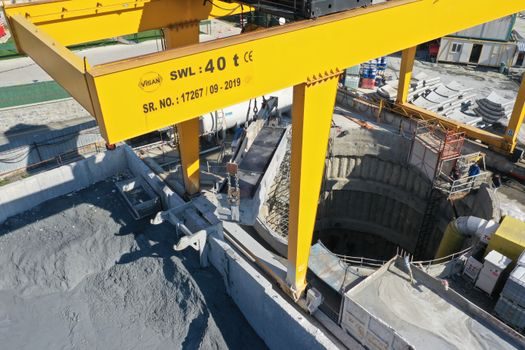
Every new bridge crane in 2026 should ship with upper-limit, lower-limit, and overload-limit cut-outs as a baseline, plus an anti-collision system if more than one crane shares a runway, and a radio-remote or pendant with two-step enable to meet modern operator-fatigue and pinch-point standards [S2][S6].
Documentation gating matters: OEM mechanical drawings, electrical schematics, foundation reaction loads, and a documented load-test certificate (typically 125% of rated capacity) should all be delivered with the crane, not promised for later [S2][S6]. For buyers in regulated industries — nuclear, pharma, food — also verify the OEM's QA programme, weld procedure qualification, and the supply chain for spares, since a Class D crane without a 10-year spares commitment is a future shutdown risk [S5][S6].
Comparison: Single-Girder vs Double-Girder vs Jib vs Gantry
For a 5 t, 12 m span, 6 m lift, 12 lifts/h Class C duty, a single-girder top-running bridge is the cost-effective default, while a double-girder wins for 10 t+ where the hoist must sit between the girders to keep headroom; a gantry crane is the right pick when the building has no runway steel, and a jib crane (slewing column arm) covers the workcell pattern that a full bridge cannot reach economically. For higher-mobility work outside the building envelope, a mobile crane or crawler crane substitutes entirely.</h2> <p>The two decisive criteria are (a) hook coverage needed and (b) building steel cost: bridges give full-span rectangular coverage, gantries give the same coverage without runway investment, and jibs give circular workcell coverage at lower tonnage; buyers who need an integrated weighing and overload audit on every lift should specify a crane scale at the hoist, not a separate weighing station. The hub of category data and selection rules for this equipment sits in the overhead bridge crane reference, while light-duty conveyor-fed workcell handling is covered separately under overhead conveyor systems. [S1]
Limitations and Failure Modes Buyers Should Plan For
Under-specifying the duty class is the most common procurement error and the most expensive to fix: the crane runs fine for 6–18 months, then wheels, gearboxes and brake coils fail in sequence [S1][S6]. The second is geometry — a crane that physically cannot reach the column line, or whose end-truck "C" dimension blocks the only loading bay, is a permanent operational tax, not a defect [S2][S3].
For buyers sourcing from Chinese OEM clusters, the 2026 Made-in-China listings show LD single-girder units from US$ 2,000/set at MOQ 1, but these are entry-level Class A/B machines; the same platform re-rated to CMAA D typically costs 1.8–2.5× more, with longer lead times on the hoist and gearbox [S4]. A related procurement view across the broader lifting-machinery cluster is captured in this Overhead Conveyor Suppliers 2026 OEM map and in the Tower Crane Selection: 7 Spec Gates field guide — both apply similar duty-vs-tonnage logic, but only one is appropriate for in-building bridge work. Any sourcing decision should also walk the buyer through a repair-readiness audit using the OEM's documented procedure, as outlined in this bridge-crane repair reference style checklist.
Trackable signals for the next sourcing cycle: OEM-published cycle-life curves for Class D/E wheels in 2026, updated ATEX/IECEx marking for hoists in classified areas, and the lead-time delta between Chinese and European OEM clusters on 10 t+ double-girder builds. A concrete next step: request the OEM's CMAA/FEM duty-class declaration in writing with the quote, and reject any quotation that does not name the class explicitly — that single document is the difference between a 10-year crane and a 3-year crane [S1][S2][S6].