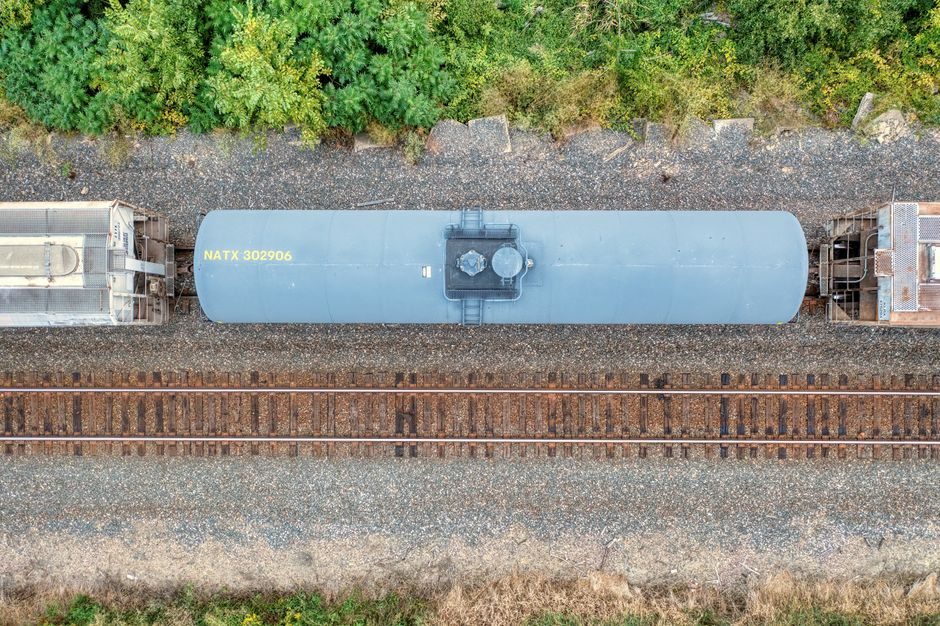
Overhead conveyors suspended from structural steel or roof purlins are increasingly specified for chemical shipping rooms and drum-staging aisles, where floor space is consumed by IBC totes, 55-gallon drums, and pallet jacks, and where a falling load would create a worse hazard than a stalled one [S1].
For chemical shipping, the engineering question is not "belt or roller" but "which overhead conveyor topology — enclosed track, power-and-free, or monorail — matches the load, the zone classification, and the existing chain conveyor interfaces at the dock," per current OEM selection guidance [S1][S2].
Why overhead routing beats floor conveyors in chemical shipping
Overhead conveyors reclaim floor area that would otherwise be lost to drum staging lanes, and they route loads through paint booths, wash bays, ovens, and chemical handling zones where personnel entry is restricted or where flammable vapors accumulate near floor level [S1]. In a drum-filling or tote-rotation cell, an overhead chain running 4–5 m above grade keeps the path of travel above the vapor-heavy zone that sits below 1.5 m, which is the typical concern cited in vendor selection literature for chemical-handling environments [S1].
For shipping specifically, the win is sequencing: a power-and-free overhead line can stage 30–60 totes on a storage spur while the floor below stays clear for forklift traffic, something a belt conveyor cannot do without dedicated floor footprint [S2]. Richards-Wilcox Conveyor notes that overhead systems "excel at handling large, oddly shaped, or heavy components that traditional floor or belt conveyors can't accommodate easily," and lists reduced manual handling, lower contamination risk, and modular reconfigurability as the primary efficiency drivers [S2].
Load, speed, and throughput — the three numbers that decide topology
Selection begins with three measurable inputs: per-hook load (kg), line speed (m/min), and throughput (loads/hour). IQS Directory's editorial guidance and Fluent Conveyors' spec-sheet methodology both treat load capacity, system speed, and throughput as the three non-negotiable entries on any conveyor data sheet [S1][S3]. For chemical shipping, typical per-hook loads cluster in the 50–250 kg range (single drums, small IBCs, parts in totes), line speeds run 5–15 m/min on accumulation spurs and 20–40 m/min on main haul loops, and throughput targets 30–120 loads/shift depending on dock-door count [S1][S3].
Cisco-Eagle's load-fit rule reinforces this: overhead is the most economical choice when the load is odd-shaped, unbalanced, or needs to be moved in a continuous loop that would otherwise block floor aisles [S5]. A chemically-shipped drum on a hook fits that profile almost by definition, while a sealed pallet of bagged reagent on a flat bottom does not — for the latter, a roller or belt conveyor on a mezzanine is usually cheaper [S3][S5].
Track type and corrosion class — enclosed track vs. I-beam vs. monorail
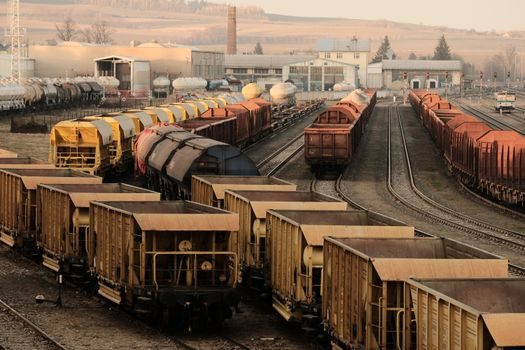
Three track families dominate chemical-shipping bids. Enclosed track (e.g., Richards-Wilcox Zig-Zag® and equivalents) uses a sealed-profile rail with the trolley wheels running inside the slot, which keeps the chain lubricant and the moving bearing surfaces away from airborne mist and wash-down spray [S2]. I-beam (or open-track) overhead conveyors use a standard S-beam or W-beam with external trolley wheels and are cheaper per metre but expose every bearing to the room atmosphere, which is a problem in sodium-hydroxide drumming rooms or bleach packaging lines [S1]. Monorail conveyors are the single-rail variant, used where the path is mostly straight with simple curves and where the carrier is a purpose-built powered trolley [S1].
For chemical shipping, the corrosion-class decision is mechanical, not aesthetic. The relevant checklist is: (1) ambient chemistry (chlorine vapor, acid mist, solvent vapor), (2) wash-down frequency and chemistry, (3) required track finish (hot-dip galvanized, powder-coated, or 304/316 stainless), and (4) trolley- wheel and chain-pin material [S1][S2]. Richards-Wilcox explicitly markets enclosed track for environments where contamination and corrosion control matter, and notes that modular enclosed-track designs accept robotics, sensors, and storage-system integration without track modification [S2].
Drive, free section, and accumulation — why power-and-free wins at the dock
A plain continuous-flow overhead conveyor moves every load at the chain speed, which is fine in a paint line and useless at a shipping dock where trucks arrive at uneven intervals. Power-and-free conveyors solve this by running a powered "dog" chain inside a free ("load") rail; the dog engages pusher dogs on individual carriers only when indexing is required, letting loads queue on the free rail while the power chain keeps circulating underneath [S1][S2]. This is the standard answer for chemical shipping because drums and totes must accumulate in front of a labeler, a stretch-wrapper, or a staging lane without colliding into the next load.
Drive layout matters as much as topology. Fluent Conveyors' spec-sheet list flags "drive" as a primary selection variable and notes that drive position depends on the system layout and floor plan, not on the conveyor itself [S3]. For a chemical shipping room with one infeed and one outfeed, a single head-end drive with a gravity or powered take-up at the tail is the lowest-risk layout; for cells with multiple spurs, a mid-drive with two take-ups handles differential thermal growth on long runs better than a single end drive [S3].
Hazardous-area zoning and chemical anchor selection for the supports
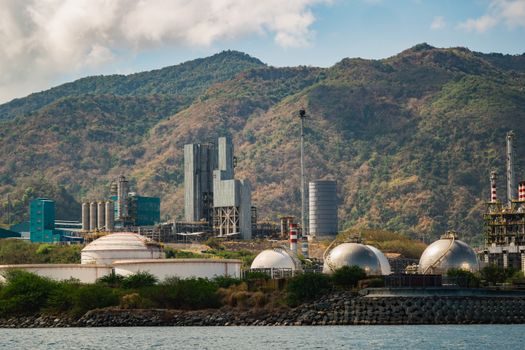
Overhead conveyor supports in a chemical shipping room are almost always suspended from the building structure by chemical anchor bolts, because the loads are point loads, the structure is often existing concrete, and welding to roof steel is usually not allowed without a hot-work permit in a flammable-vapor area. The anchor selection has to match the base material (cracked vs. uncracked concrete, seismic zone), the design load per support (which can reach 5–15 kN per bracket on a heavy-duty line), and the chemical exposure (stainless A4-70/A4-80 anchors for chloride-rich atmospheres, zinc-plated carbon steel only in dry, non-corrosive zones) [S1].
For the conveyor itself, the hazardous-area decision is whether the drive, motors, and any electrical junction boxes must be ATEX or IECEx certified for Zone 1 or Zone 2, depending on the classified area drawing. In a typical drum-filling room with open IBC transfer, the conveyor path often crosses Zone 2 boundaries at the filling hood and exits to unclassified space at the shipping dock; the motor and controls must therefore be rated for the worst-case zone the equipment occupies, not the zone where it is most often located [S1][S2]. When evaluating this, also note that chain-on-track lubrication, drip pans, and bearing shields are treated as ignition-source controls in many insurer risk assessments, which is one reason enclosed track is preferred in chemical shipping [S2].
Where overhead conveyor is the wrong tool
Overhead is not the right answer when the load is a sealed pallet, when the shipping dock has no overhead structural steel rated for the conveyor's dead plus live load, or when the product cannot be hung (e.g., low-stacked bagged chemical reagent drums that must remain upright on a pallet for regulatory reasons). Cisco-Eagle is explicit: overhead is the most efficient option only when the load is odd-shaped, unbalanced, or routed through inaccessible zones — none of which describe a standard pallet of bagged material on a stretch-wrapper output [S5].
Bulk powder and granule handling is another boundary. Floveyor's selection guide for bulk solids notes that belt conveyors and bucket elevators dominate at high tonnage but struggle with containment and fine powders, while screw and flexible-auger conveyors handle sealed transfer of reagents better than any open hook-and-chain system [S4]. If the chemical shipping operation is moving free-flowing reagent in bulk, an overhead conveyor is the wrong topology; if it is moving individual containers, IBCs, or sub-assemblies, overhead is in the running [S4][S5].
Side-by-side: overhead vs. floor alternatives for chemical shipping

Decision criteria for the same shipping room, lined up against the three realistic options:
Overhead conveyor (enclosed track, power-and-free): frees floor space for forklift and pallet-jack movement; handles odd-shaped, hanging, or hook-mounted loads; modular and reconfigurable; higher first cost and requires overhead structural steel; corrosion-resistant variants exist for chloride and acid atmospheres [S1][S2].
Belt conveyor (ground-level or mezzanine): lower first cost for straight runs; poor at accumulation without complex controls; struggles with oil-coated or wet drum exteriors common in chemical shipping; not suitable for flammable-vapor zones without explosion-proof drives [S3].
Roller / chain conveyor (floor or mezzanine): best for palletized and skid-mounted loads at the dock; cannot service filling hoods overhead or paint/wash enclosures; lowest cost per metre but consumes the floor footprint the shipping room is trying to reclaim [S3][S6].
For chemical shipping specifically, the working rule from the cited OEM literature is: specify overhead when the load is hung, the path is looped, or the floor must stay clear; specify belt or roller when the load is palletized, the path is straight, and the floor can be sacrificed [S1][S3][S5].
Procurement checklist before issuing the RFQ
Five items must be quantified before an overhead conveyor is specified for chemical shipping: (1) maximum and typical per-hook load, including dynamic factor for swing; (2) track length, curve radii, and vertical clearances, including the worst-case IBC height; (3) zone classification along the entire path, with the motor, control panel, and any sensors pinned to the worst-case zone; (4) corrosion environment — chloride, acid mist, solvent, wash-down — matched to track finish, chain material, and chemical anchor grade; and (5) interface to existing lines — infeed height, outfeed height, and whether accumulation is required upstream of labelers and stretch-wrappers [S1][S2][S3].
Track these signals over the next procurement cycle: vendor data sheets for enclosed-track conveyor increasingly call out 304 and 316 stainless chain as a configurable option, not a custom special; power-and-free dog engagement is moving from pneumatic to servo-indexed drives on new builds; and structural chemical anchor submittals are being bundled with conveyor submittals more often than they were three years ago, which is a sign that engineering, procurement, and construction are aligning earlier on suspended-equipment scope [S1][S2].
See also our earlier report, Carbon Steel Selection for Electronics: 2026 Grade and Spec Map.