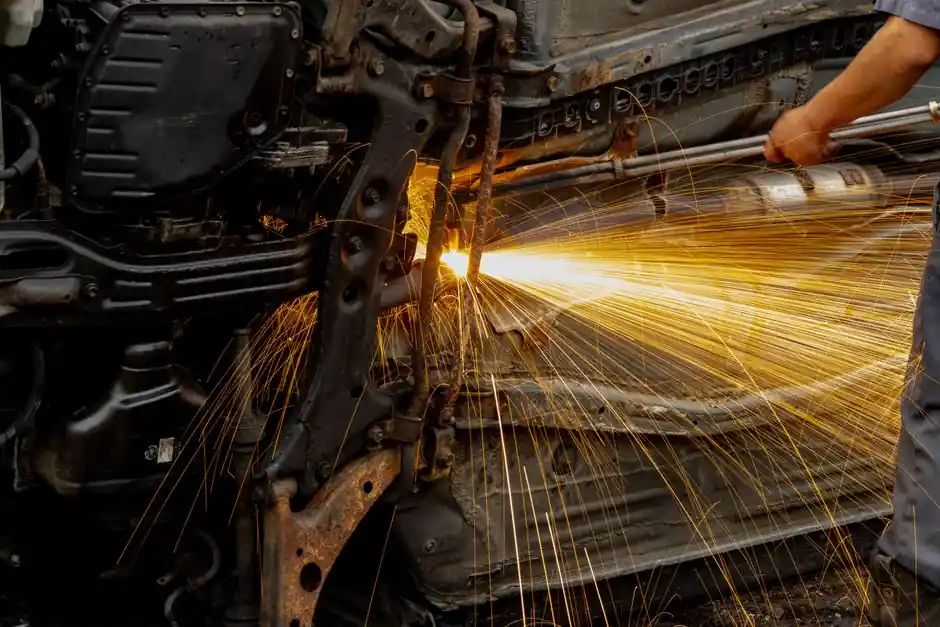
An oxy-fuel cutting torch for tunnel work is selected on three binding constraints: OSHA 1910.253's 15 psig (103 kPa gauge) or 30 psia (206 kPa absolute) ceiling on acetylene pressure, explicitly written to prevent unsafe use in underground excavations and tunnel construction [S1], the four-factor tip model (seat type, metal thickness, application, fuel gas) [S2], and the acetylene-versus-propane fuel decision tied to preheat speed, cost, and ventilation [S2][S5].
For typical rebar, lattice girder, and ground-support steel, the realistic cut range is mild steel from roughly 3 mm (1/8 in) to 300 mm (12 in) using a properly seated tip [S2], with most tunnel site work sitting between 6 mm and 50 mm plate or rebar where hand-held torches dominate.
OSHA 1910.253 Envelope Governing Tunnel Cutting
OSHA 1910.253(a)(2) caps acetylene at 15 psig (103 kPa gauge) or 30 psia (206 kPa absolute), and the standard's own commentary names "caissons, underground excavations or tunnel construction" as exactly the pressurized-chamber scenarios this pressure cap is designed to prevent [S1]. The same clause prohibits liquid acetylene and restricts generation, piping, and use above that ceiling, so any tunnel specification that lists "higher-pressure acetylene" is non-compliant on its face.
OSHA 1910.253(a)(1) also requires that no device mix air or oxygen with flammable gases prior to the burner except in a standard torch, so regulator-and-hose arrangements with unapproved mixers are out [S1]. Operators and the person in charge of oxygen or fuel-gas supply equipment, including distribution piping, must be instructed and judged competent by the employer before being left in charge (1910.253(a)(4)), and written operating rules must be kept readily available at the worksite [S1].
The Four-Factor Tip Selection Method
American Torch Tip's 4-step method reduces tip choice to seat type, metal thickness, application, and fuel gas [S2], and the same four factors are echoed by ESAB, International Gas Equipment, and The Fabricator for oxy-fuel torch tip/nozzle design and selection [S3][S6][S7]. Seat type is fixed by torch brand and model; if it is wrong, the tip will not seal, and the result is "damage to the equipment or dangerous flammable gas leakage" [S2].
Metal thickness dictates the center hole (oxygen delivery) and preheat orifice geometry, with oxy-fuel capable of cutting mild steel from 3 mm to 300 mm [S2]. Application separates cutting tips, gouging tips, and heating tips, and high-pressure cutting tips are designed specifically for automated cutting machinery where cleaner, more accurate cuts are required [S2]. Fuel gas (acetylene vs propylene vs propane vs natural gas) drives the tip's preheat orifice because flame temperature and preheat behavior differ: acetylene runs 5,600 to 5,800 F flame temperature, which is why it preheats fast, while propane and propylene are valued for robust operation and availability in tunnel logistics [S2][S5].
Acetylene vs Propane vs Propylene: Decision Matrix
Acetylene cuts fastest and preheats cleanest, with a flame temperature band of 5,600 to 5,800 F [S2], but it is the most expensive fuel gas and is the one the OSHA pressure cap is written to control underground [S1][S2]. Propane and propylene run cooler and have longer preheat times, but they are more available in remote tunnel headings, store more energy per cylinder, and avoid the dissolved-acetylene cylinder logistics that complicate confined-space work [S2][S5].
For most tunnel rebar and lattice girder work under 50 mm, propylene tips give acceptable preheat with much cheaper gas; for piercing thick plate, gouging, or any cut where preheat time controls cycle time, acetylene still wins on speed. Natural gas sits at the bottom of the preheat-performance list and is rarely specified for tunnel hand cutting. Darda's deconstruction reference frames the comparison as "oxy-acetylene offers fast preheating, whereas propane is valued for robust operation and availability" [S5], which is the same conclusion a tunnel foreman reaches in practice.
Tunnel-Specific Hazards: Ventilation, Flashback, and Cold-Cut Backup
Koike's 10-tip setup guide is explicit on flashback risk: "the flame travels backward into the torch, hoses, or even regulators… high-pitched hissing or whistling sound," with potential explosion if not addressed immediately, and recommends reverse flow check valves and flashback arrestors at minimum on every oxy-fuel cutting torch used in confined headings [S4]. Tunnel work compounds this risk because ventilation is mechanically supplied, leak paths back to the heading are short, and the surrounding concrete and shotcrete can trap heat.
Where ignition sources are restricted, the fallback is cold cutting. Darda notes that for tanks and pipelines in sensitive situations, "tank cutters or hydraulic cutting tools without an open flame are an option" [S5], and on a tunnel site this typically means hydraulic shears or pulverizer-and-shear sequences on the reinforcement rather than torch work. Cutting torches are deliberately combined with hydraulic equipment (concrete pulverizers, stone splitters, steel shears) to reduce vibration, limit heat input, and keep a planned switch-over path when gas cutting is paused for safety [S5].
Setup Discipline that Decides Cut Quality Underground
Koike's pre-cut checklist, adapted to tunnel conditions, runs as follows: inspect hoses, regulators, and torch components for damage; verify oxygen and fuel-gas pressure against the torch manufacturer's table for the tip size and fuel gas; ignite and confirm a sharp, pointed inner blue cone flame before cutting; and confirm the cut oxygen stream is clean and dry [S4]. Inconsistent gas flow or improper flame adjustment produces jagged edges, slag buildup, and uneven cuts, all of which cost grinding time in a heading where every minute on the bucket matters [S4].
Darda's quality levers are the same set written for deconstruction: nozzle size and seating matched to thickness, dry oil-free oxygen, consistent regulated pressure, and constant stand-off and travel angle to keep the striation pattern fine and parallel [S5]. For tunnel crews this means a dedicated regulator set per torch, leak-testing the seat before every shift, and rejecting any tip that shows a worn or ovaled seat even if the center hole still looks good. For wider site context on the construction-tools category these torches sit inside, see the construction tools reference and the broader construction machinery and equipment map.
What Oxy-Fuel Is For and What It Is Not For in Tunnels
Oxy-fuel cutting torches are the right tool for freeing rebar, trimming lattice girders, cropping damaged steel arches, and cutting plate embedments in tunnel cross-passages and invert work, where portability, no electrical power requirement, and a $250 to $350 entry cost for a high-end torch kit make them the default [S2]. They are not the right tool for stainless rebar, for coated or galvanized embedments that produce toxic fumes in a poorly ventilated heading, or for any cut adjacent to fresh shotcrete where heat input will spall the lining.
For those cases, hydraulic shears, abrasive cutting, or a diamond wall saw configured for steel-embedded concrete is the correct specification, and the oxy-fuel torch should be written into the method statement as the primary tool with a documented cold-cut backup when ventilation alarms trip or when combustible-gas monitoring exceeds threshold. Rebar coupler work adjacent to torch cutting should follow the rebar coupler selection spec map, since the same OSHA 1910.253 envelope and heat-input limits apply to both operations on a typical rebar-intensive heading. Related torch-side consumable choices for the wider cutting-tool family are catalogued in the welding and cutting tool encyclopedia, with a deep dive on the dedicated oxy-fuel cutter category covering nozzle seating standards and the riser-cutting machine class used on vertical tunnel elements.
Failure Modes and Reject Criteria in Tunnel Service
Tip wear shows up as a widening kerf, a sluggish pierce, slag sticking to the bottom edge, and a flame that will not hold a sharp inner cone. Replace, do not ream, because reaming opens the center hole and changes the oxygen flow that the tip was sized for [S2][S4]. Regulator creep, where the delivery pressure rises after the torch is closed, points to a failed diaphragm and is a tunnel-site reject on sight, because it can push acetylene toward the 15 psig cap without the operator noticing [S1].
Hose failures follow a predictable pattern: blistering near the ferrule, hardening at the torch end, and any visible braid damage. Koike's guidance on equipment inspection before each job and on following the manufacturer's pressure tables for the specific torch model is the most direct mitigation, because "the optimal gas pressures for your torch will depend on factors like the type of fuel gas, the cutting tip size, and the material being cut" [S4]. For tunnel crews this is the difference between a clean cut and a flashback event that takes a heading out of service for the rest of the shift.
For adjacent tunnel-task tooling, the stud welder picks for tunnel construction cover the drawn-arc and shear-connector side of the same rebar and embedment workflow.