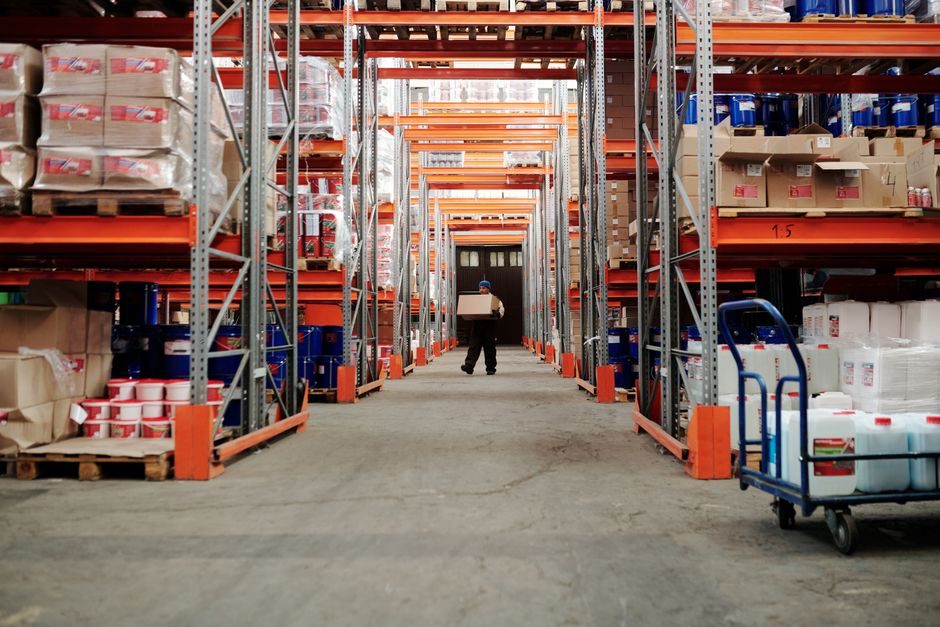
The 2026 decision between conventional pallet rack and an Automated Storage and Retrieval System (AS/RS) is set by three numbers a buyer can measure before quoting: target pallet positions per square metre, throughput in pallets per hour, and ceiling height available for vertical exploitation [S1][S3].
Selective pallet rack still dominates Chinese and export supply, with Jiangsu Union, Nanjing Liweizheng, Calin Logistic, and JISE all listing it as a core SKU alongside AS/RS, radio-shuttle and four-way-shuttle derivatives [S1][S2][S4][S7]. That co-listing is itself a signal: vendors are bundling conventional racking as the entry SKU and AS/RS or shuttle systems as the high-density upgrade.
Scope and What Each System Actually Is
Selective pallet rack is a bolted or welded steel structure — typically roll-formed or structural C-channel uprights with bolted step beams — designed for direct forklift access to every pallet position, with a standard safe working load per beam pair in the 2,000-4,000 kg band and upright heights commonly reaching 8-12 m in fork-truck-served buildings [S1][S2][S6]. The defining feature is 100% selectivity: any pallet is reachable in a single truck movement without moving another pallet first.
AS/RS is a computer-controlled stacker crane (or crane-shroud) system operating inside a fixed rack aisle, with the rack structure, crane rail, and WMS/WCS integration delivered as a single engineered line [S1][S3][S4]. Jiangsu Union, Calin and Nanjing Liweizheng all categorise AS/RS separately from "conventional rack" and "live rack," confirming the industry treats it as a distinct product line rather than a rack upgrade [S1][S2][S4].
Selection Criteria: Density, Throughput, Height, SKU Count
Four measurable gates drive the choice. (1) Storage density in pallet positions per m² of floor: selective rack with standard 2.7-3.0 m beam levels typically yields 0.5-0.7 positions/m²; double-deep and drive-in push this toward 1.0-1.3; a unit-load AS/RS aisle exploiting 20-30 m height reaches 2.0-3.0 positions/m² at the cost of total selectivity [S1][S3]. (2) Throughput: a single deep-reach forklift in selective rack sustains 25-40 pallets/hr; a single AS/RS stacker crane is typically rated 30-100 pallets/hr depending on crane speed, lift height and whether the design is single-cycle or dual-cycle [S1]. (3) Ceiling height: payback math for AS/RS generally needs ≥10-12 m clear height because the crane, rail, pallet extractor and top-clearance package together consume 1-1.5 m [S1][S3]. (4) SKU count and rotation: a warehouse with more than a few hundred SKUs and high pick-face churn is a poor fit for deep lane systems, because every retrieval can cost one or more reshuffles [S2][S7].
For comparison, a pallet-shuttle (radio-shuttle) system sits between the two extremes, which is why suppliers such as Nanjing Liweizheng and JISE list it as a separate line item alongside AS/RS [S2][S7].
Who Each System Is For — and Who It Is Not

Selective pallet rack suits operations with 50-10,000 pallet positions, mixed SKUs, low-to-medium throughput (under ~40 pallets/hr per aisle), buildings under ~10-12 m clear, and capital budgets that cannot absorb a WMS/WCS integration package [S1][S2][S6]. It is the wrong tool when a site has the height and SKU homogeneity to justify 20-30 m vertical storage, or when labour cost or labour availability is the binding constraint.
Unit-load AS/RS suits operations with 5,000+ pallet positions, predictable SKU velocity, throughput targets above 40-60 pallets/hr sustained, ceiling height of 12-30 m, and a capex envelope that can absorb 3-5× the per-position cost of selective rack in exchange for footprint reduction and labour displacement [S1][S3][S4]. It is the wrong tool for low-throughput, high-SKU-count distribution centres where every retrieval is unique, and for any site without the power, network and maintenance discipline a stacker-crane system demands.
Comparison Table — Decision Criteria
On per-position capital cost, selective rack is the low end, AS/RS is the high end, and shuttle-based systems occupy the middle band; on height, selective rack caps near 8-12 m, shuttle systems reach 10-15 m, and AS/RS routinely spans 20-30 m [S1][S3][S7]. On selectivity, only selective rack offers true single-deep random access to every pallet, while drive-in, shuttle and AS/RS trade selectivity for density. On labour content per pallet moved, AS/RS drops the human factor to a remote operator or WMS scheduler, whereas selective rack still depends on counterbalance or reach-truck drivers in the aisle [S1][S2]. On integration scope, selective rack is a steel structure with optional wire-mesh decking (Calin and Huameilong both list wire-mesh decking as a separate line) [S4][S5], whereas AS/RS is delivered with crane, rail, electrical, controls, WCS and WMS interfaces as a single engineered package [S1][S4].
Real Use Cases in the 2026 Supply Base
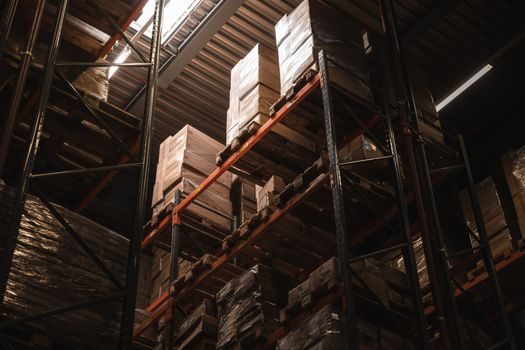
Conventional selective rack remains the default for general-merchandise and 3PL warehouses exporting from Jiangsu and Shanghai, with sample-shipment and small-MOQ options offered by Nanjing Liweizheng (10-set MOQ, 1,000 t/month supply) and Dalian Huameilong's pallet-rack line [S2][S5]. AS/RS is being specified where Chinese suppliers advertise "intelligent warehousing" — Calin Logistic positions itself as a "solutions in the field of intelligent warehousing and logistics equipment" rather than a rack fabricator, and JISE bundles "Robotics Shelf" and "Four Way Shuttle" alongside conventional products [S4][S7]. The 24 m multi-tier rack project referenced in the U-Racking news page is a useful real-world data point: it sits at the upper edge of conventional rack and the lower edge of AS/RS, demonstrating the crossover zone where bolted steel still competes with crane-served aisles [S3].
Limitations, Failure Modes and Sourcing Constraints
Selective rack failure modes are well documented: beam-to-upright clip disengagement under fork-truck impact, column buckling from fork impact at the floor level, and overloaded decks — all addressable with column guards, row-end frames and stated SWL signage [S1][S6]. AS/RS failure modes are different: stacker-crane downtime stops the aisle, WCS/WMS integration drift causes phantom inventory, and seismic or fire-suppression design is non-negotiable at 20-30 m heights [S1]. Sourcing constraints in 2026 include the typical China-supplier pattern of 10-set minimum order quantities for racking and longer lead times for AS/RS engineered packages, which is why vendors keep both product lines active rather than pivoting [S2][S4].
Standards, Codes and Sourcing Discipline

For European projects, EN 15635 governs the safe use and inspection of static steel racking, while EN 15512 governs the design of adjustable pallet racking; for North American projects, AISC and RMI's MH 16.1 are the equivalent design basis [S1]. Damage-assessment and repair protocols typically follow EN 15629 / RMI guidelines for component replacement after impact. The procurement discipline to demand from any 2026 vendor — selective or AS/RS — is documented SWL per beam pair, upright-frame load tables, anchor-bolt torque values, and a signed conformity package; vendors that list only generic "pallet rack" without a load table should be treated as commercial-grade only.
For related mechanical-equipment decision logic, the Stacker Crane vs Sorting System comparison maps onto the same density-vs-throughput trade-off at the machine level, and the Planetary Reducer 2026 article is a useful reference for the crane-rail drive-train components an AS/RS stacker depends on. Trackable 2026 signals to watch: vendors consolidating the "intelligent warehousing" label around four-way shuttle rather than crane-only AS/RS (JISE and Calin both list four-way shuttle / robotics shelf lines) [S4][S7], and the persistence of 24 m-class multi-tier rack installations in China, which mark the upper edge of where selective rack still wins on capex [S3].
For component-level specifications, see storage rack, and pallet stacker.