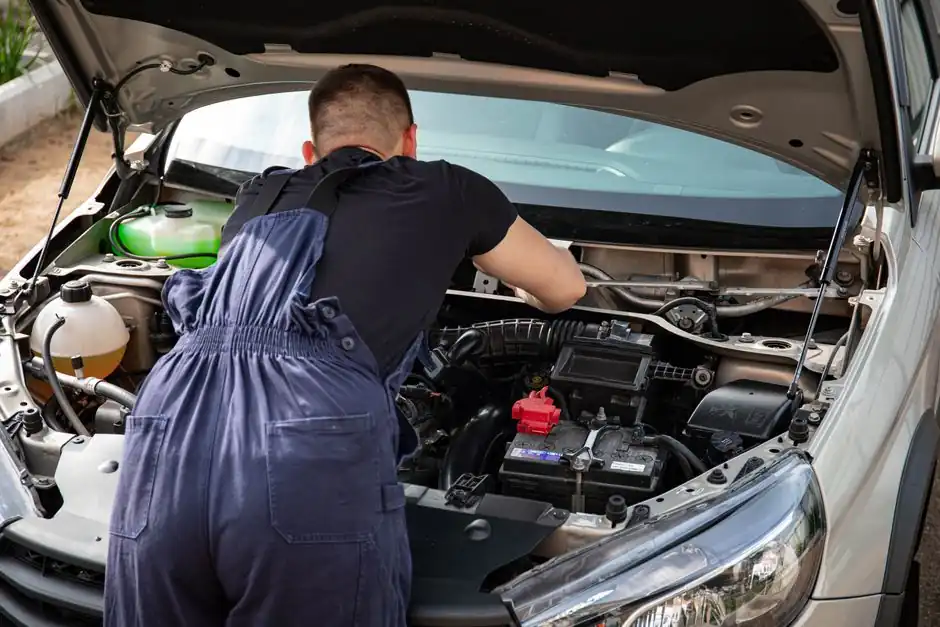
A parts washer is enclosed industrial equipment that removes contaminants (oil, grease, cutting fluid, metal chips, carbon, ink, corrosion) from workpieces by combining a cleaning medium with one of four energy inputs: spray impact, immersion and agitation, ultrasonic cavitation, or rotating drum tumbling [S1][S3].
The cleaning result is governed by the so-called Sinner's Circle, the four operating variables of time, temperature, chemistry, and mechanical action; the same total cleaning effect can be reached by trading, for example, a higher wash temperature against a shorter cycle [S5]. Wikipedia notes that a 10 to 15 °F (5.6 to 8.3 °C) rise in bath temperature roughly doubles the chemical reaction rate of the detergent, which is why most production washers are heated rather than ambient [S3].
Aqueous spray washers: heated jets and the Sinner trade-off
Spray washers use high-pressure jets of heated water mixed with alkaline detergent, and the four Sinner factors (time, temperature, chemistry, mechanical action) can be traded one-for-one to hit a target cleanliness on engine blocks, gearboxes, and machined housings [S5]. Industrial cabinets typically run at 1.5–6 bar spray pressure with wash temperatures of 50–80 °C, although exact values are application-specific and not standardised [S1].
For metal components, quick drying after the rinse cycle is required to stop flash corrosion; built-in options include hot-air blowers, heated chambers, compressed air knives, and vacuum drying for complex geometries such as hydraulic fittings and precision assemblies [S5]. Cabinet-style units behave like a large dishwasher: load, close the door, run the cycle, and unload, which is why they dominate medium-batch automotive and maintenance shops [S5].
Immersion and ultrasonic washers: cavitation as the mechanical action
Immersion washers submerge the part completely in a tank of heated cleaning solution, with the mechanical action supplied by either pumped agitation, air bubbling, or ultrasonic transducers bolted to the tank bottom [S5]. Ultrasonic systems work by inducing controlled cavitation in the cleaning fluid: cavitation bubbles form during the low-pressure half of the ultrasound cycle and collapse suddenly during the high-pressure half, releasing concentrated energy that displaces soil from blind holes and lapped surfaces that jets cannot reach [S4].
Typical industrial ultrasonic cleaners operate in the 25–40 kHz range, with 40 kHz being a common general-purpose choice and 25 kHz reserved for heavy soil; frequencies above 70 kHz are used for fine cleaning of electronics and optics, although the research does not give a single standard [S4]. Preceding ultrasonic cleaning with a degassing step and limiting the basket loading density are accepted best practices in the cited OEM literature, which is why the same supplier also offers heated soak tanks and liftkleen consoles alongside its sonic range [S4].
Solvent, bioremediation, and the regulatory turn away from chlorinated fluids
Solvent-based parts washers use petroleum distillates such as Stoddard solvent, kerosene, or diesel in a pump-and-nozzle loop, with the cleaning action coming from dissolving oils and greases into the fluid and flushing loose solids to a settled sludge [S3]. Chlorinated solvents in vapour degreasers were the industry standard until the 1980s, when environmental and safety concerns led to widespread bans and pushed the market toward water-based alkaline detergents [S3].
Modern closed-loop solvent units and bioremediating aqueous units both rely on fluid conditioning to extend bath life: oil-separating coalescers remove free oil, multi-stage filters capture particulates, and bioremediation systems use microbes to digest hydrocarbons so the same cleaning fluid can be reused for months rather than drained to a waste hauler after a few weeks [S4]. These fluid-conditioning accessories are standard offerings on current OEM catalogues rather than custom add-ons, which is part of why total cost of ownership is now a routine spec line on parts-washer RFQs [S4][S1].
Comparing washer types against four decision criteria
Comparing the four common types against typical selection criteria, spray cabinets score high on throughput and floor-space efficiency but lower on blind-hole cleaning; immersion and ultrasonic tanks score high on geometry coverage and lower on cycle time; rotary drum washers win on bulk-fastener throughput; conveyor systems win on continuous in-line integration with downstream surface treatment [S1][S5].
Cost-wise, manual sink-on-a-drum units and home-shop heated soak tanks occupy the low end; front-loading cabinet and conveyor aqueous lines occupy the mid-to-upper range; multi-stage ultrasonic plus rinse plus vacuum-dry cells sit at the high end because each stage adds a tank, a pump, and a heater [S3][S5]. Across all four types, the choice of detergent chemistry (alkaline, neutral, or emulsion) and the choice of freeboard ratio on solvent units to meet regulatory air-emission rules tend to drive compliance and operating cost more than the choice of washer type itself [S1][S4].
Key components and fluid-side hardware
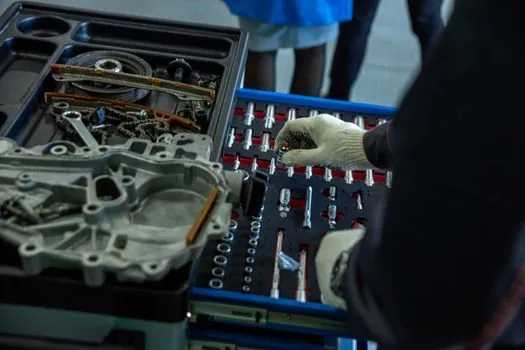
Across every type, the recurring hardware stack is a wash tank or chamber, a pump or submersible circulator rated for the cleaning fluid, a heater, a spray manifold or transducer array, a filtration stage, and a freeboard or exhaust on solvent units to keep vapour below occupational limits [S1][S4]. On solvent drum-mounted models, the pump is typically a small submersible unit that draws from the drum and discharges through a fixed gooseneck nozzle, which is the basic configuration that a hobbyist was asking about on a Mustang forum in 2002 [S2].
Fluid conditioning is the second critical subsystem: oil-separating coalescers (OSEP), sludge trays, and drum liners are standard accessories because, as the same forum thread notes, "the cleaning solution eventually becomes filthy with all of the gunk and oil and then you would need to drain and refill" unless it is conditioned [S2][S4]. For an aerospace or medical shop, the addition of final rinse tanks fed by deionised or reverse-osmosis water, followed by a hot-air or vacuum dryer, is the path to a surface that is clean, dry, and ready for non-destructive inspection [S5].
Failure modes and practical constraints
Common failure modes include pump cavitation when the tank runs too low, heater scaling in hard-water aqueous service, and ultrasonic transducer burnout when the bath is run dry or loaded beyond rated weight, all of which the OEM literature flags as avoidable with level switches, water softeners, and load-weight interlocks [S4]. For solvent units, the most cited constraint is the EPA and OSHA regulatory envelope around VOC emissions and operator exposure, which is why many small shops have moved to heated aqueous Simple Green-style units of all-polyethylene construction [S2][S3].
Material compatibility is the other hard constraint: aqueous alkaline chemistry is unsuitable for aluminium alloys that are sensitive to high pH, certain magnesium alloys, and any part with unsealed electrical components, while petroleum solvents are unsuitable for rubber seals, certain plastics, and parts that must be residue-free before painting or bonding [S1][S3]. Specifying the wrong medium voids downstream warranties on coatings, adhesives, and precision machined interfaces, so the cleaning step should always be written into the part's process router rather than left to the shop floor [S1].
Applicable standards and sourcing notes
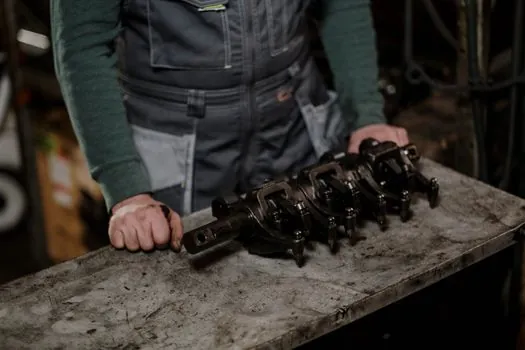
Parts-washer specification draws on OSHA 29 CFR 1910 (general industry), EPA 40 CFR Part 279 (used oil and solvent management), and NFPA 30/30A (flammable and combustible liquids code) for solvent units, while aqueous lines follow ASTM and vendor detergent data sheets for chemistry, pH, and bath-life targets [S1]. The cited 2026-06 IQS Directory article and 2025-10 Unitech Washers guide are the most recent industry references in the source set, and they both emphasise fluid conditioning and Sinner-factor tuning over any single product family [S1][S5].
For buyers writing RFQs in the next quarter, three trackable signals are worth watching: published freeboard and emission data on any new solvent unit, declared bath-life and filter-change intervals on aqueous lines, and whether the OEM offers an integrated bioremediation or coalescing option as standard rather than as an accessory [S4][S1].
The underlying component specifications are covered under sealing washer, spring washer, and pressure transmitter.