
The global testing, inspection, and certification (TIC) market is forecast to reach USD 254.41 billion in 2026 and USD 306.13 billion by 2031, a 3.8% CAGR, with petrochemical, oil and gas, and energy applications named as core growth verticals [S1].
Adoption metrics from the Industry 4.0 Club indicate 80% of manufacturers have Industry 4.0 initiatives in flight, 33% of global IoT spend is Industry 4.0 related, and only 5% report capturing measurable benefit so far, a gap that defines the petrochemical digitalization cycle [S3].
What Industry 4.0 means inside a refinery envelope
Industry 4.0 in petrochemical operations is built on cyber-physical systems, the Industrial Internet of Things (IIoT), and big-data analytics layered over existing DCS and PLC assets, with the German federal initiative's four design principles, interconnection, information transparency, decentralized decisions, and technical assistance, still serving as the reference architecture [S5].
Refining and petrochemical sites are dense, hazardous process environments where the pressure transmitter population, often numbering in the thousands per complex, feeds APC, SIS, and historian systems; making those loops digital-ready (HART, Ethernet-APL, or wirelessHART) is the precondition for any predictive maintenance or AI work [S1].
Selection criteria: where digital spend actually lands
Procurement in 2026 is concentrating on three asset classes: flow meter retrofits with non-intrusive Coriolis or ultrasonic primaries that expose HART or Modbus diagnostics, smart pressure sensor modules for leak detection and pump monitoring, and IIoT gateways that backhaul field data into cloud historians without disturbing the SIS architecture [S1].
TIC assurance underwrites the rollout: SGS, Bureau Veritas, Intertek, TÜV SÜD, DEKRA, Eurofins, DNV GL, and Applus+ are the named top-tier providers covering Oil & Gas and Petroleum certification under the broader TIC scope, with Intertek's life-management programs explicitly spanning refining, petrochemical, pipeline, and offshore assets [S1][S4].
Who benefits, and who is left waiting on the bench

Greenfield and debottleneck projects in Middle Eastern and Asian complexes are the early winners, since they can spec Ethernet-APL and 4-wire HART from the instrument index onward, while legacy brownfield FCC, coker, and ethylene crackers remain constrained by 2-wire 4-20 mA loops and limited conduit space [S1].
Operators in regulated markets (EU, Gulf, parts of China) are favored for Industry 4.0 uptake because ATEX/IECEx zones push them toward certified wireless and intrinsic-safety solutions that double as IIoT on-ramps; smaller tollers and merchant chemical plants without in-house TIC budgets are typically last in line [S1].
Options compared: IIoT instrumentation paths
The four dominant field-level choices in petrochemical digitalization line up as follows, with each profile drawn from current TIC and Industry 4.0 reporting: (1) HART 7 over 4-20 mA, lowest cost, ubiquitous, but 1.2 kbit/s limits advanced diagnostics; (2) WirelessHART or ISA100.11a, no cable trenching, battery-powered nodes typically rated for 5-10 year service, slower 250 kbit/s; (3) Ethernet-APL (IEEE 802.3cg, 10 Mbit/s, single pair), suited to new builds needing high-throughput video and vibration; (4) PROFIBUS PA / Foundation Fieldbus, digital but legacy-dominated, with installed-base migration cost in brownfield sites [S1][S5].
On data-density and cyber risk the order reverses: HART is the least exposed to remote attack, WirelessHART adds AES-128 mesh encryption, Ethernet-APL inherits switched-network IT/OT segmentation requirements, and PROFIBUS PA stays bounded by its slower physical layer, so the spec gate is rarely cost alone, it is lifetime cyber liability and bandwidth headroom [S5].
Real use cases and verified data points
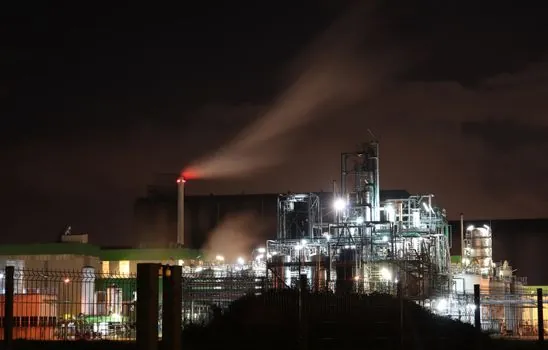
Petrochemical wastewater treatment, often a downstream compliance bottleneck, sees chemical oxygen demand (COD) reaching 11,500 mg/L with phenols, benzene, and PAHs as the principal regulated species, and Industry 4.0 is now being applied to online COD/BOD analyzers feeding industrial valve trim-position optimization for the biological step [S2].
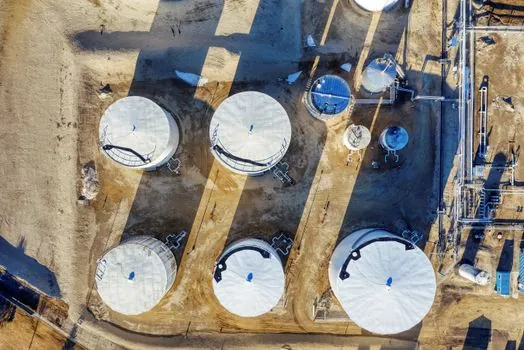
Texas, Louisiana, and Saudi complexes are quoted in TIC scoping documents as the densest populations of NACE MR0175-qualified assets, and the same populations are the lead candidates for robotic tank inspection, drone-based flare surveys, and machine-vision corrosion monitoring that the Industry 4.0 Club cites as priority use cases [S1][S3].
Constraints, failure modes, and the 5% problem
Only 5% of manufacturers report measurable benefit from Industry 4.0 initiatives despite 80% adoption, a gap the World Economic Forum and the Industry 4.0 Club attribute to a shortage of OT/IT integration talent, fragmented data models, and inadequate cybersecurity governance that turns pilot projects into stranded dashboards [S3].
Operational-technology cyber risk is the binding constraint: ENISA frames cybersecurity as a key enabler for Industry 4.0 adoption, and Dawson (2018) warns that hyperconnected systems create lateral-movement exposure that a single compromised servo-motor drive or unmanaged gateway can propagate across the DCS, which is why TIC-driven IEC 62443 and ISA/IEC 62443 conformance is now appearing in petrochemical tender language [S5].
Sourcing, standards, and what to track next
Two signals are worth tracking over the next two quarters: TIC providers expanding their Oil & Gas and Petroleum service line as a share of the 3.8% CAGR (the named 2031 endpoint is USD 306.13 billion [S1]), and the count of named IEC 62443 / IEC 61511 conformance references inside petrochemical EPC tender documents issued after March 2026.
For spec writers sourcing digital-ready equipment, the practical shortlist map shared in Industrial Automation Software Supply Shortage 2026 pairs naturally with the TIC-vendor landscape here, while operators sizing the procurement envelope can cross-check TIC scope against the OEM vs ODM for LNG Equipment shortlist to keep digital and mechanical certification on a single review path [S1][S4].