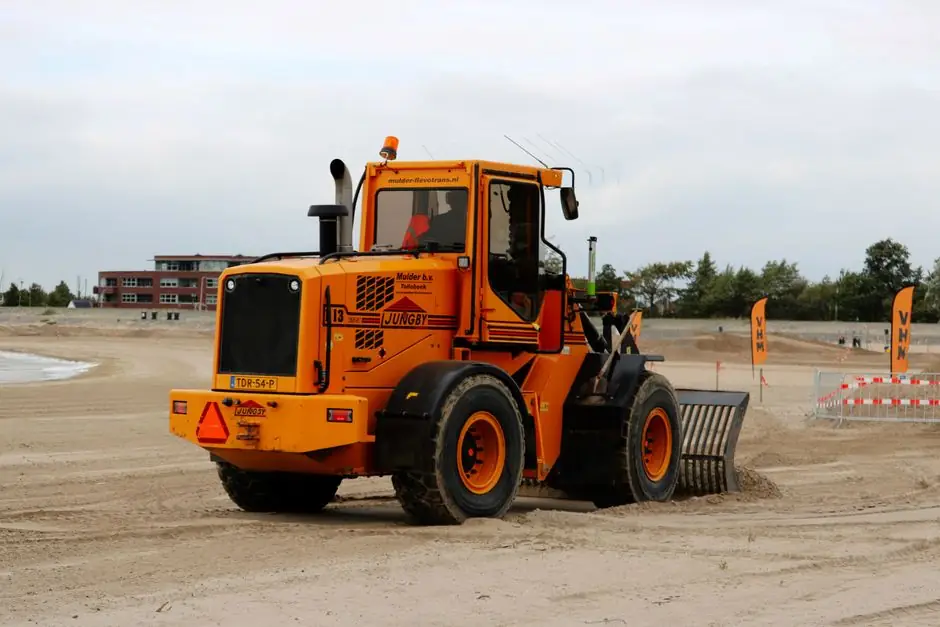
A wheel loader for port and terminal work should be sized by rated payload class, not by marketing bucket volume: the 5,000 kg class (e.g. SEM653D/SEM655D at 162 kW engine power, around 16,800 kg operating weight) is the typical workhorse for general bulk, while the 6,000–7,100 kg class (SEM665F, SEM676F at 178–199 kW, 20,500–23,350 kg) is specified for denser ore, clinker, and salt handling [S2].
Bulk terminals run repetitive, multi-shift cycles where each loading pass compounds: short hydraulic cycle time, controlled fuel use, and predictable service access routinely outweigh peak bucket size, and Hitachi's February 2026 deployment of four customized ZW310-7 units to the Port of Wismar (a Baltic Sea trans-shipment hub) confirmed that operators replace machines every roughly four years under three-shift salt-handling duty [S3].
Port Cycle Profile and Why Standard Construction Specs Fall Short
Port and terminal duty is defined by five repeating cycles: quay-to-truck loading, quay-to-stockpile transfer, stockpile building and reclaim, hopper feed, and area cleaning, and SEM's port-applications documentation groups the first four as the priority work envelope, with cleaning added to preserve access and safety [S4].
The frame, axles, cab, boom, hydraulic, and engine/transmission systems covered in a generic wheel loader selection guide map directly onto port duty, but with a shifted weight: hydraulic response and transmission smoothness dominate, while digging reach matters less than re-handling speed [S1]. SEM's port product line is positioned around three explicit advantages for terminal work, namely shorter hydraulic cycle time, higher fuel economy per liter, and lower combined maintenance and fuel cost [S2].
Buyers who overspec to peak capacity pay for it: an oversized machine is harder to maneuver in tight quay lanes, slower in tight areas, and less precise during truck loading, while an undersized unit spends too much time at the edge of its tipping envelope [S5].
Selection Criteria: Material Density, Tipping Load, and Safe Operating Load
Tipping load defines the rear-wheel lift-off point and is a hard stability limit, while safe operating load is the lower working limit that keeps the machine inside its stability margin under normal cycle conditions, and port specifiers are advised to size to safe operating load for the densest material on site rather than to peak tipping load [S5].
Bulk materials in ports behave very differently. Sand and aggregate flow easily but punish buckets and tires with abrasion; iron ore and clinker run at higher density, which directly raises the required payload class; salt is hygroscopic and corrosive, which forces stainless or coated sub-assemblies in the link and pin area. SEM's port application guidance explicitly lists density, moisture, abrasiveness, and particle size as the first qualification step, ahead of any brand or model choice [S4].
Wheel loader size class should also be checked against physical site limits: working space and turning room, travel distance between loading and dumping zones, truck or hopper loading height, and ground conditions that affect both stability and traction [S5].
Machine Class Comparison: Payload, Power, and Operating Weight
The table below is built from SEM port-application data and shows the typical payload-to-power relationship for terminal service [S2].
SEM618D: 1,800 kg rated payload, 60 kW, 5,940 kg operating weight. Use for light aggregates, fertilizer, and small-yard cleaning where a compact footprint matters more than cycle throughput.
SEM636D: 3,000 kg rated payload, 92 kW, 10,133 kg operating weight. A step up for medium-density bulk and short transfer hauls inside a confined terminal.
SEM655D: 5,000 kg rated payload, 162 kW, 16,800 kg operating weight. The mainstream general-bulk class for mixed terminals handling aggregate, sand, coal, and similar density ranges.
SEM665F: 6,500 kg rated load, 178 kW, 20,500 kg operating weight (20,700 kg with ROPS), 2.6–5.0 m³ global bucket capacity range. The minimum class for dense ore, slag, or heavy aggregate at high cycle rates.
SEM676F: 7,100 kg rated load, 199 kW, 23,350 kg operating weight. Top of the port line for the densest materials and the highest payload-per-cycle demand.
For context, Komatsu's wheel loader line spans from roughly 11,700 kg to 266,000 kg operating weight across its global range, so the 5,000–7,100 kg port class sits in the lower-mid production-loader segment rather than the mining-size envelope [S7]. Hitachi's Wismar deployment, the ZW310-7, sits several classes above the SEM 6,000 kg range and is the unit to benchmark when terminals handle salt, scrap, or heavy metals in three shifts [S3].
Real Use Cases: Salt, Bulk Aggregate, and Stockpile Reclaim
The Wismar deployment is the cleanest published 2026 reference case: four ZW310-7 units replaced prior machines that had run in three shifts with minimal interruption for about four years, with three of the new units dedicated to salt handling and the fourth used for bulk aggregate, a useful split because salt and aggregate impose very different protection and bucket wear profiles [S3].
For SEM-equipped terminals, the same four-cycle logic applies, but at a lower payload and power class: loading of trucks, hoppers, and reclaim areas with steady cycles even when material density creates heavy load conditions; terminal transfer of sand, aggregates, ore, or clinker; stockpiling and reclaiming to keep piles clean and accessible; and area cleaning to preserve quay access and safety [S4].
Stockpile reclaim is the operation most often under-spec'd, because the loader is working against a sloped face, often on compacted or uneven ground, and the cycle time penalty from a marginal payload class is larger than in flat-floor loading. SEM's selection method therefore calls for measuring the cycle, including distance, frequency, slope, surface, and number of passes, before choosing a model [S4].
Who This Class Is For, and Where It Is Not the Right Tool
The 5,000–7,100 kg wheel loader class is the correct primary tool for ports and terminals that move bulk solids in repetitive multi-shift cycles, where the work is dominated by truck/hopper loading, stockpile building, and short quay-to-stockpile transfer, and where the machine can be configured with the right bucket, ground engaging tools, and protection package for the material on site [S4].
It is not the right tool where the primary work is long-distance haul (an articulated dump truck is the better match), heavy digging (an excavator is the better tool), or very high-density mining-face loading (a larger mining-class loader or a hydraulic mining shovel is the right answer). It is also a poor choice where the terminal cannot provide basic dust control, paved or compacted quay surfaces, and tire/wash protection, because salt, chloride, and abrasive dust will erase the lifecycle advantage of any payload class.
Configuration, TCO, and Trackable Signals Going Forward
Total cost of ownership in port service is set by three controllable variables: hydraulic cycle time, liters of fuel per ton moved, and hours of unplanned downtime, and a port-spec'd wheel loader should be quoted and benchmarked on all three rather than on purchase price alone [S2]. Configuration choices that move the TCO number are bucket size matched to material density (oversized buckets cut into tipping margin), tire selection matched to surface abrasion, ground engaging tools matched to abrasiveness, and a simple maintenance architecture that protects terminal availability [S4].
Operators should also verify the dealer support model: Hitachi's Wismar case was delivered through German dealer Kiesel, which is a useful signal that port buyers should map the local dealer network, parts depot, and field-service response time before signing, not after [S3]. For adjacent terminal equipment decisions, the selection logic for construction machinery and equipment follows the same cycle-driven approach, and the same density-and-cycle framing is used when comparing mobile pumps for terminal washdown or ballast service, as outlined in the self-priming pump versus concrete pump truck selection map.
Trackable signals through 2026: OEM announcements of electric or hybrid-drive wheel loaders in the 5,000–7,000 kg class, port telematics-data disclosures on fuel-per-ton by material type, and any published update to the ZW-7 or ZW-7 successor series following the Wismar in-service date. None of these have a confirmed date in the research, so treat them as watchlist items rather than scheduled events.
Detailed specification references: terminal block.