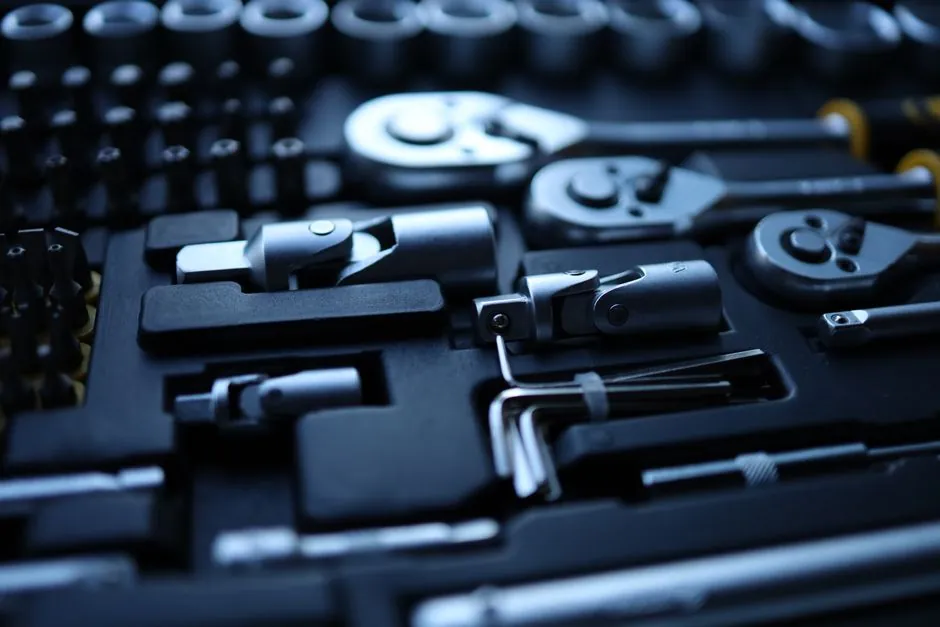
For electrical installation work, the 1/2" drive pneumatic impact wrench dominates the 340-900 Nm torque window and remains the most commonly stocked size on Chinese export catalogues such as the EP262 1/2" model published on Made-in-China.com [S2].
Selection sits inside a tight envelope: drive size, working torque, bolt class, air pressure at the tool, mass, vibration, and grip insulation. A tool that excels in a truck workshop can be the wrong choice on a live switchgear panel, so the criteria below are written for the installer on site, not the floor mechanic.
Drive Size, Torque Band, and Bolt Class
The 3/8" drive pneumatic impact wrench covers roughly 80-340 Nm and fits the smaller M6-M10 fasteners common inside panel boards and busbar sub-assemblies [S2]. The 1/2" drive class spans 340-900 Nm and handles the M12-M20 hex bolts that show up on cable tray supports, transformer lugs, and switchgear frame anchors [S2][S3]. Above 1,000 Nm, the 3/4" and 1" drive class takes over, but those are outside the routine electrical scope and overlap with structural-steel and demolition work covered separately.
Match torque class to bolt class, not to the tool's marketing peak. A typical mid-range 1/2" pneumatic model such as the EP262 1/2" is rated for the everyday M12-M16 tightening range, while the heavier FW-2500XL with 8" anvil is published at 16.3 kg shipping weight, signalling a higher-torque bracket aimed at larger fasteners [S3]. For electrical work, doubling the rated torque of the bolt gives a usable headroom; selecting a tool that hits the bolt's clamp load plus 20-30% is more reliable than chasing maximum breakaway figures.
Air Supply: Pressure, FRL, and Hose
Most 1/2" pneumatic impact wrenches in this torque band are rated for 6.2-6.8 bar (90-100 psi) working pressure with a maximum around 8.3 bar (120 psi) [S2]. Field data consistently shows that a 3/8" hose drops pressure fast under the 4-6 CFM (113-170 L/min) free air demand of a 1/2" impact, so a 1/2" (12.7 mm) air line with a filter-regulator-lubricator (FRL) is the practical minimum on a fixed installation site. A 3/8" hose is acceptable for short runs or for the smaller 3/8" drive tools, but it will starve a 1/2" wrench within 5-8 m.
For electrical work, the FRL has a second job: water and oil aerosol must be removed before the exhaust is vented near live equipment or into confined panel rooms. A 5 micron coalescing filter plus 0.3 micron regulator stage is the typical minimum, and a drip-leg on the lubricator keeps oil carry-over from contaminating insulation surfaces. The air impact wrench reference page lists the same FRL sequencing for the broader pneumatic tool category, with the caveat that oil-lubricated wrenches should not be used in cleanrooms or near sealed switchgear where oil mist is unacceptable.
Mechanism: Twin-Hammer vs Pin-Clutch vs Jaw-Drop
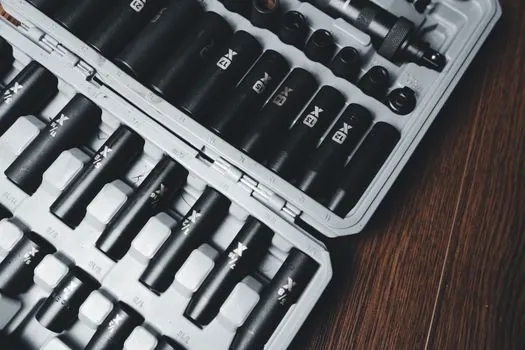
Inside the 1/2" class, three mechanisms dominate. Twin-hammer (double-dog) delivers the smoothest, fastest rundown in the 340-700 Nm band and tolerates repeated stall, which is why it is the most common choice in published Chinese export lines [S2]. Pin-clutch is mechanically simpler, easier to repair in the field with a pin and spring set, and runs cooler on long bolt cycles; it suits repetitive panel-board work where the operator runs the same M10-M12 fastener hundreds of times per shift. Jaw-drop (or dog-clutch) is the budget option, adequate for occasional use but with a shorter service life under stall conditions.
For electrical installation, twin-hammer is the default unless the crew has a maintenance bias toward pin-clutch rebuilds. The trade-off is noise: twin-hammer typically measures 95-105 dBA at the operator, so hearing protection (29 dB NRR minimum) is non-negotiable on switchgear rooms where ambient noise from fans already runs 75-85 dBA. Air ratchet wrenches (a related category documented as a straight pneumatic ratchet for low-torque bolt cycling) are quieter but cap out below 80 Nm, so they are a complement, not a replacement, for the impact class on heavier busbar work [S5].
Mass, Grip, Vibration, and Operator Safety
Published 1/2" pneumatic impact wrenches in the EP262 1/2" class sit around 1.8-2.4 kg net body weight, with the FW-2500XL shipping at 16.3 kg including the 8" anvil and case [S2][S3]. For overhead work on cable tray, transformer tap changers, or ceiling-mounted conduit, sub-2.0 kg body weight is the practical target: above 2.5 kg the operator's arm fatigue degrades both torque consistency and accuracy over a shift.
Grip insulation is a real spec on a 1/2" impact, not a comfort option. Look for a composite or rubber overmold rated to IEC 60900 for live-line work (1,000 V AC), or at minimum a documented dielectric strength test on the housing. Vibration is the other operator hazard: the EU Vibration Directive 2002/44/EC sets a daily exposure action value of 2.5 m/s² and a limit value of 5.0 m/s² (8-hour A(8)), and many unbranded pneumatic impacts in the 600-900 Nm bracket publish triaxial values of 8-12 m/s², which can hit the limit value in under two hours of continuous trigger time. For routine electrical work, a published vibration value below 4 m/s² keeps a full shift inside the action value without mandatory medical surveillance.
Selection Criteria Comparison: 3/8" vs 1/2" Pneumatic Impact
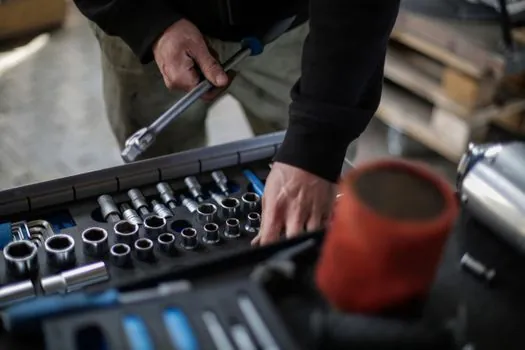
For an electrical-installation buyer choosing between two drive sizes, the practical comparison runs on four criteria: torque coverage, mass, air consumption, and cost. The 3/8" drive delivers 80-340 Nm at roughly 1.2-1.8 kg body weight, 3-4 CFM (85-113 L/min) free air, and a typical export FOB price around USD 30-60 in single-unit lots [S2]. The 1/2" drive delivers 340-900 Nm at 1.8-2.4 kg, 4-6 CFM (113-170 L/min), and a typical export FOB price around USD 50-110 [S2][S3]. Above 1/2" drive, mass climbs past 3.0 kg and air consumption past 7 CFM, which exceeds most portable 25 L compressor outputs and pushes the tool out of the electrical-installation envelope.
On cost, the impact drill category is sometimes confused with pneumatic impact wrenches, but a cordless electric impact drill trades air hose clutter for battery cost and runtime limits; on a fixed site with a compressor already running, pneumatic remains the lower total-cost option. Where the work is mobile and a compressor is not available, an 18-20 V cordless 1/2" impact at 400-800 Nm can substitute, but expect USD 200-400 for a kit and battery cycle limits on a full shift. The neighbouring air pick is for chipping concrete, not bolt tightening, and should not be cross-specified.
On-Side Checks Before First Trigger Pull
Before the first trigger pull on a live switchgear job, three acceptance checks are worth running. First, connect the torque wrench tester on a representative M12 8.8 bolt and confirm the wrench delivers the bolt's clamp load torque within ±10% over five cycles; this is the only way to catch an unregulated supply or a worn hammer mechanism before the joint is made. [S2]
Third, confirm exhaust direction. On switchgear work, a front- or side-exhaust tool pointing into a live cabinet is a contamination and noise problem; a bottom- or rear-exhaust tool vented through a hose to outside the cabinet is safer. A final check on the electrical measurement side is to verify the tool's grip is dry and free of conductive contamination, and that the low-voltage electrical protective gear (insulating gloves class 0, face shield) is in date before the trigger is pulled on any work within arm's reach of exposed busbars.
When the Pneumatic Impact Is the Wrong Tool
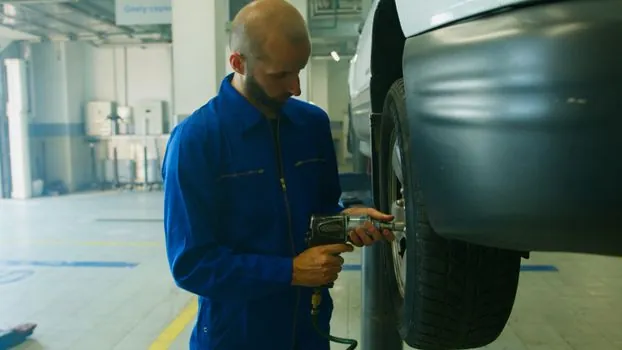
The 1/2" pneumatic impact is the wrong choice when the bolt is a calibrated tension control bolt (TCB) that requires a defined torque plus angle method, when the joint is a critical busbar connection with a manufacturer-published torque window of ±5% (use a calibrated electronic torque wrench instead), or when the work area is classified for ignition source control and a non-sparking bronze or beryllium tool is mandated. It is also wrong for the 80-150 Nm finishing range on small terminal blocks, where an air ratchet or a click-type torque wrench gives better accuracy and lower fastener-strip risk. [S2]
For the demolition-style removal of rusted or painted bolts above 900 Nm, a heavier 3/4" drive tool is the safer pick, and that selection is covered in a separate spec map for demolition use. The same drive-size escalation logic applies if the welded steel mesh anchor bolts on a substation baseplate call for 1,000+ Nm breakaway torque.
Track three signals over the next quarter: any move to brushless 18-20 V cordless impacts displacing pneumatic 1/2" models on fixed-site electrical work, revised Chinese export FOB pricing on the EP262-class 1/2" wrench, and any new IEC 60900 or ASTM F1505 dielectric test data published on pneumatic impact housings from the major Taiwanese and Wenzhou pneumatic-tool OEM clusters.