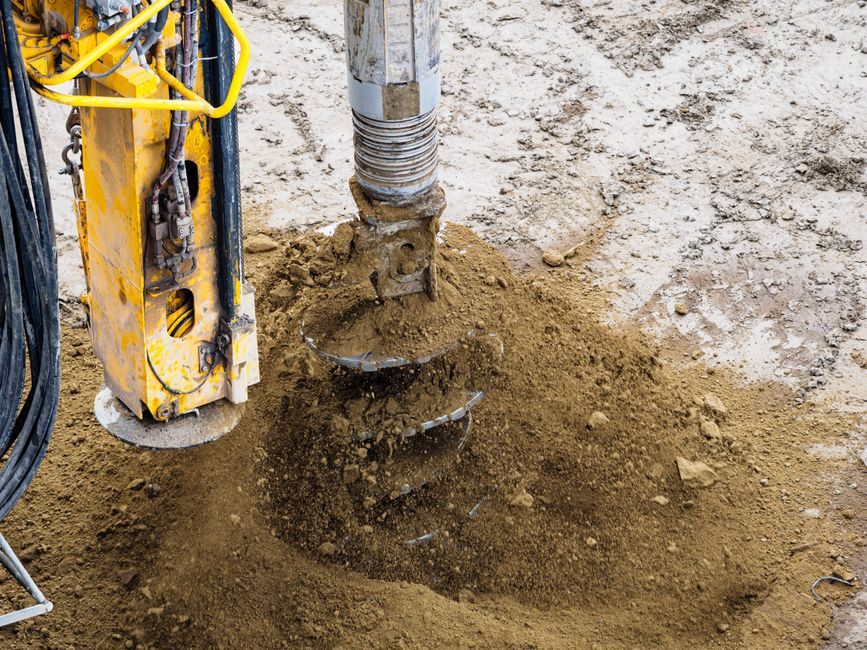
Per-stroke impact energy, not rated engine power, is the spec that separates a usable pile driver from a misapplied one, with the operating envelope spanning roughly 20 kJ for a 1-2 ton drop-hammer rig and 800-1500 kJ for a large offshore hydraulic hammer driving 2.5 m diameter steel monopiles [S1].
Selection between drop, diesel, hydraulic, and vibratory classes is driven by pile material, required bearing capacity, ground conditions, and the project's permissible noise and vibration envelope, with each class trading impact force for site mobility and cost-per-meter installed.
Class-by-class impact-energy and frequency envelope
Drop-hammer rigs deliver 20-60 kJ per blow at 8-12 blows/min, suiting small precast concrete or timber piles on remote or low-headroom sites, and remain the lowest-cost option when craneage and crew time are not on the critical path [S2].
Diesel hammers, common on civil jobs, run 80-300 kJ per stroke at 40-60 blows/min, with models such as the Delmag D46 (rated near 46 kJ) and D100 routinely specified for driven precast concrete and H-piles to 30 m depth in medium-dense granular soils. Hydraulic impact hammers reach 300-1500 kJ at 30-50 blows/min, dominating offshore wind monopile and oil-and-gas conductor driving where stroke and energy must be software-tunable per blow [S3].
Vibratory drivers do not produce per-blow impact energy at all; instead they vibrate the pile at 20-40 Hz with amplitudes of 5-30 mm, using resonance and reduced skin friction to sink sheet piles and casings in granular soils, and are routinely paired with an impact hammer for the final 1-3 m to "set" the pile.
Advantages across the four main classes
High bearing capacity per pile, predictable load-test results, and no spoil removal are the three advantages that keep driven piles in the spec for bridges, ports, and wind-farm foundations despite rising vibration-mitigation costs.
Drop hammers keep capex and repair access minimal and need only a basic crane, so they are specified for low-headroom interior work and for underpinning jobs where a hydraulic power pack is impractical to position. Diesel hammers self-contained, high cycle rate, and tolerate uneven pile-head quality without stalling, which is why they remain standard equipment for marine piling on barges [S2].
Hydraulic impact hammers offer the highest energy-per-blow, fully programmable stroke and blow rate, and real-time monitoring of blow count, ram weight, and energy transfer, which delivers better quality-assurance records for warranty-driven infrastructure projects. Vibratory drivers install sheet pile walls and casings several times faster than impact hammers in non-cohesive soils, with lower peak ground vibration and the ability to extract piles cleanly on demobilization, reducing material loss.
Disadvantages, failure modes, and site constraints

Pile driving produces ground vibration, airborne noise above 90 dB(A) at 15 m, and displacement of surrounding soil that can damage adjacent structures within roughly 1-1.5 pile-length distances, which is why urban jobs increasingly pre-drill or switch to hydraulic pressure sensor-monitored press-in rigs.
Drop hammers deliver low energy and slow cycle, so production rates are uneconomic on large commercial piles. Diesel hammers generate exhaust fumes and cannot operate inside confined spaces or in environmentally restricted zones, and they lose efficiency on long or heavy piles because ram stroke shortens as bounce pressure drops [S1][S3].
Hydraulic hammers require a dedicated hydraulic power pack (typically 200-600 kW), a 30-50 t service crane, and a trained operator, so mobilisation cost is high; a mis-stroked blow on a high-capacity hydraulic hammer can crush the pile head and force a costly cut-off and re-drive. Vibratory drivers are largely ineffective in stiff clays or dense glacial till, and the resonance setup risks loosening adjacent foundations rather than densifying the ground, so they are paired with an impact rig for any structural load-bearing role.
Selection criteria and decision matrix
The four decision criteria that actually drive spec are per-blow energy, ground type, noise/vibration limit at the site boundary, and pile material with the typical envelope of 20-1500 kJ / granular vs cohesive / 90-130 dB(A) limit / timber-concrete-steel.
On remote civil works with precast concrete piles in granular soil and no noise cap, a diesel hammer such as a Delmag D62 is the default low-risk spec. On an offshore windfarm driving 6-10 m diameter monopiles, a hydraulic impact hammer rated 800-1500 kJ is mandatory because no diesel hammer on the market can deliver that single-blow energy with the software-tunable stroke control that modern fatigue-based driving criteria require.
For sheet-pile cofferdams in saturated sands, a vibratory driver with a high-frequency hydraulic clamp and 25-30 mm amplitude is first-pass, with an impact hammer kept on standby for the final set. For interior underpinning where headroom is under 4 m and neighbours are within 10 m, a drop hammer at 20-40 kJ or a static press-in rig is the only responsible choice because peak particle velocity stays below the 5-10 mm/s limit that most urban specifications adopt.
Standards, monitoring, and sourcing boundaries

Driven-pile acceptance is typically governed by project-specific driving criteria derived from a wave-equation analysis (WEAP) calibrated against an indicator pile test, with end-of-drive blow count and hammer-rated energy as the two input variables; final capacity is then confirmed by a static load test to 200% of design load [S1].
Offshore monopile driving for windfarms follows ISO 19902 for fixed steel structures and DNVGL-ST-0126 for support structures, both of which require a fatigue analysis based on actual recorded blow count and energy transfer rather than a single rated energy, so on-board hydraulic-hammer monitoring is no longer optional. Vibration at neighbouring structures is normally assessed against DIN 4150-3 peak particle velocity limits of 5 mm/s for industrial buildings, 3 mm/s for residential, and 2.5 mm/s for sensitive structures, with the same standard being the benchmark most European tenders adopt.
Specifying a pressure transmitter on the hydraulic circuit of a modern impact hammer is now common practice, because real-time ram acceleration and hydraulic pressure data feed the WEAP back-analysis and document the energy actually delivered to the pile, which the warranty clauses on most 2025-2026 infrastructure tenders require.
Who a pile driver is for, and where it is the wrong tool
Pile drivers are the right tool for projects that need high per-pile bearing capacity, repeatable load-test results, and installation in saturated or granular soils where bored cast-in-place piles would need casing or slurry.
Pile drivers are the wrong tool for brownfield urban infill with neighbours under 1.5 pile-length away, for cohesive soils above 100 kPa undrained shear where set-up is needed, and for any site where a flow meter on the hydraulic return line shows the power pack cannot sustain the rated flow under continuous duty. In those cases, the realistic alternatives are a hydraulic static press-in rig, a bored pile with oscillator, or a PLC-controlled rotary rig, which is the same decision tree that civil estimators apply when vibration, spoil, and noise caps rule out percussive driving.
Driven-pile work is moving toward closed-loop monitoring and hydraulic-only impact energy, so the next trackable signals for any specifier are: hammer rental fleets publishing verified per-blow energy logs as standard deliverables, and more EU tenders tightening DIN 4150-3 limits below 2.5 mm/s on residential jobs, both of which will push the diesel-hammer share of urban civil piling work down over 2026-2027.
This topic is covered further in Rotary Drilling Rig Installation: Class-Specific Setup, Mast Erection, and Acceptance Test.