
Planetary reducer total cost of ownership is a function of five interacting levers: initial purchase, energy losses, lubricant and seal consumption, unplanned downtime hours, and end-of-life disposal — and the first lever is the smallest one on the bill [S2][S3].
Specifying engineers who anchor decisions on the gearbox quote alone routinely overpay 20-40% over a 20,000-hour operating horizon, because efficiency-grade and lubrication-interval choices compound faster than the discount a procurement team negotiates on day one.
What TCO Actually Counts: Defining the Cost Boundary
TCO captures every cost incurred over the lifecycle of the asset — purchase, use, maintenance, support, and disposal — and the purpose of the analysis is to expose the costs that budget planning easily overlooks [S2]. For a planetary reducer, the five standard buckets map directly onto: (1) acquisition, (2) operating energy, (3) planned maintenance, (4) unplanned downtime exposure, and (5) decommissioning [S3].
Acquisition includes the gearbox itself, input adapter (C-face, flange, or servo-mount), coupling or pinion, and any required backstop. Operating energy is governed by mechanical efficiency at the duty point. Planned maintenance covers grease replenishment, oil changes, and seal replacement. Unplanned downtime is the monetary risk attached to bearing failure, tooth fracture, or oil seal blowout. Decommissioning covers steel scrap recovery versus controlled disposal of aged lubricant.
The hidden trap is that engineers tend to fund bucket 1 from the project CAPEX line and then treat buckets 2-5 as a shared maintenance budget that nobody owns — which is why the installation quality decisions made on day one quietly dictate lifecycle cost for the next 15 years.
Cost Driver 1: Efficiency Grade and Energy Losses
Each additional planetary stage subtracts another 1-3% from overall efficiency, so a 3-stage unit can sit 4-6 percentage points below a single-stage unit at the same ratio.
Translated into electricity cost, a 3% efficiency loss on a 30 kW continuous-duty motor running 6,000 hours per year wastes roughly 5,400 kWh annually — a recurring penalty that overtakes a typical purchase-price delta within 18-30 months on industrial kWh tariffs.
Efficiency is a function of gear quality grade (AGMA Q5 vs Q10 vs Q12 — higher grade = better surface finish, lower friction), lubricant type (synthetic PAO versus mineral oil shifts viscous loss 10-20%), and operating temperature. The same unit running 20 °C hotter loses another 0.5-1.0% to churning losses.
Cost Driver 2: Lubricant Volume, Interval, and Seal Service Life
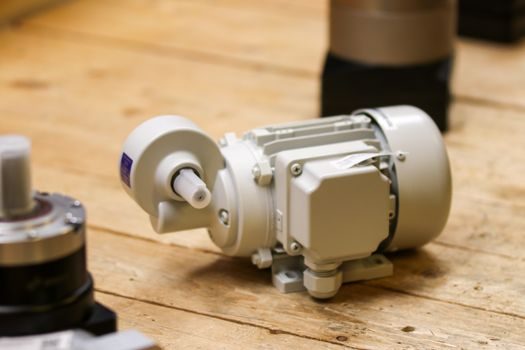
Lubricant cost is rarely material on its own — but the service interval is. A grease-lubricated reducer running 20,000 hours to first regrease is a fundamentally different cost object than a unit that needs regrease every 4,000 hours, because every regrease event is a planned stop and a labour ticket. [S2]
On oil-lubricated units, the spend stack includes oil charge, oil change labour, used-oil disposal, and the breather/filter elements. For servo-class applications in washdown or food-grade environments, food-grade H1 synthetic lubricant often costs 3-5x conventional synthetic PAO, but it eliminates the risk premium carried by H1 audits.
Seal life is the silent multiplier. Radial lip seals on input and output shafts typically run 10,000-25,000 hours before visible leak rates require replacement; a double-lip or PTFE-based seal extends that to 25,000-40,000 hours at roughly 1.5-2x seal unit cost. The trade-off pays back inside one full service interval on any 24/7 process line.
Cost Driver 3: Unplanned Downtime Risk and Failure Modes
Unplanned downtime is asymmetric in cost: a single 8-hour outage on a high-availability line can cost the same as the entire reducer purchase price, and unplanned stoppages account for a disproportionate share of the 20-year spend stack on continuous-process lines. This is why designers often specify oversized units running at 50-70% of rated torque specifically to push bearing L10 life past 40,000 hours.
Shock load, frequent reversal, and ambient temperatures above 40 °C are the three accelerants that shorten bearing life fastest.
Cost Driver 4: Mounting Configuration and Application Match

Planetary reducers ship in in-line, right-angle (bevel-helical planetary), shaft-mount, and flange-mount configurations. Right-angle and shaft-mount variants add 5-15% to purchase price but eliminate the cost of a separate coupling, guard, and baseplate, so total installed cost is often 5-8% lower than an in-line equivalent. [S2]
The right pick depends on whether the duty is energy-cost-dominated (favour in-line helical) or precision-positioning-dominated (favour servo-rated).
For applications where stop-start cycles, indexing accuracy, and reversing loads dominate, a cycloidal or harmonic reducer topology may outperform planetary on TCO despite higher unit cost — the comparison comes down to shock tolerance, peak-torque capacity, and acceptable efficiency loss.
Selection Map: Who TCO Favours Which Configuration
For continuous-duty conveyors, mixers, and extruders above 5 kW: in-line helical planetary, single or two-stage, oversized by one frame for L10 life margin. TCO leader on 20,000-hour horizons. [S3]
For cranes, hoists, winches, and track drives: in-line planetary with integrated backstop, two-stage minimum, with a focus on peak-shock rating and brake compatibility. Right-angle bevel-planetary is preferred when space is constrained but expect 2-3% efficiency penalty.
For servo axes (packaging, robotics, indexing tables): servo-class planetary with low-backlash gear mesh, accepting 30-60% price premium for sub-3 arc-minute repeatability. Compare against RV reducers for high-torque axes and harmonic drives for high-ratio compact axes.
Total-Cost-of-Ownership Framework: The 20,000-Hour Spend Stack
[S2]
Drop the same unit's efficiency from 97% to 94% — a realistic penalty for an undersized, hot-running, or wrong-lubricant unit — and the 20,000-hour TCO rises 8-15% on energy alone, before any unplanned downtime event. Halve the maintenance interval and the planned-maintenance bucket alone grows 4-8% of the total. These are the levers that matter when the procurement quote is essentially fixed.
The audit discipline that holds TCO honest is the same one used in cloud-migration analysis: configure the operating profile (duty cycle, load factor, ambient, hours/year), itemise each cost bucket separately, and model the worst-case unplanned-downtime exposure as an explicit line item rather than a hidden assumption [S3].
Where the Spend Stack Lies vs Other Industrial TCO Profiles
Planetary reducer TCO contrasts sharply with material-handling equipment TCO: for planetary gearboxes, energy losses are the largest single bucket because continuous electromechanical drive losses accumulate hour after hour; for rough terrain forklifts, operator labour and fuel dominate; for checkweighers, calibration and compliance documentation dominate. [S3]
Comparing planetary reducers against worm reducers and cycloidal units on a four-axis decision matrix: planetary wins on efficiency (96-98% vs 30-60% worm vs 85-92% cycloidal) and unit cost; cycloidal wins on shock tolerance and downtime avoidance; worm wins on self-locking and lowest acquisition cost. The selection is a duty-cycle problem, not a price problem.
For applications with intermittent duty or where downtime exposure is the binding constraint — precision indexing, robotics, hoisting — the TCO playbook for hot-box core shooters and fire-rated door installations shares the same lesson: lifecycle cost is governed by the bucket the buyer stops measuring, not the bucket the buyer negotiates hardest.
Limitations, Failure Modes, and What TCO Cannot Capture
TCO assumes the operating profile used in the model matches the field profile; if the duty cycle shifts 30% above the design point, all five buckets move and the model becomes decorative. Maintenance labour rates must be site-specific — a 2-hour regrease in a clean plant is not the same cost as a 6-hour job in a remote mine. [S2]
TCO also does not capture catastrophic-loss events outside the gearbox itself: a reducer failure that drops a suspended load carries liability exposure, regulatory reporting, and reputational cost that no spreadsheet line can price. For those scenarios, oversizing, redundancy, and condition-monitoring retrofits are the controls.
Finally, TCO assumes the lubricant specification is honoured. A reducer designed for synthetic PAO running on generic mineral oil at the original 20,000-hour change interval will fail prematurely and the failure will show up as an "unplanned downtime" event, not as a lubricant problem — which is why lubricant specification belongs in the TCO model, not in the maintenance binder.
Sourcing, Standards, and Trackable Signals
Reducer ratings should be specified against AGMA 2001 (fundamental rating factors for spur and helical gears), AGMA 6014 (for gearmotor units), ISO 6336 (calculation of load capacity for spur and helical gears), and ISO 14001-aligned quality management for the manufacturer. For explosive-atmosphere or washdown applications, ATEX 2014/34/EU (EU equipment for use in explosive atmospheres) certification is a separate cost line that must be added before the TCO model is closed. [S2]
For process-industry buyers, the next trackable signals are: published efficiency at the actual duty point (not catalogue-maximum), independently verified L10 bearing life on the specific shaft and bearing combination, and a written lubricant interval from the OEM rather than a generic "per maintenance schedule." Any of these three documents, missing at quote stage, will be billed back as unplanned downtime within the first 36 months of operation.