
Polypropylene smart manufacturing in 2026 is consolidating around three concrete moves: MES-driven batch control on pellet and compounding lines, FDM printing-parameter optimisation for PP tensile performance, and broader SLA/SLS/MJF process standardisation — all targeting a global PP market where Thailand alone is projected to reach USD 2 billion by 2030 at a 2% CAGR from 2023, driven by packaging and automotive lightweighting demand [S4].
The engineering rationale is straightforward: PP is the second-most-produced commodity plastic, with a density band of 0.895–0.93 g/cm³, and its ductility plus living-hinge fatigue resistance make it a default material for bottles, containers and laboratoryware [S3]. That familiarity is exactly why control engineers are now wiring PP lines into synthetic resin MES stacks rather than leaving them on standalone PLCs.
FDM Printing Parameters That Drive PP Tensile Performance
Layer height, infill density and raster-line orientation all have a statistically significant influence on the elastic modulus of FDM-printed PP, with ANOVA and Tukey HSD post-hoc analysis resolving the maximum number of homogeneous subsets — meaning no parameter can be tuned in isolation [S1].
The paper's four-regime design treats raster orientation as a categorical variable, not a continuous one, because PP's high elongation under load makes the modulus sensitive to bead-to-bead bonding direction [S1]. For process engineers, the practical gate is to lock layer height and infill density first, then sweep raster angles through 0°/45°/90° and a cross-ply, logging modulus against a fixed tensile coupon geometry. Reference work on PLA thermal post-treatment shows the same parametric logic — part-level mechanical response is dominated by a small set of controllable variables, not by machine variability [S1].
Process Comparison: Moulding vs FDM vs SLS vs MJF vs SLA for PP
Traditional injection moulding and blow moulding remain the lowest unit-cost path for high-volume PP parts; FDM, SLS, MJF and SLA each trade throughput for design freedom, rapid iteration and reduced tooling rework [S3].
FDM is the lowest-capex entry point but inherits the parameter-coupling problem above; SLS sidesteps support structures and is preferred for ductile living-hinge prototypes; MJF (HP Multi-Jet Fusion) gives the best surface finish on polyolefin-like parts; SLA requires PP-like photopolymer resins rather than true PP, so it is reserved for visual or masters [S3]. Material-sourcing directories continue to list FDM, SLS, MJF, DMLS and SLA as the five core 3D capabilities a PP buyer should filter on [S2]. A useful buyer heuristic: if the part needs food-grade or chemical-resistance certification, default to moulded PP; if the part is a prototype with under 500 units and 2-week lead-time, default to SLS or MJF; if it is a jigs-and-fixtures bracket on the factory floor, default to FDM with locked parameters [S2][S3].
Factory-Floor Automation: MES, Robotic Handling and the Resin-Sand Line Linkage
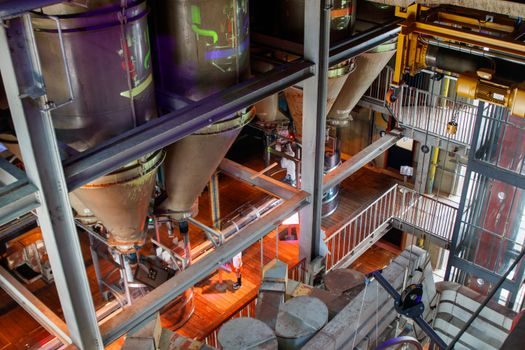
Modern MES platforms such as Polaris Automation's Chordata Batch target recipe-driven batch processes, and the same recipe-and-batch data spine is being applied to PP compounding and additive lines so that material lot, parameter set and tensile outcome are traceable end-to-end [S5].
The data spine matters because PP lines are not isolated: a resin-sand line running furan or phenolic binder shares the same MES recipe, the same weigh-hopper batching logic and the same robotic demoulding cell as a PP compounding skid. Inline viscosity and torque sensors on the extruder feed the MES historian, and the historian closes the loop to robotic pellet handling — a pattern already deployed across Chinese PVC resin plants and now extending to PP [S5]. For a PP plant engineer, the verification gate is simple: every batch record must resolve to a resin lot, a parameter set, and a downstream QC tensile/MFI value within one MES query.
Additive Manufacturing Material Selection Criteria
Specifying an additive manufacturing material for PP applications comes down to four decision gates: density (target 0.895–0.93 g/cm³), elongation at break, chemical resistance to the service fluid, and living-hinge fatigue cycle count [S3].
Density rules out glass-filled or talc-filled grades for any application where lightweighting is the design driver. Elongation at break is the single most discriminating property for FDM PP coupons and is the property the Tukey HSD analysis ultimately resolves [S1][S3]. Chemical resistance to acids, bases and solvents is where PP outperforms PLA and ABS, and is the reason PP is the default for laboratory bottles and cleaning-solution containers [S3]. Fatigue cycle count is the gate for living-hinge lids: PP resists repeated flexing where brittle plastics fail after a few hundred cycles [S3]. The four gates together filter roughly 80% of candidate resins before any mould-flow or print-path simulation is run.
Limitations, Failure Modes and Where PP Smart Manufacturing Is Not Appropriate

PP smart manufacturing on FDM fails when warping is not controlled — PP has a higher coefficient of thermal expansion than PLA, and bed-adhesion losses dominate dimensional yield [S3].
PP smart manufacturing on MES-driven batch lines fails when the recipe is decoupled from QC: if MFI and tensile data are not written back to the same lot record, traceability collapses and the line reverts to manual review [S5]. PP smart manufacturing is also not appropriate where the application requires optical clarity comparable to PMMA, where continuous service temperature exceeds the PP upper limit, or where the part is regulated for medical implant-grade biocompatibility — those applications step outside PP's specification envelope and require a different polymer family entirely [S3]. Custom-OEM sourcing channels in regions such as Guangxi show that industrial wastewater equipment, not PP resin production, dominates small-factory output, so buyers chasing pure PP resin lots should filter for manufacturer/factory listings with PP as a main product, not a by-line [S6].
Verification Signals and 2026 Trackable Indicators
Two signals are worth tracking over the next two quarters: the share of new PP line RFPs that include closed-loop MFI feedback to the MES historian, and the publication of further FDM-PP studies that resolve raster-orientation effects on fatigue cycle count rather than only elastic modulus [S1][S5].
A third, longer-cycle signal is the Thailand resin capacity build-out — at a projected 2% CAGR toward USD 2 billion by 2030, any deviation from that trajectory will surface in packaging and automotive tier-1 supply first [S4]. For factory-floor engineers, the next node is to lock the FDM parameter set against a fixed PP grade, log it into the MES, and benchmark MFI and tensile values against the Sood et al. and Chalgham et al. reference baselines already cited in the additive-manufacturing literature [S1]. Buyers comparing copper material and PP for the same jigs-and-fixtures application should run the four-gate filter on both — PP wins on chemical resistance and density, copper wins on thermal conductivity and stiffness, and the choice is rarely a wash.