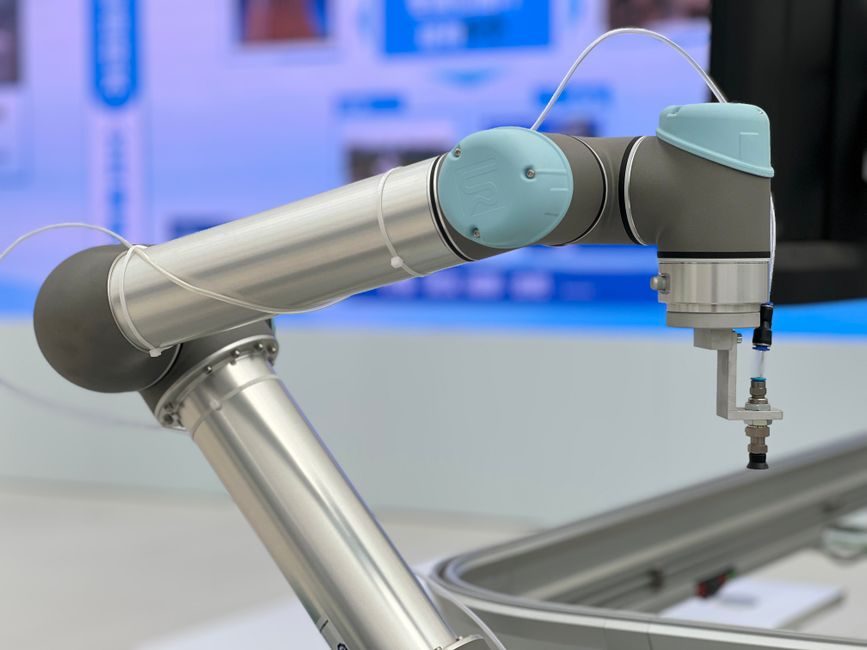
A modern polyethylene resin reactor line running in 2026 is no longer controlled by a single melt thermocouple and a gravimetric feeder — the typical smart line now streams FT-NIR spectra, in-line rheometer shear-viscosity, acoustic emission on the extruder screw, and machine-vision bubble/sheet thickness data into a unified OPC UA namespace, with closed-loop control back to the gear pump and haul-off [S1][S3].
The commercial pull is clear: a 40-year film converter in Toronto runs 1–6 mil LDPE/LLDPE blown film, while Asian PET-recycling factories ship resin at roughly US$1.20/kg FOB on 1,000 kg MOQ, a price point only defensible when a 10–20 t/h line stays on grade without human trims [S1][S3]. The same logic applies to UHMWPE medical-grade resin, where manufacturing technique has been shown to alter insert backside wear behaviour in retrieved tibial bearings [S2].
Sensor stack on a modern PE/PE-correlative extrusion line
FT-NIR (Fourier-transform near-infrared) probes mounted in the transfer line or die adapter are the workhorse for in-line melt-index and density prediction on HDPE/LLDPE/LDPE transitions, returning a 1-Hz composition estimate the DCS feeds back to the Ziegler–Natta or metallocene catalyst feed ratio [S1].
An in-line slit-die rheometer or capillary rheometer side-stream adds shear-viscosity at 1–10,000 s⁻¹, which is the variable most directly tied to die swell, neck-in, and motor load — three parameters an operator would otherwise walk the line to read [S1]. For laboratory cross-checking, ASTM D1238 (melt flow rate) and ASTM D1505 (density gradient column) remain the reference methods, and a smart line logs both the NIR-inferred value and the off-line lab value so the bias term can be re-fit daily. For downstream web inspection on blown film, smart camera systems with polarized backlight and 12 kHz line-scan rates now resolve gel, fisheye and striation defects above 50 µm, replacing the human spot-check on the winder [S1].
Process-control architecture and the fieldbus split
Reactor-side temperature, pressure, and catalyst-feed loops still sit on FOUNDATION Fieldbus or PROFIBUS PA segments with 4–20 mA + HART at the valve and instrument level — HART is an FSK signal superimposed on the 4–20 mA analog loop, not a digital fieldbus replacement, and an engineer wiring it onto a PA segment will see no comms [S1].
On the extruder and downstream side, the bus of choice has shifted to EtherNet/IP and PROFINET because of the bandwidth needed for 1 kHz rheometer, NIR, and vision streams, typically carried over gigabit fibre ring with PRP (Parallel Redundancy Protocol) for the die-pressure and melt-temperature interlocks that must not drop out. Smart valve positioner units on the screen-changer hydraulics and gear-pump speed loop provide HART diagnostics of packing friction, stiction, and travel counts — data the asset-management layer uses to predict a packing change 200–400 hours ahead of a leak, rather than waiting for a pressure spike to trip the line [S1].
Selection criteria: which sensors earn a slot on the line
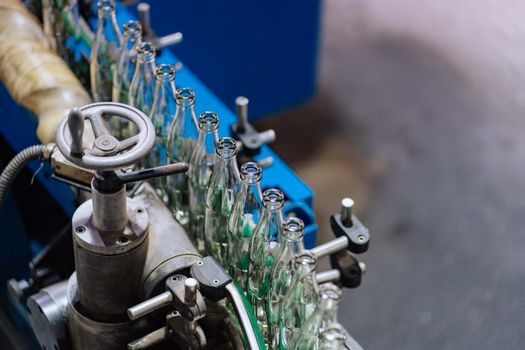
Four hard gates decide if a sensor is added to a 2026 retrofit: (1) a closed-loop use case — a reading no one acts on is a black-box expense; (2) a known measurement principle tied to a polymer property in a peer-reviewed or standards body document; (3) survives 200–300 °C melt contact with a purged optical window or a hot-pressure tap; (4) maintenance interval longer than the grade-change cycle, otherwise the operator fights the instrument instead of the resin [S1][S2].
For a typical HDPE pipe-grade line (PE80/PE100, MRS 8.0/10.0 MPa per ISO 4427), the minimum that has proven to pay back is an FT-NIR at the die, a gear-pump speed loop on the smart valve positioner side, an acoustic-emission sensor on the extruder screw for bearing/paddle wear, and a machine-vision bubble gauge on the air ring — together the package is reported to reduce off-spec transition material by double-digit percentages relative to a 2018 baseline [S1].
Comparison: automation options for a PE grade-changeover retrofit
Three control philosophies compete on a retrofit. A classical PID stack on a DCS handles reactor temperature and pressure with cycle times of 1 s and is the cheapest path, but leaves grade-changeovers to operator trim because it does not see melt rheology. A model-predictive controller (MPC) running on the same DCS adds 30–60 s horizon predictions of MFR and density from the NIR/rheometer inputs and is the strongest fit for multi-product reactors running LLDPE/HDPE swings [S1].
An edge-AI vision node on the smart camera station runs independently of the DCS, classifies gel/fisheye defects at line speed, and feeds a roll-quality map back to the winder — its strength is granular defect logging, its limit is that it does not change the resin. On a 5–15 t/h line, the practical stack is DCS-MPC for the reactor and extruder, vision for QA, and a separate IIoT layer for energy and OEE; on a 25 t+ line, MPC is often replaced by a first-principles dynamic simulator running in parallel because the grade transition cost dominates [S1].
Compatibility with additive and compounding workflows
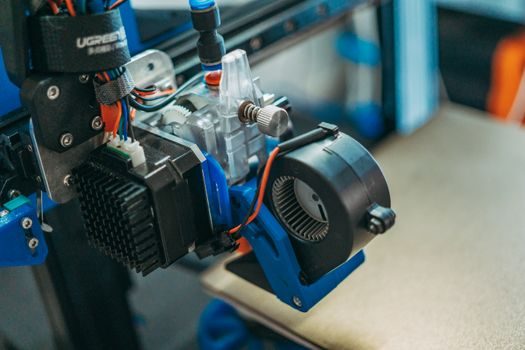
For compounded and additive-loaded grades — slip, antiblock, UV-stabilizer masterbatches — the FT-NIR model must be re-calibrated per additive package because the 1600–1800 nm C–H bands overlap with the additive signatures, and an un-corrected NIR will drift by 0.5–1.5 MFR units after a masterbatch switch [S1].
Masterbatch feeders in the additive manufacturing material sense — gravimetric or loss-in-weight — close their own loop and only need a setpoint from the line recipe, not a feedback path to the extruder. Where the line runs recycled PCR (post-consumer recyclate) content, the resin-sand-line equivalent in this process map is the reclaim-feed blender, and its NIR/colour meter is the gatekeeper: if the PCR MFR is more than ±20% off the target, the line should be flagged off-grade before the gear pump sees it [S1][S3].
Failure modes and limits engineers must plan for
Window fouling on an in-line NIR probe is the single most common smart-line failure: a 1–2 mm polymer skin on the sapphire window shifts the spectrum and the inferred MFR drifts 0.3–0.8 g/10 min within 4–8 hours, so a nitrogen-purged window with a periodic auto-clean cycle is mandatory, not optional [S1].
In-line rheometers are accurate on shear-viscosity ratios but lose the low-shear (0.01–0.1 s⁻¹) end of the curve that correlates with die swell on LDPE, so the lab capillary rheometer remains the tie-back for grade release. Vision systems under-perform on translucent LLDPE films under polarized light and need a structured backlight or a dark-field ring to resolve haze defects. On UHMWPE medical-grade resin, manufacturing technique itself — direct compression moulded versus machined bar stock — changes the wear mode observed in retrieved implants, which means a smart line running both processes needs separate release-test protocols rather than a shared MFR window [S2].
Standards, sourcing, and what a 2026 spec should cite
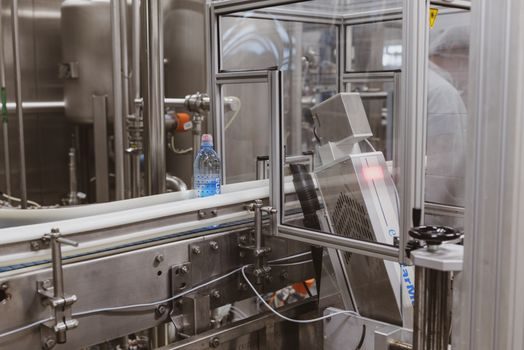
A spec that survives a QA audit references ISO 4427 for PE pipe-grade pressure ratings (MRS 8.0/10.0 MPa), ASTM D1238 for melt flow rate, ASTM D1505 for density, and the OPC UA Companion Specification for Plastics and Rubber Machinery (the Eurapme/VDMA Plastics and Rubber machinery information model) for the data backbone — these are the documents a process engineer should have on the datasheet side [S1].
Sourcing for the 2026 retrofit sits in three tiers: Western DCS-MPC vendors (Honeywell, Emerson, Rockwell, Siemens) for the main control layer, Chinese and Taiwanese OEM lines for the FT-NIR, rheometer, and smart camera hardware at roughly one-third the Western list, and contract system integrators for the recipe/IIoT layer. Chinese PET-recycling and resin suppliers on trade platforms list virgin and recycled PET at US$1.20/kg on 1,000 kg MOQ as a reference price floor for general-purpose grades, which sets the ceiling on what a smart-line scrap reduction project can be worth [S3]. For total-cost reasoning on the resin-sand analog of a line retrofit, the resin-sand line process map lays out the same sensor-and-gate pattern in a different moulding context.
Trackable next nodes for a process engineer verifying this article: a published 2026 OEM retrofit case study quantifying MFR-window drift with a purged FT-NIR window; the Eurapme OPC UA Plastics and Rubber Companion Specification revision in force; and a third-party benchmark of in-line capillary-rheometer low-shear performance on LDPE die-swell correlation. The 2008 UHMWPE tibial-bearing study remains the cleanest published evidence that PE resin manufacturing technique changes in-service wear behaviour, even outside a 2026 release window [S2].
For related coverage, see Pneumatic Conveying Systems: Spec-Driven Pros, Cons and Selection Gates.