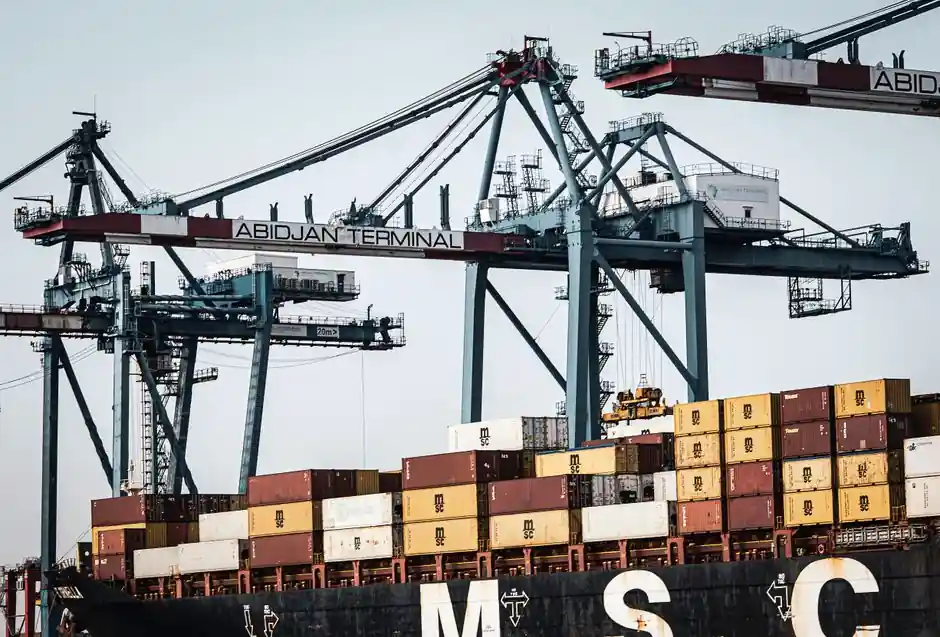
SANY Marine signed a record South American port equipment order on 10 July 2026 covering reach stackers, forklifts, and rotary drilling rigs for terminal foundation work, confirming active 2026 procurement for marine piling fleets [S1].
Port and wharf piling typically demands medium-class rotary rigs in the 60-100 t range with 180 kN·m torque, 1.8-2.5 m hole diameter, and 60-100 m depth, the same envelope that dominates highway bridge and large-building foundation work in published 2025 application data [S3].
Why the medium class dominates quay and berth piling
Port terminals combine large-diameter load-bearing structural piles for quay walls, berths, and container yard foundations with mid-range depths of 40-80 m, the exact envelope of a 180 kN·m torque, 200 kW engine, 0.8-1.8 m diameter class with about 65 t total weight, and application data from 2025 shows medium rigs cover over 90% of port terminal piling workloads [S3]. The DR-120 model in the port segment, with 120 kN·m max output torque, 5-30 m depth, 500-1800 mm diameter, and 25 t total weight, addresses the lower end of quay work where lighter crawler chassis and 32 MPa hydraulic system pressure are sufficient [S5]. SANY's SR185-C10 sits in the upper-medium band with 180 kN·m drive torque, 190 kN main winch lifting force, 180 kN pull-up/pull-down force, 1800 mm max diameter, and 59 m / 47 m depth options on a 212 kW chassis [S2].
What heavy-duty terminal projects need that mid-rigs can't deliver
Large quay walls, deep-water berths, and bridge approach viaducts at ports frequently require the large-class envelope: 240 kN·m torque, 300 kW engine, 1-2.5 m diameter, 80 m depth, and rigs over 100 t, a class that 2025 application data shows covering about 10% of port and large-pile workloads but doing the deepest and most loaded work [S3]. The SANY SWDM360 sits in this band with 26.1 m overall height, 2.5 m max drilling diameter, 100 m max depth, a 6-time sealed power box to resist dust and saltwater spray, and patented uppercarriage rotation brake technology with double-cylinder luffing for the heavy mast loads that berth construction imposes [S6]. SANY's port-machinery product line groups reach stackers, forklifts, empty container handlers, and rotary drilling rigs together, which reflects how the same contractor fleet typically sources the full quay and yard equipment package [S1].
Selection criteria that actually filter a port rig
Three engineering criteria filter port rig candidates faster than marketing brochures: torque-to-pile-diameter ratio, chassis mass versus quay load rating, and corrosion protection of the uppercarriage. The SANY SR185-C10 delivers 100 kN·m of torque per metre of max diameter (180 kN·m / 1.8 m), a useful first-pass number when matching torque curves to 1500-1800 mm port piles [S2]. For smaller wharf work the DR-120 ratio of 67 kN·m per metre (120 kN·m / 1.8 m) is acceptable on friction piles up to 30 m and interlocking piles up to 40 m per its spec sheet [S5]. Mast sidewards inclination of ±4° and forwards inclination of 4° on the DR-120 allow the operator to compensate for the sloped working platforms common in marine piling, where the rig sits on a temporary bund or jack-up barge [S5].
A second pass filter is engine power density. The DR-120 uses a Cummins diesel at 151 kW (water-cooled, turbocharged) on a 25 t chassis, giving roughly 6 kW/t, while the SR185-C10 uses 212 kW for about 61 t working mass (estimated), giving a similar power-to-mass ratio in the upper-medium class [S2][S5]. Port-side diesel-electric or hybrid options are not visible in current port-class rig brochures from the listed Chinese suppliers, which is a procurement risk where port authorities now impose Tier 4 Final or Stage V emission limits on construction equipment.
Comparison: small, medium, and large rig classes for port work
For port procurement, three rig classes cover almost every quay and berth scenario, and the trade-off across them is concrete in the published 2025 application data: the small class (100 kN·m torque, 170 kW engine, 0.5-1 m diameter, ~40 m depth, ~40 t) covers under 1 m diameter piles for slope protection and partial load-bearing, market coverage about 30% of port piling; the medium class (180 kN·m, 200 kW, 0.8-1.8 m, ~60 m, ~65 t) covers bridge piles, large building piles, and port terminal load-bearing piles, with over 90% market coverage; the large class (240 kN·m, 300 kW, 1-2.5 m, 80 m, over 100 t) covers extra-large bridge and special large-building piles, around 10% coverage [S3]. In practice, a port terminal contractor bidding on quay walls should default to a medium-class rig and only step up to the large class where pile diameters exceed 2 m or depths exceed 80 m, the SWDM360 envelope, with the DR-120 reserved for temporary wharf structures and small-craft berths [S3][S5][S6].
Standards, certifications, and supplier reliability signals

The DR-120 port wharf rig spec sheet lists CE, RoHS, ISO 9001:2000, and ISO 9001:2008 certifications [S5]. The SANY global press release on the South American port deal explicitly lists rotary drilling rigs, hydraulic grabs, trench cutters, and fire-fighting equipment in the same marine-fleet package, which is a useful signal that the vendor can support warranty, spares, and service across the full marine piling fleet, not just the rig itself [S1]. For torque-class veracity, the SR185-C10 5-34 rpm rotation range and 4200 mm hydraulic cylinder rod stroke on a 185 kN main winch with 28 mm cable are numbers an engineer can cross-check against any third-party dyno sheet, which is rare in this segment [S2].
Failure modes and constraints specific to port work
Three failure modes bite port rigs harder than inland rigs: saltwater corrosion on the uppercarriage, sloped or soft working platforms, and the inability to mobilise spares from a regional depot. The SWDM360's 6-time sealed power box directly addresses the first; DR-120's 32 MPa max working pressure and 3.5 MPa pilot pressure indicate a robust hydraulic system for the second, but working platform preparation (geotextile, crushed-stone mat, or steel bog mats) is the contractor's responsibility and is not a rig-spec line item [S5][S6].
What 2026 procurement teams should track next
Two trackable signals will shift the 2026-2027 port-rig market: the delivery and after-sales performance of the SANY South American port fleet shipped in July 2026, and any new port-class rig launches with Tier 4 Final or Stage V diesel platforms to meet the stricter emission rules now appearing in European and some Latin American port tenders. Cross-reference this spec map with adjacent drill-rig applications, including the road-construction rotary drilling rig selection guide for highway-bridge work, the demolition-project rotary rig spec bands where pile extraction forces matter, and the pulp-and-paper slewing-ring bearing spec map for the uppercarriage rotation bearings shared by all three rig classes. For a deeper foundation concept primer, the rotary drilling rig encyclopedia entry covers the torque-head, Kelly bar, and mast geometry that this spec map assumes. [S1]
Detailed specification references: terminal block, and lamps and light fittings.