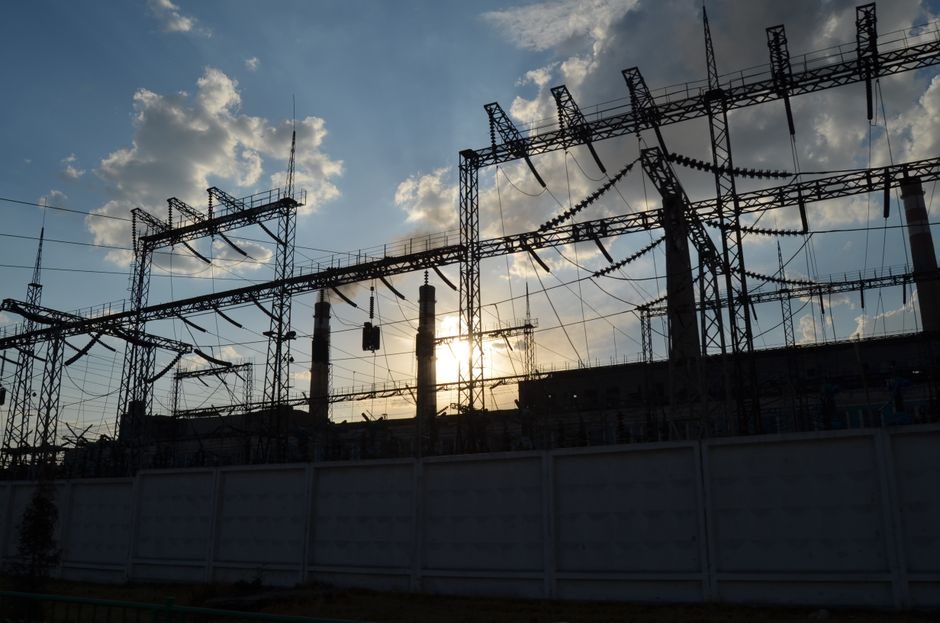
A power distribution box is a low-voltage downstream assembly (≤690 V, branch circuits typically ≤1600 kVA feed) that sits on the load side of a power transformer, which is a magnetic voltage-conversion device operating across HV/MV networks from 6 kV up to 500 kV class [S2].
The two are routinely confused in single-line diagrams because both sit in the substation; functionally, the power transformer does the kV→V conversion while the distribution cabinet does the protection, switching and metering of the outgoing feeders.
Defining the Two Devices on the Same Single-Line Diagram
A power transformer is a static electromagnetic device with primary and secondary windings on a common core, designed to step transmission-class voltages (typically 33 kV, 66 kV, 110 kV, 220 kV, 400 kV and up) down to sub-transmission or distribution levels, or to step generation voltage up to transmission voltage [S2][S5].
A power distribution box (or distribution cabinet) is an enclosed low-voltage switchgear assembly — incoming breaker, busbar, outgoing MCBs/MCCBs/ACBs, metering — that takes a 380/400/690 V feed and breaks it into branch circuits for lighting, sockets, motors, HVAC and small process loads. It does not change voltage; it switches, protects and meters [S1].
Indian practice (IS 10028, Part 1) gives a hard line: transformers rated above 1600 kVA are classed as power transformers; those up to and including 1600 kVA are distribution transformers — that 1600 kVA threshold is the most-cited boundary in the field [S3].
Voltage Class, kVA Rating and Where Each Device Lives
Power transformers typically operate at 33 kV / 66 kV / 110 kV / 220 kV / 400 kV primary side and 6.6 kV / 11 kV / 33 kV secondary side, with unit ratings that commonly run from 5 MVA to 500 MVA in transmission substations [S2].
Distribution transformers cover the 6 kV to 35 kV class on the primary, with secondary at 400/230 V three-phase four-wire, and ratings typically up to 2500 kVA in oil-immersed pad-mount form or up to 1600 kVA in dry-type [S2][S4].
Welldone's current oil-immersed distribution line covers 10 kV / 11 kV three-phase units at 250 kVA, 315 kVA, 400 kVA, 500 kVA, 630 kVA and 800 kVA — a representative rating ladder for new Asian and Middle-East utility orders in 2026 [S4]. The power distribution box downstream of such a unit will carry 400 V busbars rated 630 A to 6300 A depending on the main breaker frame, feeding 16 A to 1600 A branch ways.
Loading Profile, Duty Cycle and Design Stress

Distribution transformers see highly variable load, often 30–80% of nameplate with daily load factor swings of 0.4 to 0.7, and are sized for 150% peak overload over a few hours on radial feeders [S2]. The downstream power distribution box is sized for short-circuit withstand (Icw typically 25 kA / 1 s for commercial panels, 50–85 kA / 1 s for industrial ACB assemblies), not continuous load — that is the structural difference in spec philosophy.
Loss design also diverges: power-transformer no-load losses are minimised because the unit is energised 24/7, while distribution-transformer load losses are prioritised because the unit cycles with feeder demand [S2].
Comparison Matrix: Power Transformer vs Power Distribution Box
Four decision criteria line the two up cleanly. (1) Function: the power transformer converts voltage; the power distribution box does not. (2) Voltage class: power transformer works at 6.6 kV–400 kV, distribution box works at ≤690 V. (3) Rating: power transformer is rated in MVA (5–500 MVA typical), distribution box is rated in busbar current (630 A–6300 A) and short-circuit withstand (Icw 25–85 kA/1 s). (4) Standards: power transformer to IEC 60076 / IS 10028, distribution box to IEC 61439-1/-2 for low-voltage switchgear assemblies. [S1]
Material: power-transformer core is grain-oriented electrical steel (CRGO, typically M4 / M5 / M6 grade, 0.23–0.30 mm lamination); distribution-box busbar is copper (T2, 99.9% Cu) or aluminium (6101-T6), and the enclosure is cold-rolled steel ≥1.5 mm or SS304 for corrosive atmospheres. Lead time also diverges: a 110 kV 31.5 MVA power transformer typically quotes 12–20 weeks ex-works; a 1600 A distribution cabinet typically quotes 4–8 weeks ex-works in 2026 [S1][S4].
Selection Criteria: Which Device for Which Application
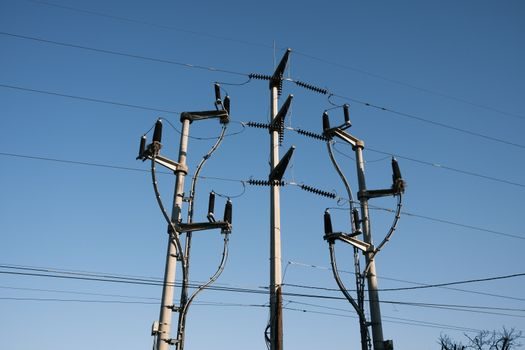
Spec a power transformer when the job is bulk voltage conversion between transmission and sub-transmission voltage classes, or between sub-transmission and MV distribution — i.e. utility substations, large industrial plant MV incomers (11 kV / 33 kV), wind-farm step-up to 33 kV / 66 kV / 110 kV, or data-centre MV-LV transformers at 2.5 MVA to 10 MVA. Spec a power distribution box when the job is downstream switching, protection and metering of 400 V feeders inside a building, plant room or skid [S1][S2].
Do NOT spec a power distribution box for voltage conversion — it has no windings, no taps, no vector group. Do NOT spec a power transformer for branch-circuit switching — it is not designed for the 10⁴–10⁵ mechanical operations of an ACB or the discrimination selectivity required across 30+ outgoing feeders.
Hazardous-area plants (oil & gas, chemical, paint rooms) should spec the explosion-proof distribution variant (Ex d IIB/IIC T4–T6, IP65, IEC 60079-1 zone-1/2 enclosure) rather than a standard power distribution box — the enclosure thickness, flame-path and cable-entry thread must all meet the Ex d standard [S1].
Use Cases, Failure Modes and Field Track Record
Typical 2026 sourcing line: a 110 kV / 11 kV 31.5 MVA power transformer is paired with an 11 kV / 0.4 kV 1000 kVA distribution transformer at the plant boundary, which feeds a 1600 A main-bus distribution cabinet that breaks into 200 A, 400 A and 630 A motor-control centres (MCC) and lighting boards — this is the canonical three-stage chain in a mid-size industrial estate [S2][S4].
Common power-transformer failure modes: winding hot-spot thermal ageing (top-oil temperature > 95 °C continuous, hot-spot > 118 °C, per typical IEC 60076 loading guides), bushing partial discharge, OLTC contact wear, and oil moisture > 30 ppm at 66 kV class. Common power distribution box failure modes: busbar bolted-joint hot-loosening (torque creep on Cu/Al joints), breaker trip-unit mis-coordination, IP54 gasket ageing letting in dust and humidity, and cable-entry gland corrosion in coastal sites [S2][S5].
For fuse-protected branches inside a distribution cabinet, a back-of-envelope discrimination study is mandatory before sign-off — the fuse selection criteria walk-through covers the six engineering gates (voltage, current, I²t let-through, AC/DC rating, utilisation category, physical form) that lock the build cleanly.
Sourcing Levers, MOQ and Supply-Chain Notes for 2026
China-based OEM ex-works MOQ for power transformers typically starts at 1 piece with indicative pricing around US$ 1,000 per piece at low kVA, scaling into the tens of thousands of US dollars for MV-class units; power distribution box MOQ is similarly 1 piece for stock assemblies, with custom-built panels 5–20 pieces minimum [S1].
For hazardous-area orders, the explosion-proof distribution certification path (ATEX 2014/34/EU for EU, IECEx for global, UL Class I Div 1 for North America) adds 8–12 weeks to lead time and roughly 30–60% to the unit price versus a non-Ex panel of the same busbar rating. Lead times for 110 kV-class power transformers in mid-2026 still run 16–24 weeks ex-works for Asian and European OEMs, with copper and CRGO price volatility the dominant cost swing factor [S1][S4].
Upstream switching that sits between the transformer secondary and the distribution box — the manual load-break switch, AC-22/AC-23 isolator, IP-rated enclosure — is its own spec gate; the manual load-break switch spec gates breakdown covers current rating, pole count, utilisation category and IP class side by side.
Trackable signals for the next 90 days: CRGO steel and copper cathode LME price moves (each 10% move shifts a 1000 kVA transformer price roughly 4–6%); IEC 61439-1/-2 third-party retest volume at Chinese CTFs (capacity signal for distribution-box orders); and ATEX Notified Body queue times for Ex d cabinets, which are the practical bottleneck on explosion-proof distribution deliveries in 2026.