Selection of a manual load-break switch is a four-gate spec exercise: continuous thermal current (commonly 16-1600 A across 1P-4P body sizes), utilization category per IEC 60947-3 (AC-21, AC-22, AC-23), short-circuit withstand (Icw 5-25 kA/1s typical), and enclosure IP class (IP54 indoor, IP65 outdoor) [S1]. Skip any of these four and the switch either derates silently under load or welds closed on first transformer-magnetising inrush. Reference architecture for body size, pole count, and rotary operating mechanism is on the industrial switch reference page.
Eight industrial manufacturers currently publish manual load-break switch lines on the 2026 vendor index, covering 15 catalogue models from 16 A DIN-rail mountable units up to 1600 A panel-floor withdrawable frames, with most stock items shipping in 4-6 weeks from China, Korea, and India [S1]. The commodity-tier products cluster in the 32-630 A / 3P-4P / AC-23 segment, which is also where most MCC feeder, transformer secondary, and HVAC disconnect applications land.
Rated Current and Pole Count: The First Hard Gate
Continuous thermal current (Iu or In) is the non-negotiable first gate; the body size, the contact cross-section, and the terminal bolt pattern all key off it. Below 125 A, the rotary-cam 1P/2P/3P/4P modular form factor dominates, with 32 A and 63 A frames accounting for the bulk of distribution-panel disconnects [S1]. Above 125 A, the 3P and 4P front-operated panel-floor frames with extended shafts and padlockable handles take over, with 200 A, 400 A, 630 A, 1000 A, and 1250 A as the standard ladder steps [S1].
Compensate ambient temperature before crossing this gate: most rotary switches are rated at 35-40 °C, and derating curves typically knock 1-2 frame sizes off the catalogue number for every 10 °C above that, especially in enclosed cabinets without forced ventilation [S1]. Four-pole (4P) switched neutral is mandatory for TN-S systems where the neutral carries harmonic-loaded return current, and 4P frames cost roughly 25-40 % more than the equivalent 3P body. Vendor catalogues list 4P configurations explicitly, e.g. the GLD11-32A 4P frame in the 32 A / 4P body size, sold as a power switch with full fourth-pole isolation [S3].
Utilization Category AC-22 vs AC-23: The Second Hard Gate
AC-22 and AC-23 from IEC 60947-3 are not marketing labels; they bound the inductive load the switch can break. AC-21 covers resistive loads (heaters), AC-22 covers mixed resistive + light inductive (distribution feeders, lighting), and AC-23 covers heavily inductive (squirrel-cage motors, transformer secondaries) with break ratings typically 4-8 × In and make ratings 8-10 × In [S1]. Specifying a 100 A AC-21 switch on a 75 kW motor feeder is a textbook contact-welding failure: the motor's locked-rotor inrush of 6-8 × FLC on start trips the break rating, and the contacts tack-weld on the first cycle.
The 12 kV / 630 A air-insulated CKFY-12 family sits at the other end of the category map, with air-break contacts rated for frequent switching of transformer and capacitor bank loads in secondary distribution substations, fixed-cabinet installation, AC current path, steel-plate enclosure [S2]. For low-voltage motor disconnect at 400 V, AC-23 is the minimum spec; for HVAC fans and pump starters, AC-22 is acceptable only if the starter handles the inrush, otherwise AC-23 is required.
Short-Circuit Withstand, Icw and Making Capacity
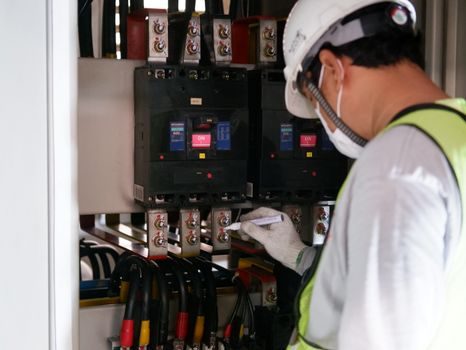
Three numbers define short-circuit behaviour, and they are not interchangeable: Icw (short-time withstand, 1 s), Icm (dynamic making capacity peak), and Icn (conditional short-circuit current with back-up fuse). For 100-630 A frames, Icw values of 5-15 kA / 1 s are typical; for 1000-1600 A frames, 25-50 kA / 1 s is common [S1]. Unfused switches rely on the upstream breaker or fuse to clear faults and are rated Icw only; fused switch-disconnectors integrate HRC fuses and quote an Icn of 50-100 kA.
Coordinate the Icw with the upstream device's let-through. A 400 A switch with Icw = 10 kA/1 s upstream of a 25 kA breaker is fine; downstream of a 65 kA breaker without current-limiting fuses, the Icw gate fails because the 1 s energy exceeds the contact-erosion limit. Specifying fused versions raises the Icn gate by an order of magnitude at modest cost premium, and they double as a visible-isolation point for LOTO procedures per IEC 60204-1.
IP Rating, Enclosure, and the On-Site Duty Cycle
Indoor switchgear in clean MCC rooms can run IP20 (back-of-hand) to IP40, but the moment a switch lands on a factory floor, plant room, or outdoor pad, IP54 (dust-protected + splashing water) is the floor, and IP65 (dust-tight + water-jet) is the default for washdown and coastal sites [S1]. Enclosure material is the second decision: powder-coated steel for indoor, polycarbonate for lightweight wall-mount up to 250 A, and stainless steel (304 or 316) for food-grade and offshore.
Mechanical endurance (M-class) and electrical endurance (A-class) are the duty-cycle numbers most specifiers miss. An M3 (1500 ops) or M4 (2500 ops) mechanical rating is fine for an upstream transformer isolator switched a few times per year, but a generator-tie switch racked in and out daily needs M5 (5000 ops) or M6 (10000 ops) [S1]. Electrical endurance is the wear from making/breaking under load, typically expressed as operations at rated current; values under 1000 cycles at AC-23 are a flag for undersizing.
Selection Criteria Comparison: Modular DIN vs Panel-Floor vs Fixed Cubicle
For three form factors side by side: DIN-rail modular (16-125 A, 1P-4P, AC-22/AC-23, IP20-IP65 enclosure retrofit, 4-6 week lead, low cost) suits small commercial and residential distribution; panel-floor front-operated (200-1600 A, 3P-4P, AC-22/AC-23, Icw 15-50 kA, M4-M5 endurance, mid cost, 6-10 week lead) suits industrial MCC feeders and transformer secondaries; fixed cubicle (630-4000 A, 3P, AC-22/AC-23, Icw 25-65 kA, M5-M6 endurance, high cost, 10-14 week lead) suits MV substation and main-tie-main switchboards at 12-24 kV [S1][S2].
Cost-per-amp at 400 V / 100 A frames sits in the $0.30-0.60/A band for modular, $0.20-0.40/A for panel-floor, and $0.40-0.80/A for fixed cubicle including enclosure; below 32 A the modular premium widens because of the fixed mechanism cost. Across all three, the Icw and utilization category dominate the cost more than the current rating, which is why two switches at the same 400 A can differ in price by 2-3×.
Common Spec Errors and Failure Modes
Four errors account for most field failures. First, picking AC-22 on a motor disconnect - the inrush welds the contacts within the first ten operations. Second, ignoring the 4th-pole on TN-S - return current through the neutral back-EMFs the upstream RCD and trips nuisance. Third, underrating Icw relative to the upstream breaker - the upstream device clears the fault, but the switch contacts experience I²t beyond the erosion limit. Fourth, mixing IP20 indoor switches into IP54 outdoor cabinets with knockouts - the IP gate fails at the cable gland, not the switch body. [S1]
A fifth error worth flagging: mixing switching device families on the same bus. An isolating switch is a no-load isolator (off-load only); a load-break switch is on-load; a changeover switch is a transfer device. Specifying an isolator on a load-make/load-break duty cycle produces the same contact-welding outcome as the AC-22 on motor mistake, because the isolator's break rating is typically 0.5-1 × In and is for dead-state isolation only.
Standards, Sourcing, and What to Verify Before PO
Verification stack before purchase: IEC 60947-3 utilization category and Icw stamped on the nameplate, IEC 60204-1 LOTO compliance for the padlockable handle, CE/UKCA marking, and the manufacturer's published derating curve for ambient temperature and terminal orientation. Vendor catalogues list 8 manufacturers and 15 products as of the 2026 vendor index, with model codes spanning CKFY-12 (12 kV / 630 A air) down to GLD11-32A 4P (32 A / 4P modular) [S1][S2][S3].
For transformer-secondary disconnects at 400 V / 63-400 A, three lead-time signals to track through 2026-Q3: Korean and Japanese makers (VitzroEM and adjacent suppliers) quoting 6-8 weeks for Icw 25 kA frames; Chinese makers (Aswich, Pomanique, ENTEC) quoting 4-6 weeks for Icw 10-15 kA frames at 25-40 % lower unit cost; and the India Allis Electric line at 200-1600 A 3P/4P Icw 35 kA with 8-10 week lead and direct India-CE dual marking [S1]. Comparable load-side architecture for related feeder equipment is detailed in the load switch and load cell reference pages, which sit alongside isolating and industrial switch families in the broader switchgear taxonomy.
For related coverage, see Best Dry-Mix Mortar for HVAC: Spec-Driven Selection Guide.