
Choosing a power meter in 2026 starts with four calls: single-phase vs three-phase, CT input class, accuracy tier (0.2/0.5/1.0), and communications stack (Modbus RTU, TCP, 4G, Wi-Fi/MQTT) [S3]. Get those four wrong and the meter becomes a display, not an instrument.
The catalog of active 2026 listings splits cleanly into three form factors: DIN-rail energy meters for switchgear retrofits (typical 60 A direct or CT-operated), 96×96 panel-mount multifunction units, and benchtop optical power/energy meters for photonics labs [S1][S3][S5]. Each form factor has its own accuracy hierarchy, isolation class, and certification floor.
Form Factor 1 — DIN-Rail Energy Meters (CT or Direct, 1P / 3P)
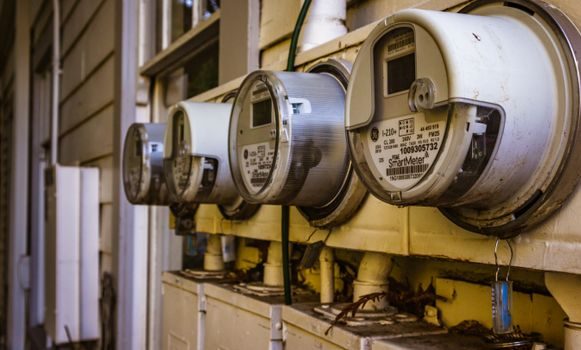
DIN-rail electronic energy meters dominate new switchboard builds in the 2026 Made-in-China catalog: 60 A single-phase direct-connect models and three-phase four-wire CT-operated units both surface in the active listings [S3]. The 60 A direct-connect single-phase kWh meter ships in DIN-rail format with 1-year warranty and is the low-cost default for sub-distribution boards [S3].
For three-phase four-wire CT-operated builds, the wireless 3-phase WiFi/MQTT power meter (Acrel ADW300 line on IoT platforms) and the multi-channel DIN-rail meter with RJ45 (Sfere) represent the 2026 communications-enabled tier [S3]. These are the meters to specify when the buyer wants kWh plus per-phase voltage, current, and power-quality data on a BACnet/Modbus or MQTT bus.
Accuracy: typical DIN-rail Class 1.0 active-energy meters suffice for tenant sub-billing; plant-load metering usually requires Class 0.5S or Class 0.2S — confirm the test certificate, not the brochure. Installation note: indirect-connected (CT/PT) units are the only safe path above 100 A; direct-connected 60 A units should never be used past their rated current without an upstream CT.
Form Factor 2 — 96×96 Panel-Mount Multifunction Power Meters
The 96×96 panel-mount footprint (LCD or LED, three-phase four-wire) is the workhorse of MCC buckets and genset panels in 2026 — Shanghai Shengzi's three-phase digital power meters in 96×96 are listed with 50-piece MOQ and full multifunction scope [S4]. Same family of form factors covers digital ampere meters, voltmeters, and combined V/I/Hz/kW/kWh/kVAr units [S4].
The 2026 upgrade tier above 96×96 panel-mount is the embedded-panel multifunction smart LCD panel meter with RS-485 and TCP — Hangzhou Antin's ATZ2000 and the matching ATZ2000 Smart Power Quality meter both sit in this slot, with 1-year warranty and three-phase four-wire capability [S3]. These support reactive energy, multi-rate TOU registers, and maximum demand — the spec to demand for utility-grade billing points and for power-quality monitoring at the LV side of distribution transformers.
Communications protocol pairing matters. RS-485 Modbus RTU is the 2026 default on panel-mount units; TCP and RS-485 dual-stack (as on the ATZ2000) covers plant SCADA; 4G AMR (as on the single-phase Tyneham smart energy meter) covers tenant sub-metering without on-site communication wiring [S3]. Buyers who skip the protocol question at PO stage pay for it during commissioning.
Form Factor 3 — Benchtop Optical Power and Energy Meters (Photonics Labs)

For laser and photonics test, the 2026 benchtop tier is the Newport 1936-R / 2936-R family — RoHS-compliant dual-channel power and energy meters with 5.7-inch graphical TFT display, 250,000-point internal storage, USB and RS-232 computer interfaces, and 90-240 VAC universal input [S2][S5]. The 2936-R was formally discontinued on 2026-02-27 with the 7Z01708 recommended as the replacement SKU [S2].
Numbers worth pinning: 2 channels, up to 400 kHz bandwidth, 10 kHz cw / 20 kHz peak-to-peak measurement rate for photodiode sensors, 1 kHz for thermopiles, ±0.2% accuracy CW, ±1% for peak-to-peak / pulse-to-pulse / integration, 0.0004% of range full-scale resolution, 8 gain ranges over 7 decades, 1 Hz-250 kHz frequency measurement range, 0-1 / 0-2 / 0-5 / 0-10 V analog output (user-selectable impedance), 308 × 216 × 133 mm, 5.6 kg, operating 5-40 °C at <70% RH [S2].
Compatible detector families are explicit: 818-xx/DB and 918D photodiodes, 818P/919P thermopiles, 818E pyroelectric, 819C/819D — with hot-swappable sensor input up to 25 mA (photodiode) or 130 V (thermopile/pyroelectric) [S2]. Lab buyers should treat detector compatibility as a hard gate: a 2936-R-class meter is wasted on a detector outside the published list.
Comparison: DIN-Rail vs Panel-Mount vs Benchtop Optical
Decision criteria, side by side, drawn from active 2026 listings [S1][S3][S4][S5]:
· Application scope: DIN-rail = sub-billing and switchgear retrofits; 96×96 panel = MCC and genset panels; benchtop optical = photonics R&D. · Accuracy: DIN-rail Class 1.0 typical, 0.5S on premium; panel-mount 0.5 class common; benchtop optical ±0.2% CW [S2]. · Form factor: 35 mm DIN-rail (TS35), 96×96 mm panel cutout, 308×216×133 mm benchtop. · Communications: Modbus RTU (RS-485) baseline; TCP, MQTT/Wi-Fi, 4G AMR as options on premium panel/DIN units; USB + RS-232 on benchtop optical. · Power supply: line-powered from measured circuit (panel/DIN) or 90-240 VAC universal (benchtop). · Certification floor: CE and RoHS are baseline 2026 requirements across all three tiers [S1][S2][S3][S5].
Buyers who default to a 96×96 panel-mount for every job usually overpay for benchtop photonics work and under-spec the comms on switchgear retrofits. Match the form factor to the cabinet first, accuracy second, comms third.
Who Should NOT Buy the Default DIN-Rail Energy Meter
Single-phase 60 A direct-connect DIN-rail meters fail on three common 2026 duty profiles and should be ruled out early [S3]:
· Loads above 100 A — direct-connect units overheat at sustained overcurrent. Specify a CT-operated three-phase unit (e.g. Acrel ADW300 wireless class) instead [S3]. · Utility-grade revenue metering — Class 1.0 active-energy accuracy is below most utility acceptance thresholds; demand Class 0.5S or 0.2S with a test certificate from an accredited lab. · Sites needing TOU, multi-rate, or maximum-demand registers — basic 60 A single-phase direct units do not carry these registers. Specify a three-phase multifunction panel-mount with reactive energy and maximum demand in the spec (ATZ2000-class) [S3].
For prepayment residential and AMI tenant sub-metering, the STS-keypad single-phase prepaid smart meter and the ANSI-protocol smart electricity meter are the matching 2026 SKUs [S3]. For lifetime-maintenance factory retrofits, the Toprie smart-factory power electric meter with temperature and speed sensor inputs covers energy plus environmental on a single Modbus link [S3].
Special-Duty Power Meters: Clamp, Phase-Volt, and High-Voltage
Clamp-form-factor power and energy meters occupy a separate niche — portable diagnostics on existing conductors without disconnection. The 2026 Mewoi catalog covers this gap: 1000 A AC clamp meters with 48 mm jaw and 35-60 kV high-voltage variant, 1100 A high-voltage current clamps (65 kV), Mewoi 3100d earth-resistance clamp meters (0.01-200 Ω / 0-20 A), Mewoi 5000b double-clamp phase volt-ampere meters, Mewoi 5700 three-phase digital phase volt-ampere clamps, and wireless high-voltage current clamp models [S1]. Pricing on the Mewoi 3100d earth-resistance clamp sits at FOB US $469 per piece in the active listing [S1].
These clamp-form-factor instruments are the correct pick for spot-load audits, phase-sequence checks, and earth-loop testing on live switchgear — not for permanent metering. Spec them as diagnostic tools, not as billing instruments. Related reference: the micro-ohmmeter bench-mark guide covers the same low-resistance / contact-resistance measurement family from the bench side.
Sourcing, Standards, and What to Verify on the PO
Active 2026 sourcing channels split between two layers. Tier 1: OEM-direct via manufacturer showrooms on Made-in-China (Mewoi 19-line catalog, Shanghai Shengzi 6-line 96×96 catalog) [S1][S4]. Tier 2: trading-aggregator new-product feeds where ATZ2000-class three-phase panel meters, ADW300 wireless 3-phase CT units, Sfere DIN-rail multi-channel RJ45 meters, and ANSI-protocol smart meters are listed side-by-side for spot comparison [S3]. Both layers are useful — OEM-direct for volume pricing on a defined SKU, aggregator feeds for shortlisting alternatives against a published spec.
Mandatory PO checks for a 2026 power meter buy: CE declaration and RoHS certificate (baseline on every active listing reviewed) [S1][S2][S3][S5]; test report stating accuracy class under reference conditions, not a brochure number; CT/PT burden and ratio compatibility where the meter is indirect-connected; Modbus register map (for RS-485/TCP units) before PLC/SCADA integration; IP rating for the install location (IP20 inside panels, IP54 minimum for outdoor cabinets). Related reading for the broader 2026 spec landscape: the valve positioner sizing and selection spec map covers the same 2026 plant-build selection logic for a different instrument family.
Two trackable signals to watch in the second half of 2026: first, the Newport 7Z01708 replacement SKU for the discontinued 2936-R will reach broader distribution after 2026-02-27 — confirm the exact datasheet before reordering [S2]. Second, the Made-in-China aggregator continues to surface 4G AMR and WiFi/MQTT DIN-rail three-phase units at sub-US$300 price points, with US$ 500-700 representing the configured three-phase quality-meter tier [S3] — these price bands move quarterly, so lock the quote at PO rather than at enquiry.
Spec-level background on the components involved: linear guide, crossed roller guide, and power meter.