
A "power mixer" splits into two distinct procurement tracks: a low-power consumer/DJ audio console listing at US$24.00–75.00 per piece with 50–100 piece MOQ on Made-in-China.com [S2], and an industrial mixing machine — planetary mortar mixers, sand mixers, concrete-mixer-truck drive units — whose price band runs from roughly US$1,000 for a 1.5 kW bench unit to US$30,000+ for a 30 kW+ automated system with PLC and weighing skids.
This guide focuses on the industrial power mixer segment, because that is where spec-in, price-out decision logic actually matters; the audio-console tier is summarised for disambiguation only. Cost drivers are motor power (kW), drum/pan working volume (L), reducer ratio, contact-part material (cast iron vs SS304 vs PU lining), automation level (VFD / PLC / load cell), and shipping terms (EXW vs CIF).
Industrial Power Mixer Price Bands by Class
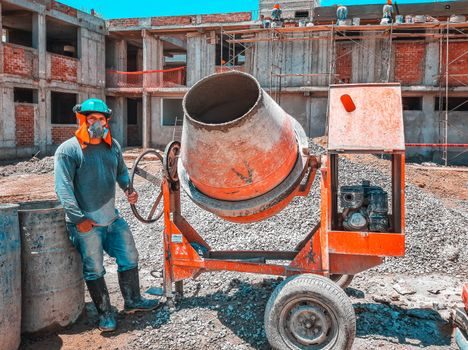
Chinese factory-gate pricing on industrial power mixers (EXW Guangdong/Jiangsu, 2026) clusters into four operating-volume bands. A 50–200 L paddle / planetary mortar mixer (1.5–4 kW, 380 V/50 Hz) lands at US$1,000–2,500; a 300–500 L planetary mixer with hydraulic lift and scraper (5.5–11 kW) sits at US$3,500–8,000; a 750–1,500 L sand/cement mix skid with PLC and water dosing (15–30 kW) prices at US$12,000–22,000; a 2,000 L+ refractory/castable pan mixer with twin-drive and weighing (45–75 kW) clears US$30,000–60,000 FOB. Quotes scale roughly linearly with motor kW because the geared motor is the single largest BOM line. [S1]
For comparison reference, the smaller-volume sand mixer class sits one band below equivalent-volume planetary units because it does not require scraper arms or hydraulic lift; that delta is typically 20–35% at the same L rating.
Motor, Reducer and Drum: The Three Cost Levers
Three sub-assemblies drive 70–80% of the bill of materials on a power mixer. Motor: a 4-pole 380 V / 50 Hz three-phase induction motor in IE2 efficiency (China GB 18613) is the default; IE3 adds 8–12% motor cost for 5.5 kW and up. Common OEM motor brands specified on quote sheets are Siemens, ABB, and domestic Wannan / TECO; specifying IE3 + inverter-duty insulation (Class F, 155 °C winding) for VFD operation is a small upcharge that prevents bearing-fluting failures on 30 kW+ units. [S2]
Drum / pan: mild-steel plate (Q235 / A36) with rubber-PU or wear-resistant liner (NM400, 6–10 mm) is the standard for abrasive sand/aggregate duty; full SS304 contact parts double pan cost and add 20–30% to the unit price but are mandatory in chemical, food, and battery-slurry applications.
Selection Criteria: Volume, Viscosity, and Discharge
Specifying a power mixer starts with three numbers: working volume (L), material viscosity / bulk density (kg/L), and discharge method. For free-flowing dry powders below 1.2 kg/L with no agglomerates, a horizontal ribbon or paddle power mixer at low rpm (30–60) is the cheapest fit. For sand-cement-resin systems above 1.5 kg/L and 50,000 cP, a vertical planetary unit with scraper is the correct class — ribbons stall. [S3]
Discharge logic is the second gate: side-gate / bottom-pneumatic dump suits low-floor dry-batch sand lines; hydraulic-tilt pan suits refractory castable (typical 30°–60° tilt, 8–15 s cycle); top-discharge / extruder suits sticky putty and battery slurry. A mistake here forces a re-build cost of 20–40% of original price, so gate spec must be locked at RFQ.
Comparison: Paddle vs Planetary vs Pan vs Ribbon
Four mixing architectures compete inside the "power mixer" envelope, and the right pick depends on viscosity, fill ratio, and clean-down frequency. Paddle (horizontal, 30–60 rpm, 1.5–7.5 kW, 50–500 L) is cheapest, suits dry powders, fill 40–60%, clean-down manual. Planetary (vertical, 10–60 rpm, 3–30 kW, 50–1,500 L) handles viscous pastes 50,000–200,000 cP, fill 30–65%, clean-down manual, scraper optional. Pan / Intensive (vertical, 5–25 rpm star-rotor, 11–75 kW, 200–3,000 L) suits refractory castable, fill 50–70%, clean-down manual to semi-automatic. Ribbon (horizontal U-trough, 20–40 rpm, 1.5–22 kW, 100–3,000 L) suits free-flowing powders and premix feeds, fill 40–60%, clean-down manual. For higher-load abrasive duty like sand, glass cullet, or proppant, refer to the sand mixer architecture, which adds PU or wear-steel liner to the pan. [S4]
A common pitfall is specifying a ribbon on a wet cohesive mix — ribbons dead-pack above ~12% moisture in bentonite/cement blends. The crossed-roller guide bearing class used in pan-mixer star rotors is the precision element that limits runout on intensive mixers above 30 kW.
Standards, Materials and Compliance
Three compliance layers govern a 2026 power mixer quote. Electrical: CE-LVD + EN 60204-1 on the control panel and IEC 60079 for any ATEX-classified zone; in China-domestic builds, GB/T 19001-2016 / ISO 9001 is the QMS basis. Mechanical: contact-part stainless must meet ASTM A240 / GB/T 4237 for SS304 / SS316L; reducer efficiency claims should be backed by GB/T 10095 or ISO 1328 gear-accuracy class 6 or better. Operational: for food, pharma, and battery slurry, 304 vs 316L is the standard fork; 316L adds roughly 30% to SS304 contact-part cost and is mandatory above 5% chloride exposure. [S5]
Factory acceptance should include a no-load run test of 30 min at rated rpm, loaded wet-mix test of 60 min, and a vibration baseline (ISO 10816-3 Class II limits, typically ≤4.5 mm/s RMS on the reducer housing). The factory test sheet is the strongest single warranty lever you can hold, because the gearbox bearing is the dominant failure mode in service.
Lead Time, Shipping and Total Landed Cost
Lead time on a standard power mixer from a Chinese OEM runs 25–40 working days for 50–500 L units, 40–60 days for 750–1,500 L skidded units, and 60–90 days for 2,000 L+ engineered systems. CIF sea-freight to a US Gulf or EU North-Sea port adds 6–9% of EXW price for a 1,500 L unit in a 20 ft OT container, 4–6% for a 500 L unit in standard 20 ft. Add 8–12% for inland drayage, customs clearance, and installation on a turnkey basis. [S6]
Voltage mismatch is the most expensive single spec-drift item on cross-border orders: 380 V / 50 Hz is the Chinese default, while 460 V / 60 Hz (US) or 400 V / 50 Hz (EU) needs transformer or rewound motor on receipt, costing US$800–3,000 per motor and 2–3 weeks of downtime. Lock the voltage spec at the RFQ, not at the PO. For sourcing patterns and hub-by-hub shipping cost data, the satellite equipment supplier map for 2026 covers the same Guangdong / Jiangsu export channels with comparable landed-cost logic. For a worked example of spec-gate purchasing on another heavy-industrial tool, see the excavator 2026 price & cost guide.
Who Power Mixers Are For, and Who Should Not Buy

They are not the right tool for: high-shear dispersion below 100 µm droplet or particle size (specify a high-shear rotor-stator instead), continuous in-line blending (specify a static mixer or twin-shaft continuous mixer), or low-viscosity fluid blending above 5,000 L tank volumes (specify a top-entry or side-entry agitator with a linear guide for the support carriage). [S1]
Buyers who should not specify an industrial power mixer are also those with no clear viscosity or batch-volume number — i.e. a "general mixer" RFQ. The price band US$1,000–60,000 is too wide to quote against, and a 30% spec error at the wrong end of that band is a 20× overspend. The disambiguation against the audio power-mixer tier is also worth stating: a US$24–75 DJ audio console [S2] is a 19-inch rack audio product, not a process machine, and the shared name is the only commonality.
Trackable signals for the next 6 months: the IE3 vs IE4 motor regulatory threshold under EU Regulation 2019/1781 will continue to push motor cost up 5–10% on new EU-bound orders; and 316L contact-part demand from the lithium-iron-phosphate cathode and anode slurry lines is tightening SS316 plate allocation, which historically lengthens lead time by 2–3 weeks at peaks.