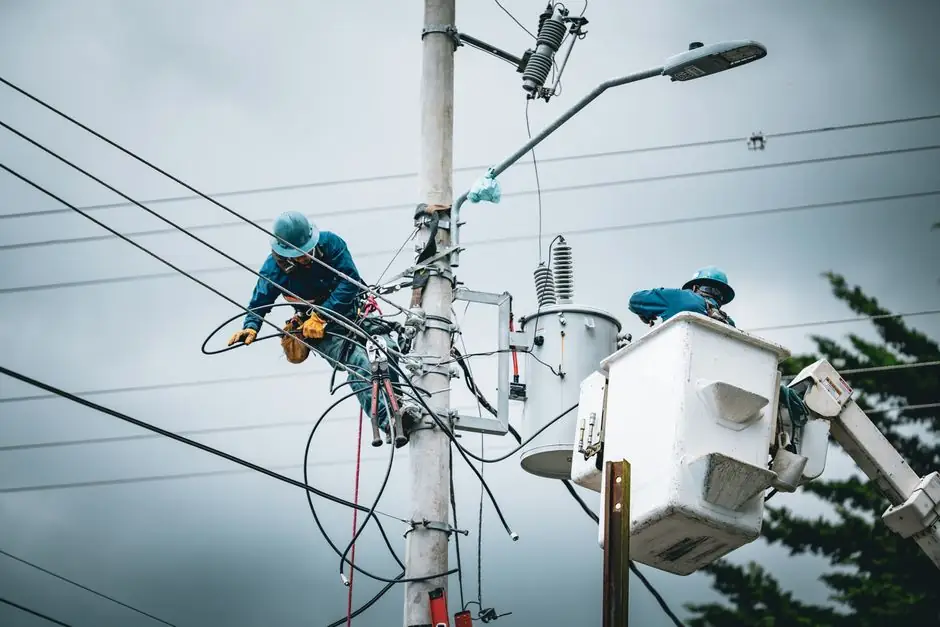
Power transformers transfer electrical power between two or more circuits through electromagnetic induction without changing the frequency.
They support generation, transmission, substations, industrial plants, commercial buildings, and residential distribution by stepping voltage up for transmission or down for utilization [S1][S5].
What a Power Transformer Does
A transformer is a static AC machine with primary and secondary windings, normally using a laminated silicon-steel core to limit eddy-current losses and insulated copper or aluminum conductors to carry current [S1][S5].
The voltage relationship follows V1/V2 = N1/N2, where V1 and V2 are primary and secondary voltages and N1 and N2 are winding turns [S5]. A step-up unit raises voltage for long-distance transmission, while a step-down unit supplies a lower voltage suitable for substations, industrial equipment, and distribution networks [S5].
The same frequency is preserved during transformation, and many units can be connected in reverse to perform the opposite function [S1]. In a typical power transformer, the insulating system and cooling arrangement determine practical loading, service life, and installation constraints.
Core Advantages for Power Systems
Transformers provide voltage regulation, galvanic isolation, and efficient transmission without moving parts, so they require no start-up sequence and can remain in service for long operating periods [S1]. Galvanic separation between windings limits fault propagation and supports safer operation of downstream equipment [S1][S2].
High-voltage transmission reduces current for the same transmitted power, which lowers resistive losses over long distances and improves delivery efficiency [S5].
For equipment that requires separated circuits, an isolation transformer can reduce transferred electrical noise, limit fault propagation, and improve power quality when its shielding and grounding are properly designed [S2].
Limitations That Affect Performance
Cooling is a central constraint because excessive temperature accelerates insulation deterioration, while radiators, fans, and oil pumps add cost, footprint, and maintenance points [S1]. A transformer cannot transform steady DC because the changing magnetic flux required for induced secondary voltage is absent, so its input must be alternating current [S1].
Electrical losses remain as heat, including copper losses, eddy-current losses, and hysteresis losses.
Isolation transformers are more expensive than ordinary voltage-changing units, and operation at low frequency can distort the secondary waveform [S2]. Incorrect secondary grounding can also remove part of the intended isolation benefit, making installation details as important as the nameplate rating.
Oil-Immersed and Dry-Type Options Compared
Oil-immersed transformers use insulating oil for both cooling and electrical insulation, making them practical for large capacities and high-power networks [S4]. Dry-type transformers eliminate flammable oil, which reduces fire and explosion concerns and supports indoor use in hospitals, schools, and commercial facilities [S4].
Neither construction is universally superior. Choose oil-immersed equipment where thermal performance and large capacity dominate, and choose dry type where fire safety, indoor siting, and reduced oil maintenance dominate.
Where Transformers Fit and Where They Do Not

Power transformers are strong candidates for transmission substations, step-up installations at generation assets, industrial feeders, building distribution, and dedicated equipment supplies [S5]. They are also appropriate for power distribution boxes and cabinet systems requiring a defined transformation ratio rather than only switching or protection.
They are not the right device for steady-DC conversion, frequency conversion, or a location where no viable cooling, protective coordination, grounding, or fire-containment arrangement exists. A transformer cannot remove harmonics merely because it has isolation windings, and galvanic isolation does not replace overcurrent protection, earthing, or surge coordination.
Current transformers form a separate measurement and protection category. They provide electrical isolation and accurate current measurement, but can saturate under high fault current, consume secondary burden power, and become bulky; split-core units allow installation without disconnecting the primary conductor but generally offer lower accuracy than solid-core units [S3].
Procurement and Sourcing Criteria
Specify rated power in kVA or MVA, primary and secondary voltages, connection vector group, impedance, cooling class, insulation level, tap range, and required ambient conditions before comparing commercial offers.
For large units, compare lifecycle factors rather than purchase price alone: radiator or forced-cooling provisions, maintenance access, enclosure fire rating, acoustic limits, transport envelope, oil containment, and expected loading profile [S4]. More detailed classification criteria are covered in Power Transformer Types: Classification and Selection.
Isolation-specific procurement should address screen grounding, electrostatic shielding, secondary neutral arrangement, frequency range, and the maximum supported load. The verbatim operating principle for conventional transformers is straightforward: “When an alternating current (AC) flows through the primary winding, it creates a varying magnetic field around the core” [S5].
Failure Modes to Control During Service
Thermal deterioration remains the core reliability risk because insulation life falls as operating temperature rises [S1]. Oil-immersed units add failure paths involving leakage, oil deterioration, contamination, and the fire consequences of a tank rupture [S4].
Protection must account for overload, overvoltage, short circuit, and temperature conditions. CT-based protection also requires attention to saturation, which can distort the measured current and impair protection performance [S3]. Isolation transformers add checks for shield continuity and grounding errors, while dry-type units need unobstructed ventilation because their cooling margin is lower than that of oil-cooled equipment [S2][S4].
Track three signals during ownership: winding and oil temperature, tap position and loading, and protection or alarm events. Pair those observations with scheduled oil testing where applicable, cooling inspection, and thermal-imaging checks to turn transformer maintenance from a generic service interval into a condition-based decision.