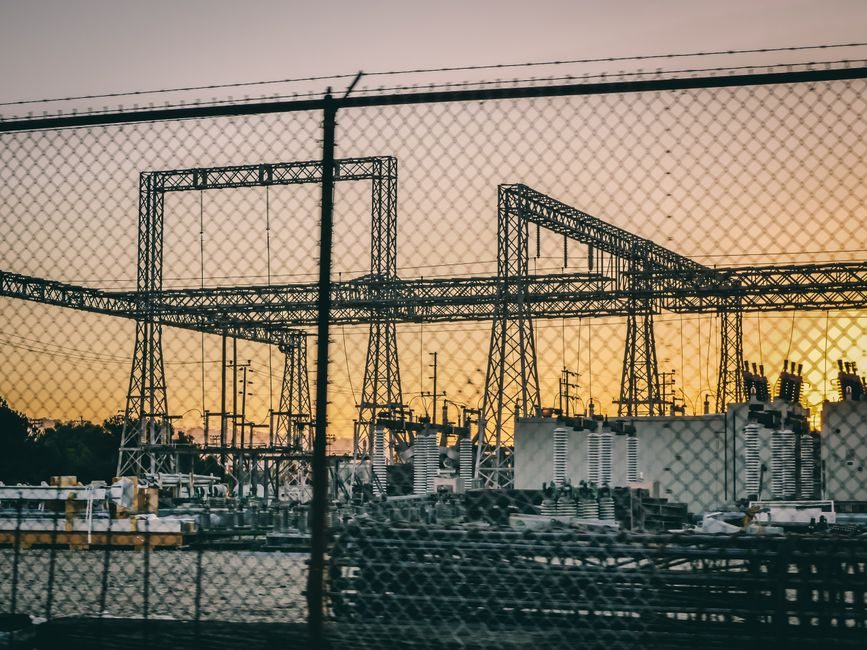
For a 2026 power transformer buy, the binding spec set is six numbers on the nameplate: rated kVA, primary voltage, secondary voltage, vector group (Dyn11 / Yyn0), impedance %IZ, and short-circuit withstand duration (typically 2 s at 25×In) — every other clause in the enquiry is a derivative of these [S2].
For oil-immersed distribution, the S11-M series (10-35 kV class, 30-2,500 kVA) is the current Chinese OEM baseline, built on rolled-grain silicon-steel cores with step-lap or wound constructions; on Made-in-China, 450 kVA 11/0.4 kV oil-immersed units for industrial/commercial service are listed in a US$1,700-1,950 factory-price band as of 2026-06-12 [S2][S4]. For related power-system context, see the Power Grid Upstream and Downstream 2026 industry chain map and the Transformer Global Production Capacity by Country 2026 article.
kVA and kV: Choose the Rating Band First, Not the Vendor
The wrong first move is vendor shortlisting before the rating is locked; the right first move is to size the load in kVA (kW / (PF × η)) and pick the standard rating tier above it, then back-calculate full-load current (In = kVA × 1000 / (√3 × kV)) for cable and breaker selection [S2].
Common 2026 distribution tiers for oil-immersed units are 30, 50, 100, 200, 315, 400, 500, 630, 800, 1000, 1250, 1600, 2000 and 2500 kVA at 10-35 kV primary, with 0.4 kV secondary as the LV default; mid-voltage secondaries at 3.3 / 6.6 / 10 kV are also in serial production for industrial and renewables step-down [S2]. For 6.6-35 kV cable and termination coordination, the power cable spec is matched to the same In figure. A typical 1000 kVA 11/0.4 kV unit weighs 2.5-3.5 t with oil, which sets the plinth and lifting plan before the order is released [S2].
Efficiency, Losses and the EU Tier-2 Question
No-load loss (Po, watts) and load loss (Pk at 75 °C) are the two loss numbers to negotiate; for an 11/0.4 kV 1000 kVA oil-immersed transformer, typical Po sits in the 1.0-1.3 kW range and Pk in the 9-11 kW range, with the exact figure dependent on core steel grade and current density [S2].
For projects in the EU or supplying EU end-users, the EU Regulation 548/2014 Tier-2 levels (effective from 2021 for liquid-immersed distribution) apply: a 1000 kVA 11 kV unit must hold no-load loss ≤ 770 W and load loss ≤ 9 100 W under the Tier-2 envelope — buyers should request the EU Tier-2 test report, not a generic ISO 9001 certificate [S2]. S11-M series designs from Chinese OEMs are typically offered as Tier-1 / Tier-2 options; the S11 designation is a Chinese efficiency designation (S11 = lower-loss class) and is not a direct substitute for EU Tier-2 certification, which requires a separate test dossier [S2].
Vector Group, Impedance and Paralleling
Vector group Dyn11 is the default for 11/0.4 kV distribution with mixed single-phase and three-phase loads; Yyn0 is the older utility default.
%IZ is set by the design and not customer-tunable in production: 4-6% is typical for 11/0.4 kV distribution units, 6-8% for 35/11 kV step-ups, and 10-12% for large rectifier or arc-furnace duty where short-circuit current must be limited. For low-voltage short-circuit and discrimination coordination, the power meter CT ratio on the LV side is matched to the bolted-fault current derived from %IZ and the upstream system impedance.
Oil-Immersed vs Dry-Type: Selection by Location
Oil-immersed transformers dominate 10-35 kV distribution because of lower cost per kVA and higher overload tolerance (typically 1.2× rated for cyclic duty); dry-type (cast-resin or VPI) is specified indoors, on upper floors, in basements without fire suppression, or in water-protection zones where a fluid leak is unacceptable [S2].
A 2025-05 PDF of SANS 60076-12 (the IEC 60076-12 loading guide for dry-type power transformers) is in circulation as a 40-page document and is the reference for cyclic and emergency overload of dry-type units in temperate and tropical climates; buyers specifying indoor dry-type should request a loading-curve calculation, not just the nameplate rating, because dry-type has lower short-time overload headroom than oil-immersed (typically 1.1× rated for cyclic duty vs 1.2-1.3× for oil-immersed in the same ambient) [S5]. For an indoor LV/MV room layout with dry-type units, the power mixer and other LV switchgear must keep the 800-1,000 mm clearance envelope on the transformer long axis. A quick comparison for the 11/0.4 kV 1000 kVA class:
- Oil-immersed: lower cost (US$1,700-1,950 for 450 kVA, scaling roughly linearly to 1000 kVA at ~US$3,500-4,500 FOB China per the 2026-06-12 listings), higher overload tolerance, requires oil bunding and fire suppression; outdoor or dedicated transformer room [S4].
- Dry-type cast-resin: typically 1.3-1.6× the oil-immersed price at the same rating, lower losses at low load, no fluid risk, IP00-IP31 enclosure; indoor installation with 1,000 mm clearance envelope [S5].
- Dry-type VPI (vacuum pressure impregnated): 1.1-1.3× the oil-immersed price, suited to humid or mildly polluted atmospheres, not for heavy industrial pollution without extra enclosure [S5].
Standards, Tests and What to Demand on the Datasheet

For IEC-jurisdiction buyers, the binding standard is IEC 60076 (parts 1-15 cover the design, temperature, insulation, sound level and short-circuit tests); for North American buyers, IEEE C57.12.00 / C57.12.90 is the equivalent; for Chinese-market supply, GB 1094 (the GB adoption of IEC 60076) is the default. The enquiry should specify "designed and tested to IEC 60076-1/-2/-3/-4/-5/-10/-11" with the test certificate list, not just "IEC standard" [S2].
The minimum test dossier for an oil-immersed 11/0.4 kV unit is: routine tests (voltage ratio, vector group, winding resistance, no-load loss & current, load loss & impedance at 75 °C, separate-source voltage withstand, induced overvoltage, partial discharge for ≥3,000 kVA); type tests (impulse, temperature-rise, short-circuit) on the design family; and special tests (sound level, zero-sequence impedance, harmonic load test) only if specified. Buyers should NOT accept a manufacturer's "factory test report" without the serial number on it and the test sheet signed by the QA engineer; this is the single most common counterfeit/document gap in cross-border supply [S2].
Where Chinese OEM Supply Sits in 2026: Price and Lead Time
On Made-in-China 2026-06-12 listings, the 450 kVA 11/0.4 kV oil-immersed transformer is posted at US$1,700-1,950 FOB; for 1000 kVA 11/0.4 kV the typical factory-price band runs US$3,500-4,500, and for 2500 kVA 35/0.4 kV it climbs to roughly US$11,000-15,000 — these are factory / FOB numbers, not landed, and exclude sea freight, import duty, foundation, oil, and commissioning [S4].
Lead time for a Chinese OEM order in mid-2026 sits at 25-40 working days for an S11-M 1000 kVA 11/0.4 kV unit, with an extra 10-15 working days if a witnessed FAT or third-party inspection (SGS / BV / TUV) is requested — factor this into the project schedule, not the procurement schedule, because the FAT booking window in the factory often runs 2-3 weeks out. Forged full-process and OEM channels through Powervolt-style industrial control transformer lines (the GP Enclosed Series is a related control-class line, not a 1000 kVA distribution class) show comparable book-to-ship windows for the 5-150 kVA class on the 2026-07-02 OEM blog [S1]. For grid and renewable step-up applications at 35 kV and above, see the Wind Turbine Transformer Supply 2026 sourcing reality and risk map. For a deeper engineering comparison, the Power Transformer encyclopedia entry covers nameplate-plate and equivalent-circuit conventions used above.
Failure Modes and Field Risks to Specify Against

The four field failure modes that drive warranty claims on 11/0.4 kV oil-immersed units are: (1) winding deformation under through-fault (mitigated by IEC 60076-5 short-circuit test certificate), (2) bushing flashover from harmonics or salt-fog (specify 12 kV outdoor bushings with 31.5 kA short-time withstand, not the default 16 kA), (3) OLTC contact wear (use an off-circuit tap-changer unless 10% V variation is a daily occurrence), and (4) tank corrosion at the base (specify hot-dip galvanised base frame + 80 µm epoxy paint, not 40 µm) [S2].
For a frame-mounted transformer, the linear guide of the tap-changer mechanism and any drawer LV terminations shares the same maintenance interval. For HV cable box-to-transformer coordination, the power cable screen bonding scheme must match the tank grounding, otherwise the screen current circulates through the tank and accelerates corrosion at the base. Sound level is often missed: 11/0.4 kV 1000 kVA oil-immersed typically runs 56-62 dB(A) at 1 m, which is above 55 dB(A) residential night limit in many EU and Chinese municipal zones — a sound-attenuated enclosure adds ~US$1,500-3,000 but is the difference between compliant and non-compliant siting [S2].
To stay in the validated 2026 supply window, lock the nameplate, efficiency tier, IEC test list, vector group, %IZ and OLTC range on the PO, and track two signals: (a) the EU EcoDesign Tier-2 revision cycle (no confirmed 2026 update in the research, so Tier-2 remains the current binding level); (b) Chinese OEM lead-time on 2500 kVA 35/0.4 kV step-up, where the booking window is the binding capacity constraint, not the catalogue price [S2][S4].