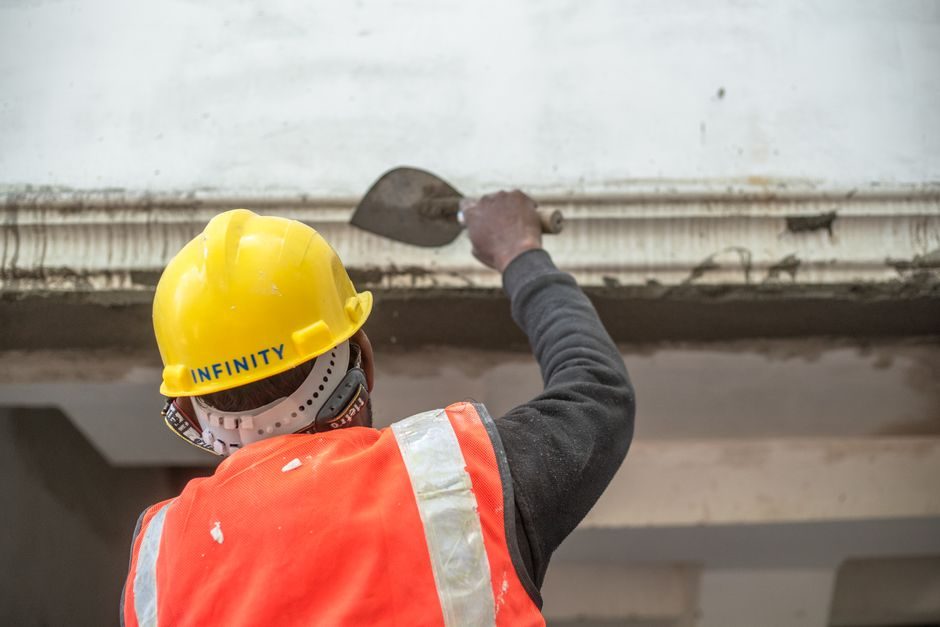
Walk-behind power trowels cover a 24-36 inch rotor envelope in the 2026 market, while ride-on machines start at 36 inches and extend past 46 inches for slabs above 5,000 sq ft; non-overlapping rotor diameters (24, 30, 36, 46 in) define the four practical size bands a buyer is forced to choose between [S5].
Entry-level ride-on trowels out of China carry a US$3,300-3,500/piece price band with 1-year warranty and CE + ISO9001:2008 certification, while bare 36-inch four-blade float pans list US$105-295/piece at one-piece MOQ and ship with 1-month seller warranty [S5]. Wacker-style 36-inch universal pan aftermarket equivalents are widely stocked on cross-border marketplaces, giving contractors a sub-US$300 consumable alternative to OEM pans [S3].
Rotor Diameter and Class Boundaries
The 24-inch class is the practical floor for edge work and small slab pours, typically paired with a 5-9 hp gas engine and a single rotor carrying 3-4 finish blades; a 30-inch unit doubles the coverage rate and is the most common rental-fleet size in 2026 stock lists from Chinese OEM catalogs [S5].
At 36 inches, the configuration shifts to twin-rotor overlap on ride-on frames; a 4-blade float pan in 12-gauge steel is the standard burnishing/panning tool on this size, weighing roughly 20-25 lb per pan section depending on steel gauge [S3]. The 46-inch class is reserved for airport taxiway, warehouse, and industrial floor pours where one pass replaces three walk-behind passes; minimum engine displacement climbs to 20-25 hp gasoline or equivalent diesel.
Power Source: Gasoline, Diesel, Electric, Battery
Honda GX160/GX270 clones (5-9 hp, 163-270 cc) dominate the walk-behind 24-30 inch segment in 2026 OEM catalogs, paired with a 360-420 rpm rotor speed range; China-origin suppliers at the US$330-385/piece tier ship 1-year warranty units with CE marking [S5].
For indoor pours, battery-powered walk-behind power trowels are emerging in 2026 rental fleets with 72 V Li-ion packs and 1.5-2 hour runtime, eliminating CO exhaust concerns; electric models remain niche versus gas, which still accounts for the bulk of contractor-grade volume [S5]. Diesel is the default above 36 inches, where the torque demand rules out small gasoline engines and the 20-25 hp Kubota-class block is the de facto choice for ride-on 46-inch machines.
Blade Configuration and Finish Quality
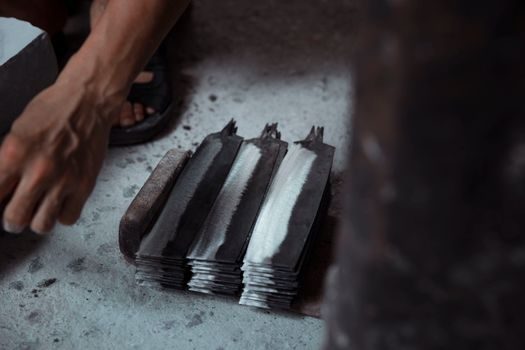
Four-blade float pans run a wider initial cut for panning and embedding aggregate; combination blades (4 finish + 2 float) extend the working range from pan to finish in one set change. A 36-inch rotor with 4 finish blades covers 6.5 sq ft per revolution at the 11.75-inch radius and finishes approximately 1,200-1,500 sq ft per hour in a typical two-operator pass sequence [S3].
Blade pitch control is the single biggest finish-quality lever: 0-5 degrees for initial floating, 10-15 degrees for intermediate, and 20-30 degrees for hard troweling; pitch is set either by a manual pitch handle (entry-level) or a hydraulic pitch control (mid- and high-tier ride-on). Using a power mixer for the slab prep stage matters as much as the trowel itself — a stiff, low-slump mix punished by under-mixing will not finish cleanly no matter how aggressive the trowel pass.
Engine Tier, Certification and Total Cost
Entry-tier Chinese OEM power trowels price at US$105-295/piece for pan packages and US$330-385/piece for complete 30-36 inch walk-behinds; mid-tier ride-ons cluster at US$3,300-3,500/piece with 1-year warranty and CE + ISO9001:2008 documentation, while premium Western brands (Wacker Neuson, Multiquip, Allen) command 2-3x the same spec for OEM-engineered frames and Honda/Kohler engine fitments [S5].
Decision criteria in one block: rotor diameter (24/30/36/46 in) sets coverage rate; engine power (5-9 hp walk-behind, 20-25 hp ride-on) sets depth-of-cut headroom; blade count (3/4/5 per rotor) sets finish aggressiveness; certification (CE, ISO9001:2008, EPA Tier 4 for diesel) sets market access — a US$330 walk-behind with no EPA engine will fail inspection on any US commercial jobsite in 2026 [S5].
Sourcing Channels and Lead Time
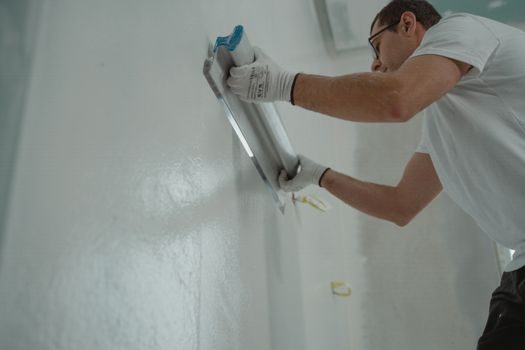
Made-in-China OEM catalogs list 1-piece MOQ for pan and walk-behind trowels, with 24-hour online support and 1-year warranty terms on machine SKUs; aftermarket 36-inch Wacker-pattern pans ship from US-based resellers at sub-US$300 price points, often with US domestic freight under 7 days [S3][S5].
For contractors running concrete-handling fleets, related capital gear lines up the same way as a pallet stacker buying guide 2026: capacity class, lift, and power source define the spec, and China OEM list price is the floor. Buyers triaging spend across a 2026 equipment capex cycle can also cross-check lifting-line items against a truck-mounted crane price & cost guide 2026 and a tower crane buying guide 2026, where spec-versus-sourcing trade-offs are spelled out the same way.
Operational Limits and Failure Modes
Walk-behind 24-inch units top out at roughly 2,000 sq ft per hour under a two-operator float-pass regime; pushing past that envelope with a 30-inch pan and same engine causes rotor bog-down and dished finish. Ride-on 36-46 inch units require a minimum 8-10 ft straight run to swing effectively — they are slab machines, not edge machines, and a 24-inch walk-behind is the correct tool within 6 inches of any wall or column [S5].
Operator certification matters: ride-on trowel incidents are one of the leading concrete-equipment injury categories, and ANSI/ASSP A10.28-2018 plus the manufacturer's operator certification is the expected compliance baseline for US commercial work in 2026. Routine failure points are spider-arm cracks (replace at first hairline), pan retainer bolts (torque to spec every 50 hours), and engine clutch springs (replace as a set, not singly). A worn power cable on battery or electric trowel models is an underrated downtime source — inspect strain reliefs at the handle junction weekly on rented units.
Selection Decision Path for 2026

Buyer rule of thumb: pick the smallest rotor that hits your coverage rate, because a 24-inch walk-behind at US$330/piece is operationally cheaper than a US$3,400 ride-on for pours under 3,000 sq ft even before you count operator cost. If your 2026 pipeline is dominated by 5,000+ sq ft warehouse or flatwork pours, a 36- or 46-inch ride-on is the only economic answer; anything below 36 inches is a walk-behind problem [S5].
For buyers running adjacent concrete-handling kit, a pallet stacker buying guide 2026 hits the same load-and-power trade-off logic and pairs naturally with this trowel spec when scoping a 2026 fleet refresh.