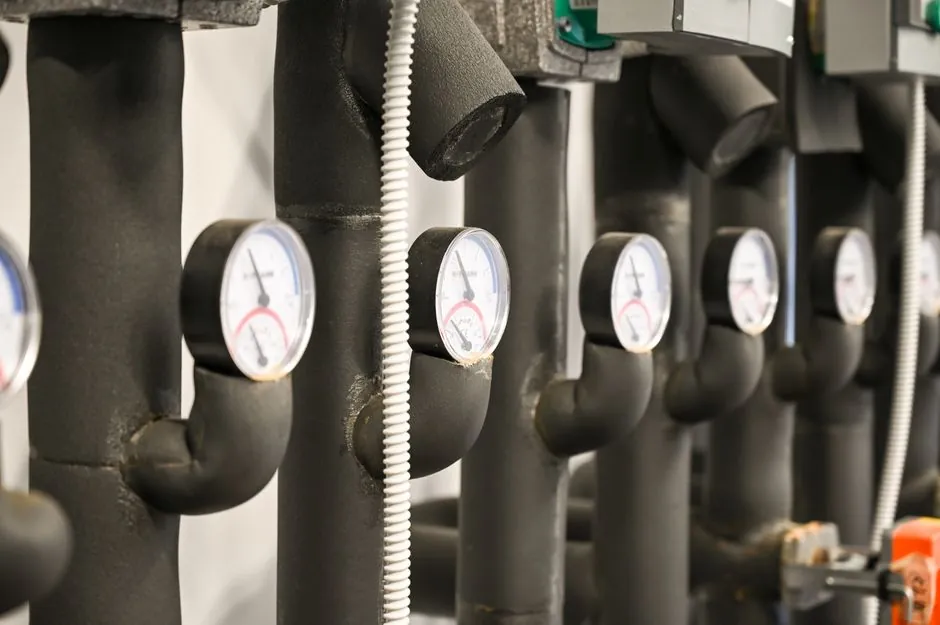
PPR cold-water lines specified for cold storage warehouses should run PN20 SDR 7.4 (or heavier) polypropylene random copolymer, stored at 5°C-30°C, UV-shielded, and fusion-welded to stainless transitions at the cold-room wall to avoid brittle cracking below 0°C [S1][S2].
Cold storage facilities typically operate between -25°C and +5°C depending on the product category (chilled, frozen, deep-frozen), so the pipe network between the chiller plant and the cold rooms is the engineering region where PPR competes directly with stainless steel and PEX-A [S6][S7].
Operating Envelope: Why Cold Storage Is a Special Case
PPR's published storage temperature band sits at 5°C-30°C, with documented brittleness risk below 5°C and creep-softening risk above 30°C, which means the pipe body is meant to live in conditioned space rather than inside a freezer box [S1].
Cold storage is split into three working regimes: chilled (+2°C to +8°C) for produce and dairy, frozen (-18°C to -25°C) for meat and seafood, and deep-frozen (-25°C to -40°C) for pharma and specialty goods; the chiller headers and the pipe chases outside the insulated envelope normally sit at 0°C-15°C, which is the only window where PPR is unambiguously safe [S7]. Inside the freezer room itself, PPR should be ruled out unless the line is continuously traced and insulated with a heat trace holding the pipe wall above 5°C.
Material Comparison: PPR vs Stainless vs PEX vs PP-RCT
Stainless steel 304/316 remains the default for freezer-room internal piping in food-grade cold storage because it tolerates -40°C without embrittlement, but a 2023 Hurckman project summary showed stainless cost roughly 1.8-2.5x an equivalently sized PPR run for the same headers [S6].
For the chiller plant and the conditioned corridors feeding the cold rooms, the practical comparison is PPR, PP-RCT (crystal-structure PPR with higher pressure at temperature), glass-fiber composite PPR, and aluminum-composite PPR, which are the four material families typically offered under one PN20/PN25 SDR band [S2][S3]. Glass-fiber and aluminum composites cut linear thermal expansion to roughly 0.05 mm/m·K versus 0.15 mm/m·K for plain PPR, which matters on long chiller plant headers that swing from 5°C start-up to 12°C steady state.
Selection rule of thumb used by warehouse MEP designers: plain PPR for buried or sleeved runs under 6 m with minimal temperature swing, PP-RCT (or aluminum-composite PPR) for risers and long overhead headers, stainless for any run that physically enters a sub-zero room without continuous heat trace [S2][S3][S6].
SDR, PN, and Pressure Rating Math for Chilled Water
Pressure rating on a PPR pipe is meaningless without the operating temperature attached, because the allowable working pressure drops as fluid temperature rises; PN20 at 20°C is not PN20 at 60°C [S2][S4].
For cold storage chiller lines (fluid typically 1°C-7°C glycol or chilled water at 4 bar working, 6 bar design), PN20 SDR 7.4 with a 20-110 mm OD range covers the majority of branch and main runs, and PN25 SDR 6 is reserved for pump discharge headers above 6 bar [S2][S4]. A typical catalog range is 20-160 mm OD with wall thickness 2.0-20.8 mm depending on PN and size, with the most common warehouse sizes sitting at 25 mm, 32 mm, 50 mm, 63 mm, and 75 mm [S4].
Designers should derate by a safety factor of 1.25-1.5 on top of the catalog PN value when the line sees pump cycling, and they should never apply the room-temperature PN number to a glycol line that will see brief 40°C excursions during low-load warm-up, because that is the failure mode documented in field failure analyses [S2].
Storage and Handling on the Warehouse Site
PPR delivered to a cold storage build site has to be stored indoors at 5°C-30°C with low humidity, shielded from UV, and acclimatized for at least 24 hours before fusion welding if the pipe temperature is below 10°C [S1].
Below 5°C the pipe becomes measurably more brittle and cracks during handling, so for winter deliveries in northern climates, climate-controlled staging inside a heated warehouse storage area is the standard mitigation, and reduced stacking height plus longer fusion-heat soak times are typical field compensations [S1]. Above 30°C, pipes soften enough to deform under stack weight, so a pallet racking layout with capped central supports and a max stack height of roughly 1.5 m is the rule.
Inventory rotation is FIFO, because polypropylene random copolymer ages in storage and a 12-month on-site stockpile is the practical ceiling before a re-certification of the fusion welding parameters is needed; this aligns with standard PPR pipe storage cage practice on active build sites [S1].
Jointing Method and Cold-Room Wall Penetrations
Socket fusion welding at 260°C is the standard PPR joint and produces a homogeneous joint stronger than the pipe body when done correctly, but cold-room wall penetrations must transition to stainless steel flanges or threaded stainless transitions because no PPR fitting is rated for repeated -25°C to ambient cycling at the wall sleeve [S4][S6].
For the chiller plant side (which is the warm side of the wall), continuous PPR from the chiller to within 300-500 mm of the cold-room envelope is acceptable and is in fact the common cost-saving detail, with the stainless transition clamped to the outside of the insulation jacket [S6]. Inside the cold room, stainless 304 with TIG-welded joints or stainless press-fit is the realistic choice, and PEX-A with EVOH oxygen barrier is a third option for under-floor heating coils embedded in the cold-room slab during initial construction.
Where PPR Is the Wrong Choice
PPR should be ruled out for any pipe that physically operates below 0°C for more than brief transients, for outdoor exposed roof drainage on cold rooms where winter ambient hits -20°C, and for any ammonia refrigeration plant where the fluid is not water but a refrigerant, because PPR has no published compatibility rating with ammonia [S6][S7].
It is also the wrong choice for fire sprinkler risers inside a cold storage facility, where the relevant code requires a wet or dry system listed for that hazard and the listing does not include PPR; a separate steel or CPVC sprinkler riser is mandatory, and the PPR chilled-water line should be kept physically separated from the sprinkler trim by at least 50 mm clearance to allow fusion rework access [S6].
Verification Standards and Sourcing Checklist

For European projects the relevant reference is DIN 8077/8078 (PPR pipe dimensions and quality) plus EN ISO 15874 for hot and cold water PPR systems, and for pressure derating at temperature the ISO 13781 protocol is the cited method; North American projects typically reference ASTM F2389 for PPR pressure-rated pipe and CSA B137.11 [S2][S4].
For a cold storage warehouse bid, the verification checklist before signing the PO is: (1) PN20 or PN25 stamped on the pipe at 1 m intervals; (2) manufacturer test certificate to EN ISO 15874 or ASTM F2389; (3) declared 50-year design life at the actual operating temperature, not at 20°C; (4) UV-protected packaging and a 5°C-30°C storage clause in the delivery contract; (5) fusion welding equipment supplied or specified with a temperature calibration log; and (6) a clear transition detail at every cold-room wall sleeve to stainless 304/316 [S1][S2][S4][S6].
Trackable signals for the next quarter: revised EN ISO 15874 temperature-derating tables for PP-RCT material in the 0°C-10°C band, more cold-storage project listings for aluminum-composite PPR on long chiller headers, and any ammonia-refrigeration code clarification that would either open or close the door to PPR in refrigerant-side piping. For plant engineers building a chiller plant design of record, the working fluid coupling selection guide for industrial drives and a bulk bag and pallet spec map for warehouse receiving are adjacent references that share the same PN/SDR and stack-height decision logic.