
Pressure switch selection is dominated by four numeric envelopes: set-point range, proof pressure, burst pressure, and on-to-off differential (deadband), each of which narrows the candidate list before electrical form even enters the discussion [S3].
The same selection form used by OEM switch houses (MPL, Micro) captures electrical load, switching element form (SPST/SPDT, N/O or N/C), logic, AC/DC circuit, medium, contaminants, min/max temperature, proof/burst pressure, pulsation Y/N, and the approvals matrix (UL, CSA, CE, PPAP, RoHS, REACH) on a single page [S3]. Buyers who skip any one of these fields routinely receive an envelope-matched switch that fails the first cycle on the test bench.
Set-point range and switching technology: where the catalog splits
The first hard cut is set-point range, because the sensing element (diaphragm, bellows, piston, MEMS strain gauge) and the housing scale with that range: MPL publishes 500 Series down to 0.05 inH2O, 600 Series from 1.5 inH2O to 45 PSI, and 800 Series from 10 PSI to 250 PSI in an all-aluminum-zinc alloy housing for heavier-duty work [S3]. The 9375 Series is positioned for HVAC air-proving duty where reliable differential detection across low static pressures is the acceptance criterion [S3].
For pneumatic factory automation, SMC groups its pressure switch and sensor selection by switching type (mechanical pressure switch, solid-state pressure switch, pressure sensor with display) and by the smallest port/thread the user's manifold will accept, then walks the buyer through pressure range, output spec, and mounting footprint [S4]. The same flow-chart discipline (application examples first, then numeric range, then output, then fitting) is what separates a five-minute selection from a three-week RFQ cycle.
Proof pressure, burst pressure, and the safety ratio
Proof pressure is the maximum pressure the switch can withstand without permanent set; burst pressure is the higher number at which the housing or diaphragm is expected to fail catastrophically, and both belong on every datasheet and every purchase spec [S3]. A common engineering rule is to size proof pressure above the system's maximum spike (pump dead-head, water hammer, relief-seat chatter) with margin, and to keep normal operating pressure comfortably below the proof rating.
Where the source document does not give a numeric ratio, the buyer should request it: form fields for proof and burst pressure are listed alongside set point in the MPL enquiry form because vendors do not publish the same ratio across product lines [S3]. The same logic applies to vacuum and differential switches, where the proof rating has to be checked on both sides of the diaphragm independently.
Deadband, hysteresis, and on-to-off differential
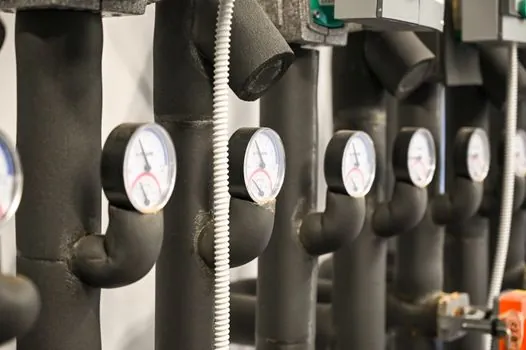
Deadband (also called on-to-off differential, hysteresis, or repeatability band) is the pressure drop between the cut-out and the next cut-in, and it is the single number that determines whether a switch is usable for pump control, compressor unloading, or filter-differential alarming [S3]. A wide deadband (several PSI on a 100 PSI range) is fine for a low-cycle compressor unload, but it will chatter a small pneumatic pump to death in a few weeks.
MPL describes the 600 Series as offering SPDT snap-action switching with an explicit on-to-off differential, which is the engineering term buyers should write into the spec rather than the looser word "hysteresis" [S3]. For solid-state switches, deadband is often expressed as a percentage of set point and can be field-adjustable, but it will always trade off against repeatability and response time, so the three numbers must be read together.
Electrical form, load, and circuit type
Electrical form is the second hard cut: SPST vs SPDT, N/O vs N/O, inductive vs resistive load, AC vs DC circuit, and the actual current at the contact voltage all have to be on the spec sheet before the part number is fixed [S3]. A mechanical snap-action switch rated 5 A at 250 VAC will not survive a 2 A DC inductive solenoid load without arc-suppression, because DC does not cross zero and the contact will weld on the first break.
Solid-state switches (usually a transistor output) remove the contact but introduce leakage current, voltage drop, and a limited switching frequency, and they will not carry the inrush of a solenoid valve or motor starter without derating. For a discussion of how that electrical interface lines up with the rest of the control loop, see the pressure transmitter and pressure sensor reference pages, which cover the analog and digital output side that a switch usually interlocks with.
Media compatibility, temperature window, and approvals
Wetted materials (diaphragm alloy, O-ring elastomer, port metallurgy) must match the process medium; a nitrile diaphragm that is fine for plant air will fail in weeks on a lubricant aerosol or a mild solvent, and a stainless diaphragm may still be attacked by chloride-bearing condensate [S3]. The enquiry form asks for medium, contaminants present, and min/max temperature as separate fields for exactly this reason: vendors cannot assume a generic "oil" or "water" service.
Approvals are the other gate: UL and CSA for North American panels, CE for the European Union, PPAP for automotive tier-one supply, and RoHS plus REACH for any product sold into the EU after the substance restrictions came into force [S3]. Hazardous-area work adds ATEX or IECEx zones, and a pressure measurement project that mixes explosion-protection requirements with hygienic or food-grade wetted parts needs those approvals written into the RFQ, not added at the panel-shop stage.
Pulsation, vacuum, and differential service
Pulsation is a yes/no question on the enquiry form because a reciprocating pump or a compressor discharge will destroy an un-snubbed pressure switch in days, regardless of how generous the proof pressure looks on paper [S3]. The standard counter-measures are a remote-mounted snubber, a small captive volume between the switch and the process, or a switch with an internal pulsation damper rated for the duty cycle.
Vacuum and differential switches are not interchangeable with a standard pressure switch: a vacuum switch is set to actuate on falling absolute pressure, and a differential switch compares two ports (filter delta-P, across a coil, across a heat exchanger) rather than sensing against atmosphere [S3]. For tank-level and pump-shutoff work, a related decision is laid out in the magnetic level gauge vs level switch comparison, which uses the same set-point / deadband / proof-pressure logic at a different process variable.
Comparison: four pressure switch families against selection criteria

The four families line up against the four dominant selection criteria roughly as follows. Miniature low-pressure switches (MPL 500 Series, 0.05 inH2O and up) win on sensitivity and cost, but they lose on proof pressure and on any medium that attacks the elastomer diaphragm [S3]. General-purpose SPDT snap-action switches (MPL 600 Series, 1.5 inH2O to 45 PSI) win on switching versatility and on a clearly specified on-to-off differential, and they are the default for compressor-unload and filter-delta-P duties [S3]. Heavy-duty higher-pressure switches (MPL 800 Series, 10 to 250 PSI) win on proof/burst margin thanks to the all-aluminum-zinc alloy housing, at the cost of resolution at the low end of the scale [S3]. HVAC air-proving switches (MPL 9375 Series) win on differential resolution and on a temperature window matched to ductwork, but they are not a general-purpose substitute for industrial hydraulics.
Buyers who need continuous analog feedback rather than a discrete contact should pivot to a pressure transmitter or a pressure sensor; a pressure switch is the right part only when the load calls for a contact closure at a threshold, not a 4-20 mA or digital signal proportional to pressure.
Who should NOT pick the general-purpose SPDT switch
The general-purpose SPDT mechanical pressure switch is the wrong part for three common service cases. First, high-cycle pneumatic or hydraulic pump control (more than a few cycles per minute) where the snap-action contact will wear out long before the diaphragm does, and a solid-state pressure switch with no moving contact is the only realistic option. Second, hazardous-area service where a non-certified mechanical switch cannot be used and an ATEX- or IECEx-rated switch with a certified enclosure and a documented entity concept is mandatory. Third, sanitary or hygienic service (food, beverage, pharmaceutical) where the standard industrial housing and elastomer set will not pass clean-in-place validation; here a purpose-built sanitary pressure switch with a polished diaphragm and tri-clamp connection is the only acceptable answer, and a generic SPDT unit should be excluded at the RFQ stage. [S3]
Field signals to track between now and the next RFQ
Three trackable signals will reshape the next selection cycle. First, the proliferation of IO-Link and other industrial Ethernet protocols on pressure switches, which lets a discrete switch report set point, deadband, and cycle count over the same cable that carries the on/off contact, and which is already standard in several SMC pressure switch lines [S4]. Second, tighter RoHS and REACH substance declarations, which have already moved from checkbox to mandatory attachment on the enquiry form and will continue to be enforced at the panel-shop level [S3]. Third, the spread of PPAP and similar automotive-quality deliverables into non-automotive OEM work, which is now requested alongside UL/CSA/CE on the same form rather than as a separate program [S3]. For a related decision tree on a different process variable, the vacuum gauge selection criteria for water treatment skids article uses the same set-point / proof / approvals logic in the opposite pressure direction.