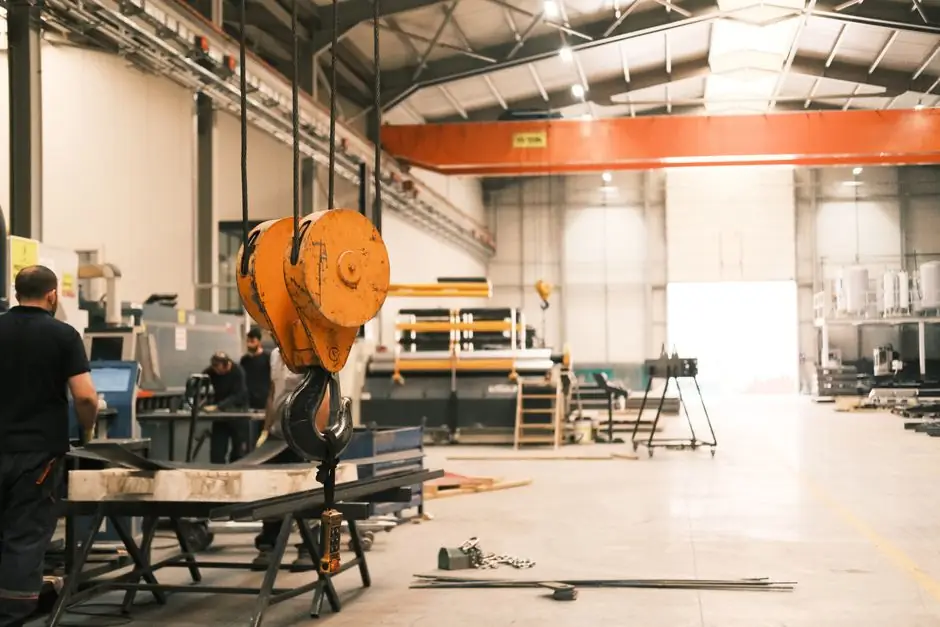
Manual hand-push overhead trolleys and motor-driven overhead conveyors share the same track and trolley hardware, but the engineering crossover sits at three measurable boundaries: per-hook load, line length per drive, and required throughput speed [S1][S3].
Push trolleys on enclosed track are generally rated up to 250 lb (115 kg) per individual load, while I-beam hand-push layouts are commonly specced across light (1-75 lb), medium (75-200 lb), and heavy (200-1200 lb) hook classes [S2][S5]. Motor-driven systems typically use a single drive to power 700-800 ft of conveyor at a hair-dryer-class energy draw, and maintain synchronous chain motion where every carrier advances together [S4][S6].
Decision Cutoffs: Load, Length, Speed
The first cut is per-hook load: anything under 250 lb on enclosed track and under 75 lb on I-beam can ride a hand-pushed trolley with low-friction bearings, no motor, and no electrical controls, which is the definition of a manual hand-push system [S3]. Loads above those thresholds, or any line that must index, accumulate, or stop selectively, fall outside what a push trolley can deliver because the operator must physically overcome the rolling friction of the entire carrier string [S1][S7].
The second cut is line length per drive: a single motor typically powers 700-800 ft of powered overhead conveyor, consuming less energy than a typical hair dryer while moving every carrier in lockstep [S4]. Manual push systems have no such hard length ceiling, but practical operator effort climbs sharply past a few hundred feet of loaded track, which is why short hand-push zones are common inside cells while long trunk lines go motorized [S3][S6].
The third cut is speed and takt: manual loading and unloading is treated as 10-25 FPM, the practical band where a worker can comfortably place or remove a part, while motorized monorails run at the synchronized speed set by the drive and VFD [S5]. Where the process needs predictable takt time, steady throughput, and disciplined movement, motorized monorail or power and free overhead conveyor is the correct class [S3].
Comparison Matrix: Push Trolley vs Motor-Driven
Side by side on the four criteria that drive a specification:
1. Per-hook load: hand-push enclosed track rated to 250 lb per load; I-beam push covers 1-1200 lb by class (light/medium/heavy), but realistic continuous hand-push comfort sits at the low end. Motorized monorail handles the same I-beam range and adds indexing at workstations [S2][S3][S5].
2. Line length per drive: hand-push has no drive, so length is limited by operator effort, typically a few hundred feet per zone. Motorized covers 700-800 ft per single drive with one motor [S3][S4].
3. Speed: 10-25 FPM for manual load/unload; motorized speeds are set by the drive and VFD, and all carriers move synchronously [S5][S6].
4. Capital and operating cost: hand-push needs no motors, drives, or electrical controls, which makes it the most economical entry point. Motorized adds a drive unit, take-up, and controls, but offsets labor with automated routing through ovens, paint booths, and robot cells [S3][S4].
Who Push Trolley Is For, and Who It Is Not For
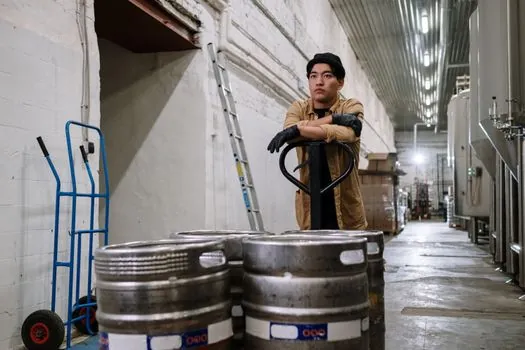
Hand-push fits work cells, light assembly, storage rooms, finishing operations, and any layout where flexibility, low cost, and quiet operation matter more than throughput [S3]. It also fits as a bridge between motorized zones, or as a future upgrade path, because the same I-beam or enclosed track components can be motorized later [S2].
Hand-push is the wrong choice for paint lines, bake ovens, caustic washers, and any process where the load must pass through an environment humans cannot enter, or where the chain must keep moving while operators are absent [S4]. It is also the wrong choice for power-and-free requirements, where carriers must accumulate, stop independently, change speed, and route through spurs and queues, because those capabilities require a second free rail and a powered drive [S3][S5].
Motor-Driven Architectures Worth Specifying
Inside the motorized family, three architectures cover most plant needs. Powered monorail uses one chain in one track, all carriers move together, and a single drive indexes or runs continuously at a set speed, which suits paint systems, assembly lines, and high-volume continuous flow [S3][S6]. Power and free uses two tracks, a powered chain on the upper rail and a free load-carrying rail below, so individual carriers can stop, accumulate, and re-dispatch, which suits selective stopping, precision sequencing, and integration with automated assembly [S3][S5]. Friction drive uses motor-driven rotating tubes in place of a chain, which lowers maintenance and noise on certain enclosed-track geometries, a tradeoff worth weighing where lubricant contamination must be avoided [S9].
For long, high-throughput lines the right comparison is overhead conveyor architecture against belt conveyor and chain conveyor alternatives: overhead wins when floor space is the bottleneck and the load is awkward, heavy, or has to ride through ovens and paint booths that floor conveyors cannot enter [S4][S7].
Track Hardware, Take-Ups, and Sourcing Detail
Track style is one of the two big hardware forks. Enclosed track comes in round (1-5/8 in and 2-3/8 in diameter) and rectangular profiles, with the chain nearly fully covered by the track, which improves safety and keeps contamination off the bearing surfaces [S2][S4][S5]. I-beam track uses 3 in, 4 in, or 6 in high-carbon I-beams, which is the heavy-duty format and is the format that supports the 200-1200 lb heavy-duty class [S2][S5].
Take-ups come in two basic types: manual (screw type) and automatic. Manual take-ups require more maintenance but have a lower purchase cost; automatic take-ups hold chain tension as the chain stretches over years of service, which matters on long motorized runs [S8]. Layout best practice is to place the drive at the high point of the system with the take-up in front of the drive, preferably at the low point but close to the drive, so slack chain is pulled away from the drive sprocket [S5].
Failure Modes and Constraints Buyers Miss
Hand-push systems fail in practice when the operator is asked to move too many loaded trolleys at once, because the rolling friction of the string is not isolated per carrier. Adding more carriers does not scale linearly with effort, and once a zone exceeds roughly a few hundred feet of loaded track, productivity drops and operators start demanding a motor [S1][S3].
Motorized systems fail when the chain pull calculation is wrong, when the take-up is placed down-line of the drive, when vertical and horizontal curves are stacked without one trolley spacing of straight track between them, or when the load is sized to the wrong hook class [S5]. A useful field signal: if your manual overhead conveyor team is calling for assist on loads that the original spec said were hand-push rated, the load class was misread at quotation, not at installation. The same logic applies to selecting motors and drives against thermal limits, which is the kind of decision detailed in IEC 60034-11 built-in thermal protection guidance.
Selection Rules and What to Track Next
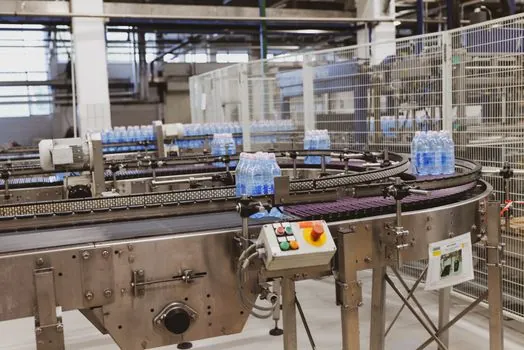
Use hand-push when per-hook load is at or below 250 lb on enclosed track, line length per zone is short, speed stays in the 10-25 FPM manual band, and there is no need for accumulation or routing through harsh environments [S3][S5]. Specify motorized monorail when takt time, synchronous flow, paint, baking, or 700-800 ft runs from one drive are required [S3][S4][S6]. Step up to power and free when carriers must accumulate, stop independently, or route through spurs and queues [S3][S5]. Two trackable signals: vendor-published per-hook load ratings versus real installed loads, and energy draw per foot on motorized lines, both of which are the numbers that catch mis-specification early.