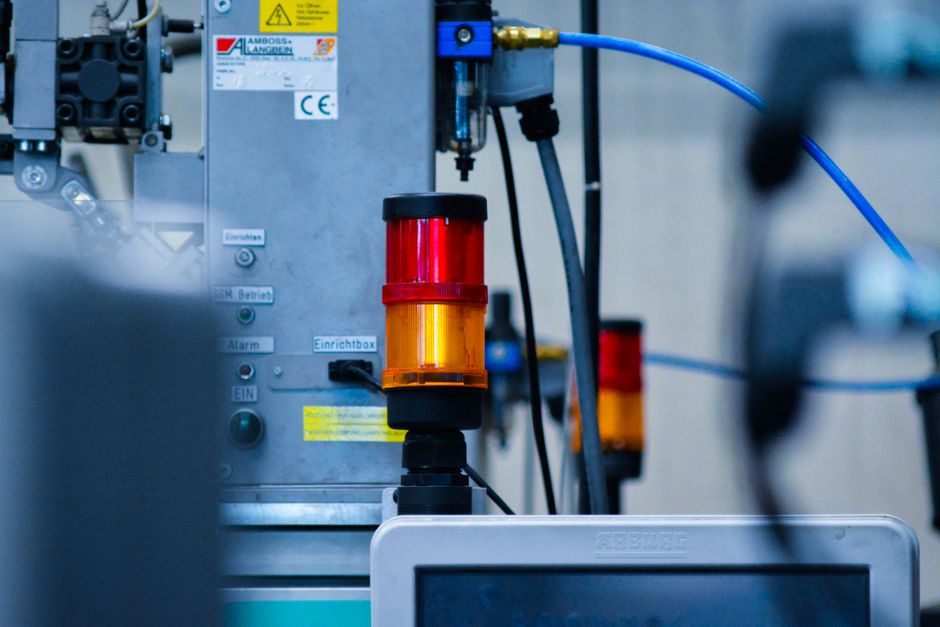
Rare-earth hydrometallurgical lines rely on instrumented settler batteries, pH/ORP loops, and conductivity probes to maintain the multi-stage countercurrent solvent-extraction trains that separate lanthanides whose ionic radii differ by only 0.01 Å between adjacent elements [S3].
Process-control stacks for these lines span pressure transmitters, multifunction process calibrators, control valves, magnetic flow meters, and conductivity/resistivity probes — the same generic catalogue an industrial distributor such as Procontrol Instrumentation lists for mining-sector service work, including digital panel meters, thermocouples and thermowells, ultrasonic level, and signal converters [S1].
Separation chemistry defines the control problem
Lanthanides form isostructural compounds with the lanthanide contraction producing only a 0.15 Å decrease in ionic radii across the 14-element series, so separation depends on amplifying subtle bonding differences rather than on bulk chemistry [S3]. Countercurrent solvent extraction with mixer-settlers or centrifugal contactors has historically been the industrial workhorse, while selective borate crystallization has been demonstrated as an alternative route yielding six distinct solid phases from a single reaction condition and enabling solid/aqueous and solid/solid Nd/Sm and Nd/Dy splits with controlled reaction kinetics [S3].
For a process engineer, that chemistry translates directly into a measurement problem: every stage needs tight pH control (typically 1–4 depending on extractant), aqueous-phase ORP, and temperature-stable flow to keep distribution ratios from drifting between stages.
Core sensor stack and where each one sits
The generic industrial sensor catalogue that an instrumentation distributor exposes — flow meters, flow switches, level ultrasonic/radar, pressure transmitters, temperature transmitters, signal converters, and control valves with positioners — maps almost 1:1 onto the measurement nodes a rare-earth SX plant actually needs [S1]. pH and ORP probes sit in the aqueous feed and raffinate lines; magnetic flow meters sit on organic and aqueous phase lines because the streams are conductive and abrasive; conductivity probes give a cheap proxy for total dissolved rare-earth concentration between stages; radar or ultrasonic level is the standard for settler interface and organic-phase inventory.
At the crystallizer step the variables change: borate-crystallization selective-phase separation demands reaction-kinetics control, and temperature uniformity across the crystallizer is the dominant process variable, so RTD-grade thermocouples in thermowells, not surface probes, are the practical choice [S1].
Comparison: instrumentation by node and signal type
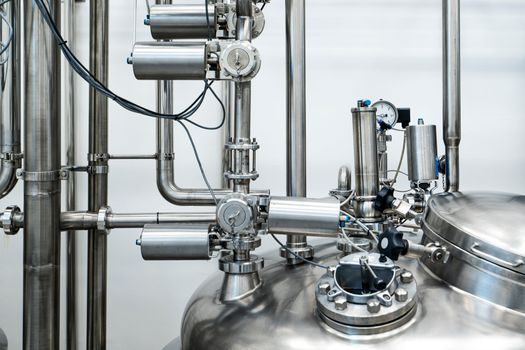
Across the four dominant measurement nodes of a rare-earth separation train, the decision criteria line up as follows. On settler interface level, non-contact radar wins on accuracy in foaming organic phases; contacting conductivity probes win on capex and on giving a continuous aqueous/organic interface proxy. On aqueous flow, magnetic flowmeters handle conductive slurries but fail on the low-conductivity organic phase, where Coriolis or positive-displacement meters are the working alternative. On pH, glass-electrode probes with double-junction reference cells handle the HF-bearing digester feed, but require frequent recalibration because of reference poisoning. The signal layer downstream of all of this is normally 4-20 mA HART on the analogue side, with PROFIBUS PA or Foundation Fieldbus on the bus side where the plant has already invested in a digital backbone. [S1]
Selection criteria engineers should apply
Specifying instrumentation for a rare-earth line starts from four filters: chemistry compatibility (HF, HCl, H2SO4, organic extractant), solids handling (settler crud, pregnant leach solution with suspended fines), signal infrastructure (existing DCS/PLC bus), and calibration access (probe retraction vs. inline). Chemistry compatibility eliminates standard elastomers early — any wetted O-ring exposed to organic phase needs PTFE or Kalrez, and HF service rules out glass-bodied instruments above trace concentrations. [S1]
Solids handling rules out small-bore magnetic flowmeters in settler underflow lines and pushes the spec toward earth-ground testers and conductive liners rated for abrasive service. For calibration, hot-tap retractable pH assemblies reduce the maintenance cost on settler sample lines where fouling is the dominant failure mode, and the calibrator of choice on the bench is a multifunction process calibrator rather than a single-function unit because it covers pH, mA, V, and RTD in one box.
Failure modes and constraints
The single largest failure source on rare-earth SX trains is reference-junction poisoning of pH probes by organic-phase carryover, which shows up as a slow drift rather than a step change and silently degrades stage efficiency. The second is settler interface misreading, where crud builds up at the aqueous/organic boundary and fools ultrasonic sensors into tracking the crud layer instead of the true interface. The third is extractant loss through valve seat failure on the organic recycle loop, which is why ceramic or soft-seated control valves are specified rather than metal-seated globe valves for that service. [S1]
Standards, sourcing, and what a buyer actually verifies
For hazardous-area electronics on a rare-earth plant, ATEX/IECEx-certified instruments with stainless or GRP housings are baseline; the actual hazardous-area classification depends on solvent flash point and ventilation, not on the rare-earth chemistry itself. Sourcing is driven by sensor type and the long-tail of spares, which is exactly the model an industrial distributor like Procontrol Instrumentation — established 1988, servicing steel, petro-chemical, paper and pulp, food and beverage, and mining sectors out of Springs, South Africa — has historically supplied through its broad-line catalogue rather than single-vendor OEM agreements [S1].
Two trackable signals for the next 12 months: publication of further pilot-scale data on the borate-crystallization route beyond the Nd/Sm and Nd/Dy proof-of-concept already in the literature [S3], and continued migration of SX-plant instrumentation onto digital bus protocols where v-process line and Foundation Fieldbus segments are being added during brownfield expansions of Chinese SX capacity.