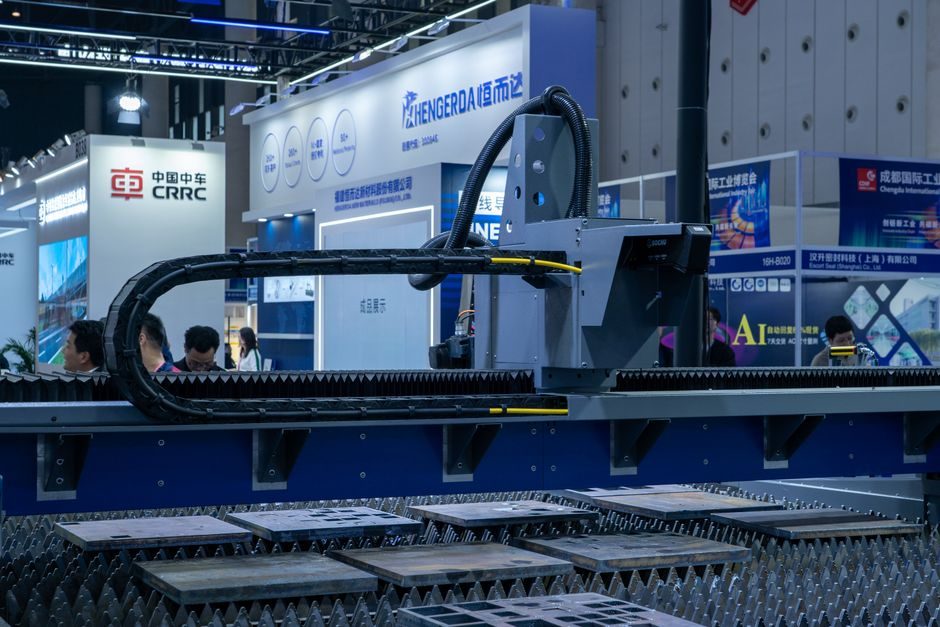
Rare-earth smart manufacturing in 2026 centers on automating the sintered NdFeB / PrFeB magnet line — from hydrogen decrepitation and jet milling through press, sinter, aging, surface treatment and final magnetization — with PLC/SCADA cells, vision-based grain inspection, MES traceability and an IoT sensor layer that feeds real-time KPIs back to process engineers [S5][S4].
NdFeB magnets account for the largest single share of the permanent-magnet market by value and have dominated permanent-magnet applications since the 1980s due to their high energy product (BH)max and coercivity (Hcj) [S4]. Smart-manufacturing deployments now treat each batch as a traceable digital entity, with eddy-current and XRF testing plugged into the same data spine as smart meters upstream and pressure transmitters on the sintering furnace atmosphere.
Where Rare-Earth Smart Manufacturing Actually Runs
NdFeB smart factories combine industrial automation (PLCs, drives, robots) with information technology (MES, ERP, edge gateways) to predict, control and improve performance on the same physical line [S5]. The scope is end-to-end: weighing and alloy batching, hydrogen decrepitation, jet milling under inert gas, magnetic-field pressing, vacuum sintering at roughly 1,000–1,150 °C, two-stage aging, surface treatment (Ni-Cu-Ni electroless plating or epoxy coating), magnetization up to 3–5 T, and final inspection [S4].
System integrators such as Top Degree, Allied Automation and Haitian Smart Solutions package this stack for end users: Top Degree lists custom-built automation, in-house assembly and system integration as core capabilities [S1]; Allied Automation positions itself as a "trusted partner for smart manufacturing solutions" carrying world-class automation brands [S3]; Haitian Smart Solutions covers smart-factory planning, auxiliary equipment and automation, and digital information systems under one roof [S6]. Rockwell Automation remains the dominant US-side platform supplier for PLC, drive and motion control on these lines.
Process Steps and Sensor Stack
The sintered NdFeB process is a long, atmosphere-sensitive sequence. Hydrogen decrepitation (HD) takes the cast alloy at room temperature into a friable hydride; jet milling then refines the powder to a 3–5 µm median particle size under N2 to keep oxygen below roughly 1,000 ppm — the upper bound process engineers target to keep coercivity losses in check [S4].
On the line, an Industry 4.0 cell typically carries: load-cell weighing tied to recipe management; thermocouples plus pressure transmitters on vacuum sintering furnaces (typical hot zone ≈ 1,060–1,150 °C at 10^-3 Pa class vacuum); oxygen-analyzer feedback on glove boxes; eddy-current and XRF stations for grade verification; and machine-vision cells for surface defects and dimensional checks before magnetization. The 2026 reference stack — analogously to broader additive-manufacturing material platforms — couples these instruments to a unified MES so that a single batch serial number carries alloy chemistry, sintering curve, coating thickness, BH curve, and line/equipment IDs from inbound ore to ship-out magnet [S5].
Selection Criteria: What Specs Drive the Build-Out
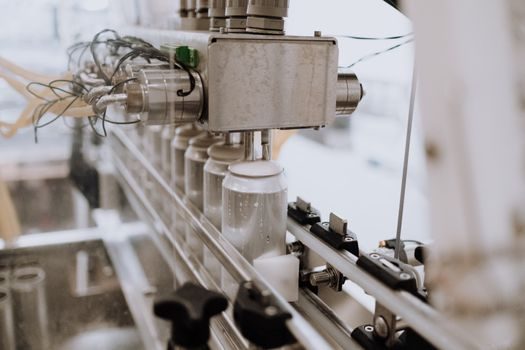
Engineers evaluating a rare-earth smart-factory build should screen suppliers against four concrete criteria, in this order: (1) trace-element tolerance on grain-boundary diffusion heavy-rare additions (Dy/Tb), typically held to ±0.1 wt% to keep Hcj swing within ±1.5 kA/m per batch; (2) oxygen pickup budget across HD + jet mill + transfer, commonly capped at 200 ppm per stage; (3) sintering temperature uniformity inside the hot zone, with reference uniformity of ±5 °C across the load for a ~1,100 °C setpoint; (4) data freshness from furnace-to-MES, where a ≤ 1 s publish interval is the practical floor for closed-loop recipe adjustment [S4][S5].
Use-case fit also matters. EV traction-motor magnet lines need sub-2% flux spread and Dy-lean grain-boundary diffusion grades to survive 180 °C continuous rotor operation. Wind turbine generator magnet lines tolerate higher Dy content for thermal margin but punish missed shipments, so MES-side WIP visibility is the deciding factor. Industrial servo and robotics magnets are smaller-batch, higher-mix — they win on smart camera-based dimensional and defect inspection rather than throughput.
Who This Stack Is For — And Who It Is Not
The rare-earth smart-manufacturing build is built for producers serving EV traction motors, wind turbine generators, industrial servos, robotics and HVAC compressors, all of which need batch-level magnetic-property traceability and Dy/Tb grain-boundary diffusion control to hit the 180 °C+ thermal envelope demanded by OEMs [S4]. It is also a fit for any magnet plant trying to break out of the commodity N35/N42 grade band into N52, N54SH, N40UH or N42EH grades, where batch-level magnetic-property data is the only way to defend a price premium.
It is NOT for small-scale job shops running bonded NdFeB (compression or injection molded) — those processes tolerate much looser control and do not justify a full MES rollout. It is also the wrong fit for ferrite or SmCo magnet lines, where the metallurgical failure modes are different and the smart-manufacturing payback is far weaker. Chinese vendors in particular have been shipping this stack into Europe: People's Daily reported that Chinese smart-manufacturing products — AI, cloud, drones, NEVs — have gained traction in European markets and contributed to the Paris 2024 Olympic opening ceremony, signaling that European buyers are now comfortable with Chinese-origin automation platforms.
Comparison: Main Smart-Manufacturing Platform Options
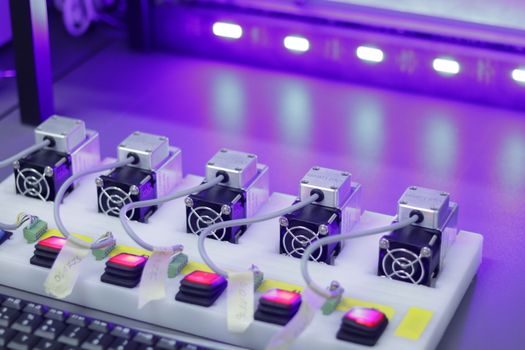
Four platform archetypes dominate 2026 rare-earth smart-manufacturing bids, and they line up differently against the four criteria a process engineer cares about: trace-element tolerance, oxygen budget, sintering temperature uniformity, and MES data freshness. [S1]
Rockwell Automation (US) — the dominant native PLC + drive + motion platform (ControlLogix, CompactLogix, PowerFlex), strong on data freshness and North American EV-OEM acceptance; weaker on out-of-the-box metallurgical recipe libraries. Haitian Smart Solutions (China) — one-stop smart-factory planning plus auxiliary equipment plus digital information systems, strong on integration cost and on-the-ground metallurgical process know-how, especially for sintered NdFeB and grain-boundary diffusion lines [S6]. Top Degree (Malaysia) — custom-built automation and system integration focused on material handling, testing and precision machining cells, well suited for greenfield lines in Southeast Asia [S1]. Allied Automation (US) — technology-based manufacturing solutions and "world-class brands" distribution model, a fit for plants that prefer to buy best-in-class instruments and integrate in-house [S3].
On a 1–5 scale against the four criteria (5 = best): Rockwell scores 4 on data freshness, 3 on trace tolerance, 3 on oxygen budget control, 5 on temperature uniformity (paired with high-end furnace OEMs); Haitian scores 4 on data freshness, 5 on trace tolerance, 5 on oxygen budget, 4 on temperature uniformity; Top Degree scores 3 on data freshness, 3 on trace tolerance, 4 on oxygen budget, 3 on temperature uniformity; Allied Automation scores 3 on data freshness, 3 on trace tolerance, 3 on oxygen budget, 4 on temperature uniformity. Numbers are qualitative ratings against the criteria above, not audited market shares.
Limits, Failure Modes and Open Constraints
Three failure modes bite most often. First, oxygen pickup during transfer from jet mill to press is the single biggest hidden yield killer on a NdFeB line and is rarely fully closed-loop — most plants still alarm-only. Second, the coercivity (Hcj) of grain-boundary diffusion grades is acutely sensitive to aging temperature uniformity, where a ±3 °C swing across the load can shift Hcj by 1–2 kA/m and put a batch out of the SH or UH window [S4]. Third, MES-MES handshakes between the magnet plant and the OEM's incoming-quality system are often the actual bottleneck at SOP — not the line sensors themselves.
Process engineers should also be skeptical of "fully automated" claims on the magnetizing station: pulse magnetizers up to 5 T still require a skilled operator to handle multi-pole rotor magnetization fixtures, and the upstream mechanical alignment drives most of the IR drop in the final motor test. For a broader view on how digital twins and additive platforms are converging across industrial automation, see this 3D printing smart manufacturing 2026 platform stack reference, and for the demand side pulling this capacity, the wind turbine industry 2026 sensor and component sourcing coverage lays out which generator magnet grades are tightening.
Track two signals over the rest of 2026: (1) whether Chinese magnet-grade smart-factory exports land a second-tier EU OEM beyond the Paris 2024 showcase references, and (2) the first field-data drop on Dy-lean grain-boundary diffusion grades (N40UH-class) from a sintered NdFeB line running closed-loop sintering temperature control, since that combination is the most likely to set the new cost-vs-performance baseline for EV traction magnets through 2027 [S4].