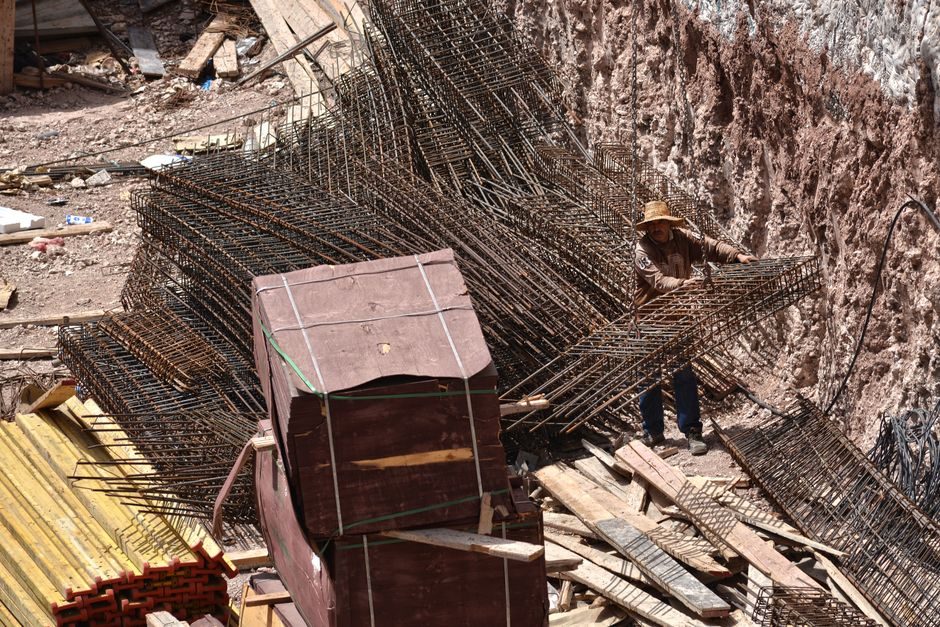
On a 2026-06-23 product page, Fascut LLC (Prairie du Sac) lists its portable electric rotary bender (Model FR-800) as a shop-or-site fabrication tool alongside separate rebar cutters [S3]. On 2026-05-09, Guangzhou Yingfeite explicitly splits its catalog into "Rebar Cutter, Rebar Bender" as two main product lines, exporting both to Thailand and Uganda [S6]. The split is structural: forming and shearing are different stress states on the bar and the machine, and the market reflects it.
Manual combo units do exist for low-volume work — a 52" manual tool on eBay handles 3/4" bending and 5/8" cutting at US $249.99 per unit, with 459 units sold on that listing (2016-07-06 baseline) [S2]. For heavier work, the 2025-03-25 eBay combo set handles 1" diameter in both bending and cutting for US $2,449.00 [S7]. These are ceiling cases for combined machines; once you need to process pile-cage grade 32–50 mm bar continuously, you separate the functions.
What Each Machine Actually Does to the Bar
A rebar bender imposes a plastic moment on the bar around a fixed-radius pin; the 2016-07-06 eBay listing for a 52" manual tool confirms its 3/4" (≈19 mm) bending and 5/8" (≈16 mm) cutting capacities on the same frame, with a stated 90°/180° bend range [S2]. A rebar cutter imposes a shear strain across the cross-section; Fascut's separate rebar cutter line is catalogued on the same product page as its bender family, not as a sub-model of it [S3]. Choosing between them is therefore a question of what geometry you need to produce, not which brand has a better badge.
Cutting does not bend the bar, and bending does not sever it; in 2026-05-27 TJK Machinery (Beijing) lists Stirrup Bender, Rebar Cutter and Rebar Bender as distinct main products, alongside Mesh Welding, Truss Making and Cage Making machines [S1]. That taxonomy is consistent with what each tool does to the steel.
Capacity Envelope: Diameter, Grade and Bend Angle
Portable electric benders commonly cover #3 to #6 bar (10–19 mm) at 90°/135°/180°; the FR-800 on Fascut's 2026-06-23 product page is positioned as a shop-and-site portable rotary bender for that range [S3]. Heavier portable benders cross into stirrup and pile-cage work — Zhejiang Okey Mechanical and Electrical Co., Ltd. (Zhejiang) lists 18V cordless rebar tiers alongside separate cutter and bender main products on its 2026-03-18 factory profile [S8].
Cutters spec by maximum shear diameter: light electric cutters stop at 16–20 mm, mid-range hydraulic cutters reach 25–32 mm, and the heavy-duty 2025-03-25 combo set extends to 1" (≈25 mm) cutting [S7]. For diameters above 32 mm, dedicated hydraulic cutters are the norm on the 2026-05-27 TJK lineup, separate from the bender family [S1]. Grade matters too — higher-yield 500/550 MPa rebar needs more motor torque to shear cleanly than the same diameter in 400 MPa grade.
Power Source and Duty Cycle
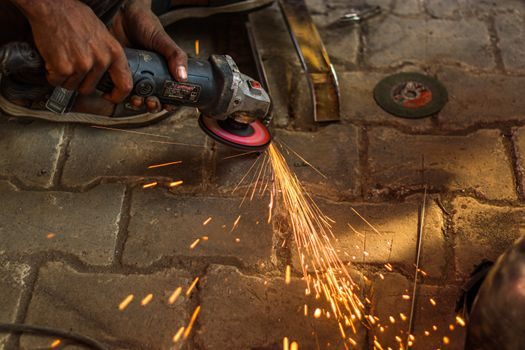
Manual (lever) tools cover very light work at low cost [S2]. Electric single-phase benders (1.5–2.2 kW class) handle shop-fab and small site work; Fascut's portable electric line on 2026-06-23 sits in this envelope [S3]. Three-phase industrial benders cross into CNC territory: on 2026-05-27, Made-in-China.com lists an 8-axis CNC bending machine for steel rebar at US $59,000.00–63,000.00 and a high-precision 3D CNC rebar bender at US $38,800.00, alongside a factory-direct CNC bender from US $8,000.00 [S5].
Cutters follow the same ladder: light electric, mid hydraulic, heavy hydraulic. Cordless 18V rebar tiers on Zhejiang Okey's 2026-03-18 factory profile are listed in the US $365.00–385.00 range per piece (MOQ 1), and they sit in a different process family — tying, not cutting or bending [S8]. For continuous production duty, separate motor-and-pump stations for cutter and bender let you service one while the other runs.
Combo Units vs Separated Machines
Combo units (one frame, one motor, both heads) are compact and cheap for low-to-mid duty: the 2016-07-06 52" manual combo at US $249.99 [S2] and the 2025-03-25 1" electric combo at US $2,449.00 [S7] bracket the manual and electric ends of that market. The 2026-05-27 TJK Machinery catalog explicitly keeps them separated as "Rebar Bender" and "Rebar Cutter" main products, even though both sit in the same steel-processing line [S1] — which is the production-volume answer to the combo question.
Comparison on four decision criteria: - Capacity ceiling: separated benders and cutters each hit 32–50 mm class; combos typically cap at 1" (≈25 mm) [S7]. - Weight: a combo one-frame unit is lighter to lift to a deck; two separated machines are heavier but you can move the one you need. - Service: a failed combo head takes the whole unit offline; separated machines let you keep cutting while the bender pin is being reground. - Cost: 2016 manual combo at US $249.99 [S2]; 2025 heavy-duty electric combo at US $2,449.00 [S7]; separated 2026-05-27 CNC bender alone at US $8,000.00–63,000.00 [S5].
Where Each One Fits and Where It Doesn't
Use a bender when the next operation is placing a stirrup, hook, lap, or pile-cage bend; use a cutter when the next operation is reducing a stock bar to a specific length. On 2026-05-27, TJK (Beijing) lists Stirrup Bender as its own product, separate from the general rebar bender — stirrups have a different bend-radius requirement (small-radius, multi-bend per cycle) and are not a job for a general-purpose bender [S1]. For an in-depth selection frame on bender capacity, motor class, form factor, and China sourcing, see the rebar bender 2026 buying guide.
Don't use a combo for high-yield 500 MPa pile-cage work, don't use a manual lever for 1" bar, and don't expect a CNC bender to shear cleanly at the end of a production run. For rebar grade and mill-sourcing context that drives the capacity choice, the deformed rebar 2026 price and cost guide is a useful companion. When the question shifts from bar processing to mesh vs strand, welded steel mesh vs prestressing strand is the relevant adjacent read.
Sourcing, Standards, and What to Verify Before You Buy
Two practical specs to confirm on any 2026 vendor datasheet: maximum sheared diameter for the cutter, and maximum bent diameter plus minimum bend radius for the bender. The 2016-07-06 eBay listing states "5/8" cutting and #6 rebar 90°/180° bends" as the headline spec pair on a 52" frame [S2] — that pattern (cutting diameter + bend diameter, both in bar-size notation) is how US-market tools are usually described. The 2025-03-25 1" combo set extends both numbers to 1" cutting on the same frame [S7].
On the supplier side, factory-direct sourcing from Guangdong and Zhejiang remains the dominant channel: 2026-05-27 TJK (Beijing) [S1], 2026-05-09 Guangzhou Yingfeite [S6], 2026-03-18 Zhejiang Okey [S8], and the multi-supplier 2026-05-27 Made-in-China.com rebar-bender catalog page [S5] all confirm active 2026 listings. Verify CE certification on the motor nameplate for European jobsites, and ask for the minimum bend radius (typically 2–4× bar diameter) on the bender's spec sheet — that number, not the headline maximum diameter, is what determines whether the tool can form the radius your rebar schedule calls for.
Track these for the next 1–2 quarters: (a) the spread between the 2026-05-27 low-end factory-direct CNC bender (US $8,000.00) and the high-end 8-axis CNC bender (US $59,000.00–63,000.00) on Made-in-China.com [S5], and (b) any shift in the 1" combo ceiling (US $2,449.00 on 2025-03-25 [S7]) as heavier electric combos enter the US-channel market.
For component-level specifications, see rebar bender, rebar cutter, and marble cutter.