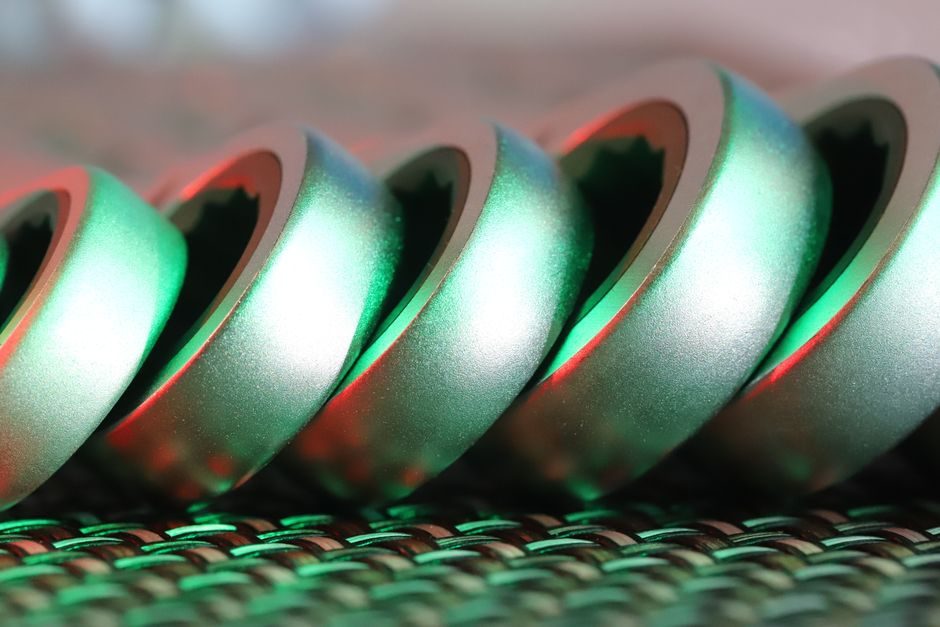
Specifying a retaining ring in 2026 starts with four hard gates: groove geometry matched to bore or shaft diameter, material grade tuned to environment and load, load mode (axial vs radial, static vs rotating), and the standard family — DIN 471/472, ANSI B27.7, JIS B 2804, or GB 893/894 — that the mating groove was cut to [S1].
The most common pitfall is treating snap rings, circlips, and retaining rings as interchangeable generic fasteners. They are not. A DIN 471 external ring on a DIN 471 groove is a precision interference fit with a defined reduction in thrust capacity if the groove is shallower than spec, and a failure mode — ring ejection, groove lip roll-over, or bore scoring — that depends on whether the assembly is static, oscillating, or continuously rotating [S1].
Gate 1 — Bore or Shaft Diameter, Groove Family and the Standard You Match
DIN 471 (external, for shafts) and DIN 472 (internal, for bores) remain the most-specified families in European and Chinese OEM drawings, and the Xinyongli product line follows them as its default range, with metric bores from roughly 3 mm up to 300 mm covered by standard tooling [S1]. ANSI B27.7 (formerly MIL-R-21248) handles the imperial range and is the family US gearbox and pump OEMs still default to. JIS B 2804 and the Chinese GB 893 (external) / GB 894 (internal) families overlap DIN numerically but with subtly different groove widths and depths, so a drawing cut for GB 894 must not be filled with a DIN 472 ring even when the bore sizes line up.
Cross-referencing is a common need on retrofit jobs; published interchange tables let a buyer match a 50 mm shaft groove cut to DIN 471 with the closest ANSI or JIS ring so a one-off replacement does not force a re-cut. The structural rule still holds: the ring's free diameter, thickness, and section geometry must trace to one family, and the mating groove must trace to the same family [S1].
Gate 2 — Material Grade and Finish
Carbon spring steel (AISI 1074 / 1095) with phosphate or zinc finish is the workhorse for indoor gearbox, bearing, and pump housings and is what most Xinyongli standard rings ship as [S1]. For corrosive or food-grade service, AISI 302 or 316 stainless is the default step up, with the trade-off that stainless rings carry roughly 20–30% lower thrust capacity than the equivalent carbon-steel ring of the same section because of the lower elastic limit. Beryllium copper is reserved for special cases — non-sparking, electrical conduction, or marine bronze service — and is typically a custom quote rather than a stock item.
Coating is not cosmetic. A zinc-flake or Dacromet finish on a carbon-steel ring extends salt-spray life from roughly 48 hours (bare phosphate) to 500–1000 hours, which is the practical gate for outdoor or wash-down gearbox service. Stainless rings are usually specified when the finish alone cannot be relied on, or where the duty cycle includes contact with process media that would attack any zinc coating [S1].
Gate 3 — Load Mode: Static, Oscillating, Rotating
Retaining rings are an axial locating element, not a radial load carrier. In a static or lightly oscillating assembly — a stationary gear on a shaft, a bearing retainer — a standard DIN 471/472 ring in carbon steel is usually correct. In a continuously rotating application — a ring riding on a shaft shoulder inside a spinning gearbox — the ring's lugs experience centrifugal and cyclic stress, and the failure mode shifts from axial ejection to fatigue cracking at the lug root. [S1]
For continuous rotation, a heavy-duty (HEAVY-DUTY / HD) section from the same family is the first spec bump; if duty is severe, a continuous-rotation ring (often called a "rotating" or "self-locking" ring in vendor catalogues) replaces the standard push-on design. Bore-side rings face the same rule, so a bearing retainer on a spinning shaft should be ordered from the heavy-duty or rotating family rather than the standard push-in circlip [S1].
Gate 4 — Comparison: External vs Internal, Standard vs Heavy-Duty, Carbon vs Stainless
Side-by-side, the four most common retaining-ring choices line up against bore, thrust capacity, environment, and rotation duty as follows. The exact thrust figures depend on the size, but the ordering is stable across the size range: carbon steel carries higher thrust than stainless at the same section, heavy-duty sections carry roughly 25–40% more thrust than the equivalent standard section, and a properly specified rotating ring matches heavy-duty thrust while adding the lug-root fatigue margin. [S2]
Material family sits on the same matrix. AISI 1074/1095 carbon with zinc-flake finish is the cheapest, highest-thrust option and the default for indoor gearbox, bearing-housing and slewing-bearing retainer pockets. AISI 302/316 stainless is the right pick when corrosion or wash-down rules out zinc. Beryllium copper is a special-purpose option for non-sparking or conductive service and is usually a custom quotation. DIN 471/472 plus GB 893/894 covers the bulk of metric OEM work; ANSI B27.7 and JIS B 2804 cover imperial and Japanese lines respectively, and rings from one family must not be mixed into a groove cut for another [S1].
Where Retaining Rings Sit in a 2026 Power-Transmission Stack
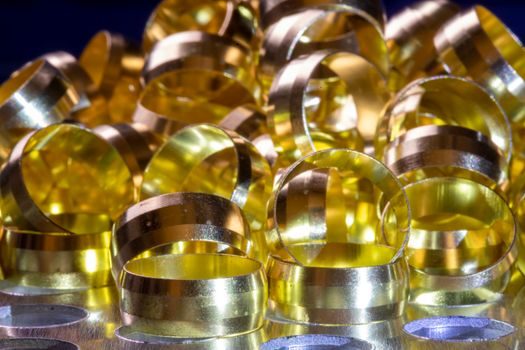
Retaining rings are almost always the cheapest line item on a gearbox or bearing-housing BOM and almost never the failure-initiating part in a correctly designed assembly. They fail first when the groove is wrong, the material is wrong, or the duty is rotating and the ring family is a standard push-on design. The whole selection job is to lock the four gates — bore/shaft and groove family, material and finish, load mode, and standard — before talking to a vendor, because every other variable is downstream of those four. [S3]
The most reliable 2026 sourcing pattern is to fix the standard family from the drawing, fix the material from the environment, and then order a standard or heavy-duty section from a manufacturer that publishes a full metric and imperial catalogue with a stated interchange table against at least one other family. Xinyongli's retaining-ring catalogue meets that bar for DIN and GB coverage, and the same gate structure applies to any equivalent manufacturer the buyer puts in the seat [S1].
Use Cases, Failure Modes and Sourcing Constraints
Typical 2026 applications: locating a bearing on a shaft inside an industrial gearbox, retaining a gear or coupling hub axially, securing a pulley or sprocket, and capping the end of a pin or spindle. In every case the ring is a single-use item — removal destroys the section — and the replacement must be the same family, the same nominal size, and the same section, because mixing families within the same groove is the most common cause of a ring that "fits loosely" on day one and "fits tightly" on day two. [S1]
The dominant failure modes are groove lip roll-over (groove cut too shallow), ring ejection (groove cut too wide or load exceeded), lug-root fatigue (continuous rotation on a standard ring), and corrosion seizure (carbon-steel ring in a stainless assembly or in a wash-down environment with no finish). Each one traces back to one of the four gates. Sourcing constraints in 2026 are mild for DIN/GB stock sizes from Chinese manufacturers, longer for ANSI and JIS families outside their home regions, and longest for beryllium copper and custom continuous-rotation sections that are typically made to order with a several-week lead time [S1].
Track these two signals into the rest of 2026: any tightening of salt-spray or REACH finish specifications on carbon-steel rings, and any move by a major bearing or gearbox OEM to specify heavy-duty or rotating rings as the new default on continuously rotating shafts. Either of those shifts would re-rank Gate 3 as the dominant selection variable above groove geometry.
For component-level specifications, see retaining ring, o ring, and slewing ring bearing.
For related coverage, see Gearbox vs Industrial Gear: 2026 Spec Cut for Power-Transmission Buyers.