
On a motor control cabinet RFQ, the timing belt line must carry at least six mandatory fields, pitch code, belt width, tooth count, pulley part number, material compound, and service factor, because omitting any one forces the vendor to either default-upsize the drive or re-quote against the distribution cabinet mechanical interface.
Synchronous (timing) belts transmit torque through positive tooth engagement with a timing pulley, eliminating slip and preserving speed ratio between motor and driven load; this is why they appear in cabinet-mounted fan, encoder, and small-pump drive trains rather than V-belts, which depend on friction [S1].
Pitch and Profile: The First Gate on the RFQ
Pitch is the centre-to-centre distance between belt teeth expressed in millimetres, and it must match the pulley exactly; common metric pitches stocked by industrial suppliers include 2M, 3M, 5M, 8M, 14M and 20M, while inch profiles MXL, XL, L, H, XH and XXH still appear in older European cabinet builds [S10].
Tooth profile (curvilinear HTD vs trapezoidal T/AT vs RPP) is not interchangeable across pitches, and buyers who write only "8M belt" without profile will receive an AT5 by default, which cannot be re-tensioned on a T2.5 pulley in the field [S8].
For MCC-embedded fans and encoder drives, 8M and 5M are the dominant pitches; an 8M-20 (8 mm pitch, 20 mm wide) belt is a typical utility size that survives shipment vibration when the belt conveyor integrator crating lets go.
Width, Length and Tooth Count
Belt width is the second hard gate; 8M series belts ship in 20, 30 and 50 mm stock widths, and torque capacity scales roughly linearly with face width because wider belts engage more teeth in mesh [S8].
Length is specified as tooth count (e.g. 1000-8M) rather than pitch length alone, because the tooth count is what the timing pulley engineer uses to set centre distance; writing "1000 mm 8M" is ambiguous and triggers a clarification round [S7].
Misumi's GV-series timing-belt conveyor line lists 30 mm pulley diameters as the small-format limit for single-track centre drives, which sets a useful sanity floor for cabinet fan drives where pulley real estate is bounded by enclosure depth [S6].
Material Compound and Tensile Cord

Three belt body materials dominate industrial RFQs: polyurethane (PU) for clean, low-noise, electrically isolated drives; chloroprene rubber (neoprene) with fibreglass tension cords for general MCC service; and HNBR or chloroprene with steel cords for high-torque, high-temperature cabinet applications above 100 degC ambient [S4].
PU double-sided timing belts (tooth profile on both faces) are used where a single belt drives two pulleys from opposite faces, a common arrangement in small transfer or indexing mechanisms but rarely in MCC internal layouts [S4].
RFQs that omit cord material get re-quoted with fibreglass as default, which is fine below roughly 5 kW but caps out for high-inertia loads; buyers should write "fibreglass or steel cord" with a duty-cycle justification if the cabinet drives a brake resistor cooling fan.
Service Factor, Ambient and Lubrication Envelope
Synchronous belt efficiency is published in the 97 to 99 percent range because there is no slip, but derating still applies for shock load, start-stop duty and ambient temperature; the standard industrial practice is to multiply the design torque by a service factor of 1.0 to 2.0 depending on driver type and hours per day [S1].
Cabinet-internal timing belts are expected to run oil-mist-free and dust-free, so PU with no lubrication is the common pick; rubber-neoprene belts tolerate incidental oil splash better and are preferred when the timing belt sits near a gearbox breather.
Buyers who skip the ambient field on the RFQ line force vendors to assume 25 degC, which under-specs any cabinet with a VFD-driven motor in the same enclosure; always write maximum ambient, altitude, and IP rating of the cabinet face.
Failure Modes and Field Returns
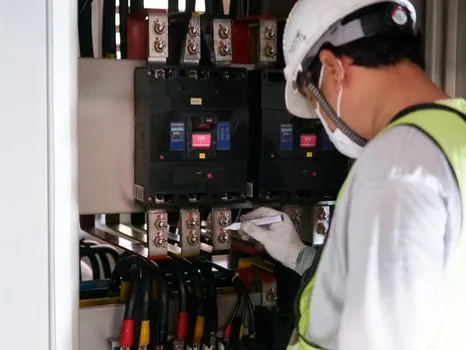
The three failure modes that show up in MCC timing-belt warranty returns are tooth shear (under-rated width or shock load), belt stretch past tensioner travel (undersized tensile cord), and tooth jump on start-up (excessive peak torque vs service factor). [S4]
A common spec mistake is to copy a conveyor-side 14M-50 belt into a 0.4 kW cabinet fan drive, which adds mass, increases bearing load, and forces a different pulley inventory; right-sizing the width to the torque map is more important than over-spec'ing.
Pull-side tensioners in cabinet builds are often omitted to save panel space, which means tooth-jump margin must come from width and profile, not from a take-up; buyers should confirm whether a tensioner is in the BOM before locking tooth count.
Standards, Documentation and Sourcing Map
Metric timing-belt geometry follows ISO 13050 (synchronous belt drives, metric pitch), and most OEM datasheets reference both ISO 13050 and the manufacturer's own part code; copying the OEM code onto the RFQ line removes ambiguity in cross-border sourcing from Indian and Chinese suppliers [S8].
Authorised distributors for Mitsuboshi, Hutchinson, Nitta, Gates, Megadyne and Goodyear hold stock in Mumbai and other industrial hubs, while made-in-China factory listings show FOB price bands of USD 0.5 to 5 for rubber timing belts in small MOQ and USD 20+ for finished assemblies [S4][S8][S10].
For MCC projects sourcing through Indian channels, request the distributor's MXL, XL, 5M and 8M datasheets; a vetted part list from the same supplier family cuts lead time when spare replacements ship months after commissioning [S8].
RFQ Checklist and Sourcing Watch-Outs

A clean timing-belt RFQ line for an MCC build reads: pitch (8M), profile (HTD or RPP), width (20/30/50 mm), length as tooth count (e.g. 1000-8M), material (PU or chloroprene), tensile cord (fibreglass or steel), service factor (1.0 to 2.0), max ambient, mating pulley part number, and quantity with annual forecast. [S1]
Belt-conveyor integrators and stacker crane OEMs reuse the same pitch codes, so harmonising the cabinet belt spec with adjacent equipment in the plant simplifies spares holding and shortens MRO cycles.
One trackable signal for the next 90 days: the ISO 13050-aligned 8M and 14M HTD profiles are now stocked at most authorised distributors in 20/30/50 mm widths, while older XL and L inch-pitch inventory is shrinking, which means new MCC designs should default to metric pitch unless the existing cabinet is already inch-pitch.