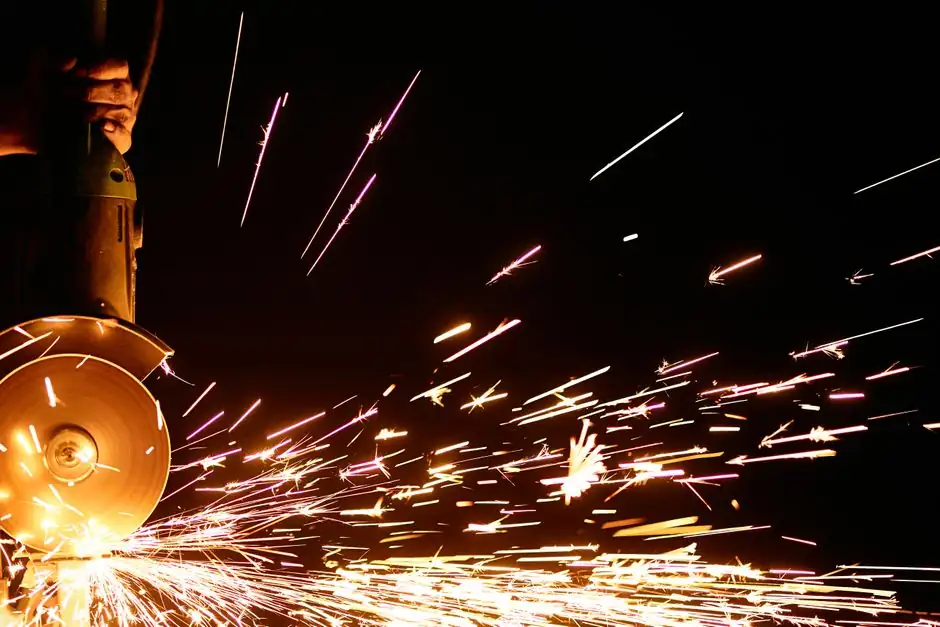
Energy-equipment foundries pouring turbine housings, valve bodies, and wind-tower flange blanks specify riser cutting machines in the 50-500 kN hydraulic shear class or the 300-800 mm abrasive-wheel class, with CE Machinery Directive 2006/42/EC conformity, ISO 12100 risk assessment, and IEC 60204-1 electrical safety as the non-negotiable delivery baseline [S1][S4].
Selection pivots on four foundry inputs: melt family (gray iron, ductile iron, carbon steel, stainless, or copper-alloy), riser neck diameter (typically 25-250 mm), hourly throughput target, and whether the cell runs manual, semi-automatic, or robotic with integrated dust extraction [S1]. The riser cutting machine reference page treats this equipment as a fixed-stroke industrial shear, not a CNC machining centre, which matters when comparing 2026 quotes that swing from US$3,500 to US$60,000 per set [S5].
Drive-Power Classes: Pneumatic, Hydraulic, Servo
Pneumatic riser cutters operating on 0.5-0.8 MPa shop-air drive the 20-80 mm neck class at 3-6 seconds per cut, while hydraulic units at 10-21 MPa system pressure deliver 5-30 kN cutting force and own the >80 mm neck territory, including the high-hardness steel-casting pours typical of valve and turbine-housing foundries [S3]. For automated energy-equipment cells, servo-CNC riser cutters hold cut-length repeatability inside ±0.5 mm and support recipe-based parameter switching between part numbers, a capability pneumatic machines cannot match without mechanical re-tooling [S3].
Energy foundries pouring 1,500 t/year or more of a single part number (a typical wind-tower flange blank) usually amortise a servo-CNC cell inside 24-36 months, while job shops running mixed valve-body pours under 200 t/day stay on manual lever or semi-automatic hydraulic [S3]. Cycle-time numbers calibrate the choice: hydraulic shear on ductile iron routinely hits 200-400 cuts per hour with a dedicated indexing fixture, against 60-100 cuts per hour for handheld abrasive grinding in the same cell [S1].
Cutting-Action Architecture: Shear, Abrasive, Saw
Shear-blade riser cutters using opposing straight or curved blades are the workhorse on gray and ductile iron, with blade life typically 5,000-15,000 cuts before re-grind; abrasive-wheel cutters (300-600 mm diameter, 2,000-3,800 rpm) take over for steel castings and for riser necks above 100 mm where shear blades chip or bind [S3]. Saw-type derivatives (band-saw or cold-saw) handle riser necks above 150 mm and trade cycle time for a low-burr cut that often eliminates a downstream grinding pass [S3].
Consumable economics flip sharply by architecture: abrasive wheels typically change out every 80-300 cuts, against a multi-thousand-cut life for shear blades, so the per-cut consumable line item is the single largest variable cost on an abrasive cell [S3]. A 510 mm (20 inch) abrasive wheel reaches roughly 150-180 mm round capacity on gray iron, while a 700 mm-class heavy foundry vertical band saw reaches about 420 mm throat and 500 mm cut height for the larger wind-tower and pressure-vessel risers [S4].
Selection Criteria for Energy-Equipment Service
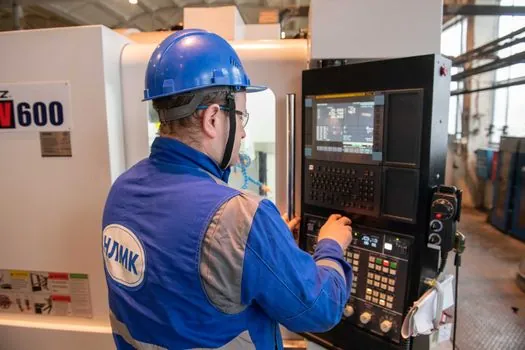
For energy-equipment foundries, the binding specifications are cutting force, throat capacity, dust-extraction airflow, and noise emission. Abrasive cutting of cast iron produces metallic and silica-bearing dust that breaches occupational exposure limits within minutes unless extraction is correctly sized at 4,000-10,000 m³/h for a single cell, and noise from a hydraulic shear sits in the 90-105 dB(A) range, so the OSHA 29 CFR 1910.95 90 dB(A) 8-hour exposure limit and the ACGIH iron-oxide and respirable-crystalline-silica TLVs are the practical gate, not optional refinements [S1]. Standards that apply to the machine itself include CE Machinery Directive 2006/42/EC, ISO 12100 risk assessment, IEC 60204-1 electrical safety, ANSI/UAMA B7.1 for abrasive wheels, and EN ISO 16089 for stationary grinding machines [S1][S4].
For offshore wind-tower applications, the cutting machine architecture shifts toward field-deployable clamshell designs: the OD715 split-frame pipe cutting and beveling machine handles 560-715 mm OD pipe, supports V and J bevel plus compound bevels, and ships in electric (2.4 kW, 220-240 V), pneumatic (2.76 kW, 2.8 m³/min at 0.6 MPa), and hydraulic (7.5 kW, 380 V) drive variants, with wall-thickness capacity up to 30 mm on the standard tool slide and 200 mm on the heavy-wall tool slide [S2]. The aluminum-body AOD variant is specified where lifting gear is unavailable on-site, while the steel-body OD variant is chosen for heavy-duty, long-term shop use [S2]. This is the same machine architecture that handles the in-service pipeline beveling adjacent to any energy-equipment foundry's field service crew.
2026 Price Bands and Total-Cell Cost
Cross-referencing wholesale channels in 2026, factory-direct riser cutting machines list between US$3,500 and US$60,000 per set, with the spread driven by stroke geometry, blade drive (hydraulic versus servo-electric), and whether the unit ships as a stand-alone press or as a feeder-plus-cut-plus-conveyor integrated cell [S5]. Entry hydraulic gate shears with manual feed and fixed blade cluster at US$4,000-10,000 per piece with CE and ISO 9001:2008 certification, while mid-band CNC riser cutters with linear guides, auto-clamp, and servo blade-feed sit at US$15,000-35,000 per set [S5].
Freight, installation, foundation work, and the dust-extraction duct add 10-18% on top of the bare-machine price, and an automated infeed/outfeed cell can roughly double the figure when the press becomes the centre of a turnkey cutoff line [S5]. Spec levers that move the price most: cutting force (cylinder bore scales linearly with price), blade geometry, ram drive type, and material-handling integration; each is negotiable independently, so procurement engineers can right-size rather than over-spec [S5]. The four price-band anchors to use in a 2026 RFQ are US$4,000-10,000 entry hydraulic, US$15,000-35,000 mid-band CNC, US$25,000-32,000 steel-blade die cutter benchmark, and US$47,000-60,000 gear-cutting CNC hobber as the multi-axis servo riser cell high-end reference [S5].
Who This Architecture Serves, and Where It Fails
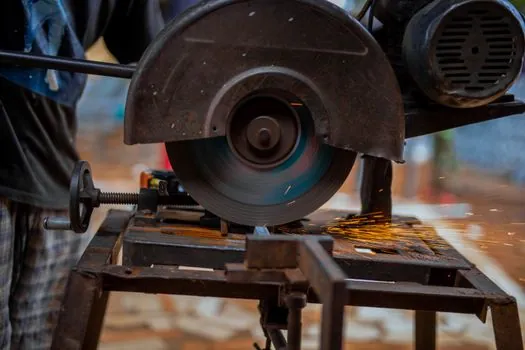
Riser cutting machines in the 50-500 kN hydraulic and 300-800 mm abrasive class are the right answer for energy-equipment foundries running continuous pours of valve bodies, pump housings, turbine casings, and wind-tower flange blanks at 25-250 mm riser neck diameter; they are the wrong answer for job shops pouring under 200 t/day of mixed short runs, where a manual lever or foot-pedal pneumatic at 0.5-0.8 MPa handles the mix variance at lower capital cost [S1][S3]. Robotic cells only pay back above 1,500 t/year of single-part-number throughput, below that the labour content does not bottleneck the line [S3].
Failure modes to engineer out: bent cut-off wheels from undersized abrasive-wheel rigidity, incomplete severance from pneumatic stall on steel castings, dust-exposure breaches when extraction drops below 4,000 m³/h, and a capital cost 5-10x that of a manual chipping station that the fettling department must absorb in its ROI model [S1][S3]. A mid-capacity hydraulic riser cutter burns through a 400 mm abrasive wheel every 200-400 cuts depending on riser neck hardness, so consumable budgeting belongs on the maintenance ledger from day one, not as a year-two surprise [S1]. Energy-equipment buyers evaluating this class should also look at the riser cutting machine selection for automotive parts spec map for comparison cycle-time data, and at the broader cutting machine reference for cross-architecture cost benchmarks.
Standards, Sourcing, and Acceptance Tests
Acceptance testing for an energy-foundry riser cutting machine should verify CE Machinery Directive 2006/42/EC declaration of conformity, ISO 12100 risk-assessment file, IEC 60204-1 electrical safety verification, ANSI/UAMA B7.1 abrasive-wheel guard compliance, OSHA 29 CFR 1910.95 noise verification, and ACGIH iron-oxide plus respirable-crystalline-silica TLV compliance, with the dust-extraction airflow measured at 4,000-10,000 m³/h under load [S1][S4]. The 90-105 dB(A) hydraulic-shear noise reading must be paired with a hearing-conservation program in the operator zone.
Sourcing gates that catch the most field failures: confirm the cutting-force rating at the stated system pressure (5-30 kN at 10-21 MPa for hydraulic), confirm wheel or blade life in cuts-per-unit rather than hours (5,000-15,000 cuts for shear blades, 80-300 cuts for 300-600 mm abrasive wheels), and confirm cycle-time per cut under load (2-4 seconds semi-automatic, 3-6 seconds pneumatic) rather than no-load [S3]. The broader plant-floor context for how riser-cut and core-set cells sequence is covered in the cutting machine reference, which clarifies why the riser cutter is the first operation downstream of shakeout and the gateway to shot-blast, grind, and final machining.
Trackable signals for the next sourcing cycle: Q4 2026 CE-mark enforcement audits under EN ISO 16089 for stationary grinding machines, and the 2026-07 wholesale price re-quotes on Made-in-China aggregated listings that will reset the US$3,500-60,000 baseline by year-end.
Detailed specification references: energy management.