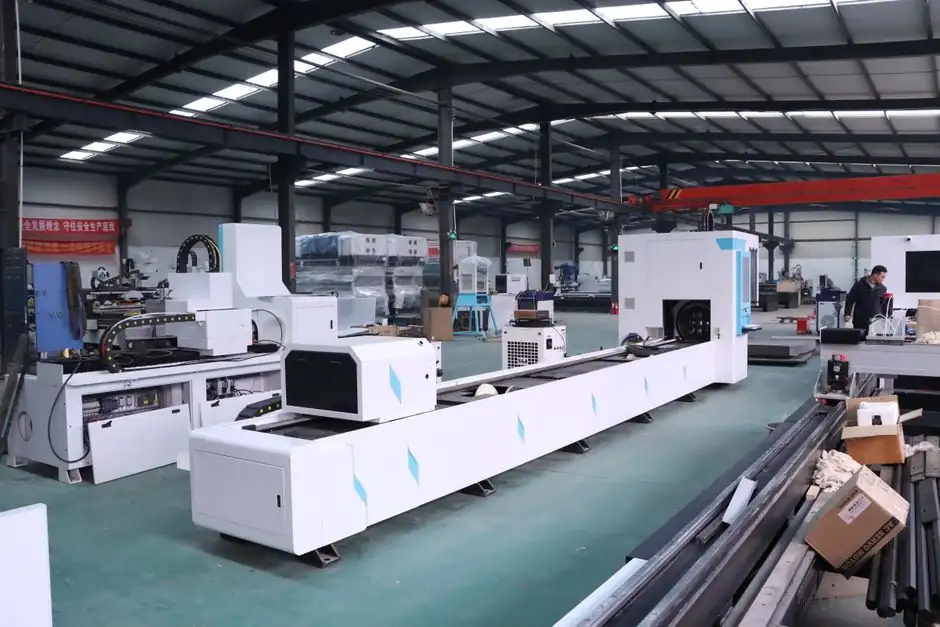
Electronics-housing die castings in aluminum and zinc alloys typically arrive at the fettling shop with riser necks in the 25–150 mm range, putting them squarely in the hydraulic-shear and small abrasive-wheel band of the riser cutting machine family.
For these parts, throughput, cut-face quality, and dust-load on the cell decide the machine choice more than peak tonnage; the selection map below ties the four common cutter architectures to electronics-housing duty.
Riser Cutters vs the Wider Cutting-Machine Family
A riser cutting machine is a heavy-duty mechanical or hydraulic shear built to part sprues, risers, and gate remnants from castings after shakeout, and it sits inside the wider cutting machine family used in foundries and fab shops [S2]. Within a casting line it is the operation that physically separates the feeder from the casting body; a coding machine marks the part after cut-off, a core machine builds the sand core, and a filling machine doses melt, none of which severs metal [S2].
The DirectIndustry buying guide frames cutting machines as a working table plus a frame supporting a cutting head, with the technology chosen by material, thickness, precision, quality, and productivity [S1]. Riser cutting is a sub-family of that definition: rough castings, hot and sand-coated, not clean plate stock, and the cut is judged on bulk separation close to the contact face rather than finished dimension [S3].
Selection Criteria for Electronics-Housing Duty
Five criteria decide the right riser cutter for an electronics-housing cell: alloy, riser-neck diameter, hourly throughput target, dust-extraction capacity, and automation level [S2][S3].
Aluminum and zinc-alloy housings favor hydraulic-piston shear or small abrasive-wheel cutters because the necks shear cleanly and the cut stream returns directly to the charge as clean returns [S2]. Gray and ductile iron housings (larger connector bodies, motor frames) tolerate shear blades with neck shearing and blade life commonly 5,000–15,000 cuts before re-grind, while steel castings above 100 mm neck diameter shift the architecture toward abrasive wheels sized 300–600 mm running at 2,000–3,800 rpm [S7].
Capacity is set by blade or wheel diameter and frame geometry: a 700 mm-wheel vertical band saw class reaches roughly 420 mm throat and 500 mm cut height, while a 510 mm (20 in) abrasive chop saw handles gray-iron gates and risers up to about 150–180 mm round [S3]. For electronics housings the relevant cut-section is 25–150 mm, which keeps the machine in the small-footprint hydraulic or 400–510 mm abrasive-wheel class rather than swing-frame industrial units [S2][S3].
Comparison of the Four Main Riser-Cutter Architectures
The four architectures line up against electronics-housing duty as follows, with data drawn from public spec ranges and the 2026-07-27 SourceBySpec riser-cutter spec map [S2][S7].
Hydraulic-piston shear: peak cutting force typically 50–500 kN, throughput 200–400 cuts/h on ductile-iron automotive castings with a dedicated indexing fixture, low dust compared with abrasive wheels, and clean reusable scrap; the downside is capital cost 5–10× that of a manual chipping station [S2]. Servo-electric press: similar cut quality to hydraulic shear with lower energy draw and quieter operation, but limited to smaller neck diameters and lower peak force; a fit for zinc and small aluminum housings under 80 mm neck. Abrasive-wheel saw: 300–600 mm wheels at 2,000–3,800 rpm, the preferred architecture for steel castings and riser necks above 100 mm, but a 400 mm wheel burns out every 200–400 cuts depending on neck hardness and the cell needs 4,000–10,000 m³/h of extraction to stay below occupational limits [S2][S7]. Band-saw variant: blade width 27–54 mm, tooth pitch matched to riser diameter, slower cycle but the smoothest cut face; useful for housings that go straight to machining without an intermediate fettling step [S2].
For electronics housings under 150 mm neck, hydraulic shear is the default; above 100 mm and on steel, abrasive wheel takes over; servo-electric fits the cleanest rooms with the smallest parts; band saw is reserved for low-volume, high-finish work [S2][S7].
Who This Is For, and Where It Breaks
Riser cutters are for foundry cleaning rooms running 50+ castings per shift per cell, where the alternative is handheld abrasive grinding at roughly 60–100 cuts/h in the same cell [S2]. They are not for job shops that cut clean plate or bar stock, where a standard cut-off saw or cold saw is the correct tool, and they are not for plastic-injection deflashing, which lives in the precision automatic trimming machine family covered in the 2026-04-07 SourceBySpec trimmer guide [S5].
The architecture also breaks down on very small electronics housings below 25 mm neck, where a shear blade crushes the contact face faster than it parts the metal, and on high-mix low-volume runs where a $200k hydraulic cell cannot be amortized over the part count. In those cases, a manual abrasive chop saw with local extraction remains the economic answer, even though it caps throughput at the 60–100 cuts/h band [S2][S3].
Real Use Cases in Electronics-Housing Production

A connector-body foundry on ductile iron running 250 cuts/h on a hydraulic shear with indexing fixture can redirect several tonnes of riser steel back to the melt deck each shift on a 10 t/day iron pour, lowering virgin pig-iron draw [S2]. An aluminum die-casting line on small power-supply housings with 40–80 mm riser necks typically pairs a servo-electric press with a downstream fettling grinder, and the press data (cycle counters, hydraulic or servo current, blade life) feeds the foundry OEE dashboard via the machine PLC [S2]. A motor-frame and large heatsink producer on gray iron above 100 mm neck usually standardizes on a 510 mm abrasive chop saw with 4,000–10,000 m³/h extraction and accepts the 200–400 cut wheel life as a maintenance line item [S2][S7].
Across these cases the common thread is that the cell is sized to the bottleneck operation, not to the cutter alone: dust extraction, casting infeed, and downstream grinding all have to keep pace with the 200–400 cuts/h the cutter can deliver, or the cell pays for capacity it never uses.
Standards, Sourcing, and Acceptance Tests
CE Machinery Directive conformity, ISO 12100 risk assessment, and IEC 60204-1 electrical safety form the non-negotiable baseline for any riser cutting machine delivered to a European or North-American foundry, per the 2026-07-27 SourceBySpec spec-first gate [S2]. For dust and noise, compliance with OSHA 29 CFR 1910.95 (noise, 90 dB(A) 8-h exposure) and the ACGIH iron-oxide and respirable-crystalline-silida TLVs is the practical gate, because abrasive cutting of cast iron produces a metallic and silica-bearing dust that breaches occupational exposure limits within minutes without a correctly sized 4,000–10,000 m³/h extraction unit [S2]. Wheel safety falls under ANSI/UAMA B7.1 for abrasive wheels, and stationary grinding-machine safety under EN ISO 16089, both of which the foundry encyclopedia entry cites for risk assessment and machine guarding [S3].
Acceptance tests on delivery should verify cut-section capacity on a worst-case production casting, dust-extraction face velocity at the hood (typically 18–25 m/s for metallic dust), noise level at the operator station against the 90 dB(A) action level, and PLC data export to the plant OEE dashboard; without these four checks the machine can be commissioned but not signed off [S2][S3]. Procurement engineers writing a 2026 RFQ for an electronics-housing cell should bundle the cutter, the extraction unit, and the downstream grinder into a single line item, because the bottleneck in a fettling shop is almost always one of the two peripherals, not the cutter itself.
Track next: the 2026 Q3 update to the SourceBySpec riser-cutter types and classifications map, and any published revision to EN ISO 16089 stationary grinding-machine safety that tightens extraction requirements on abrasive-wheel riser cutters. A useful cross-reference for adjacent equipment selection is the arc welding machine selection for bridge construction 2026 spec map, which applies the same spec-first gate logic to a different heavy-duty process.