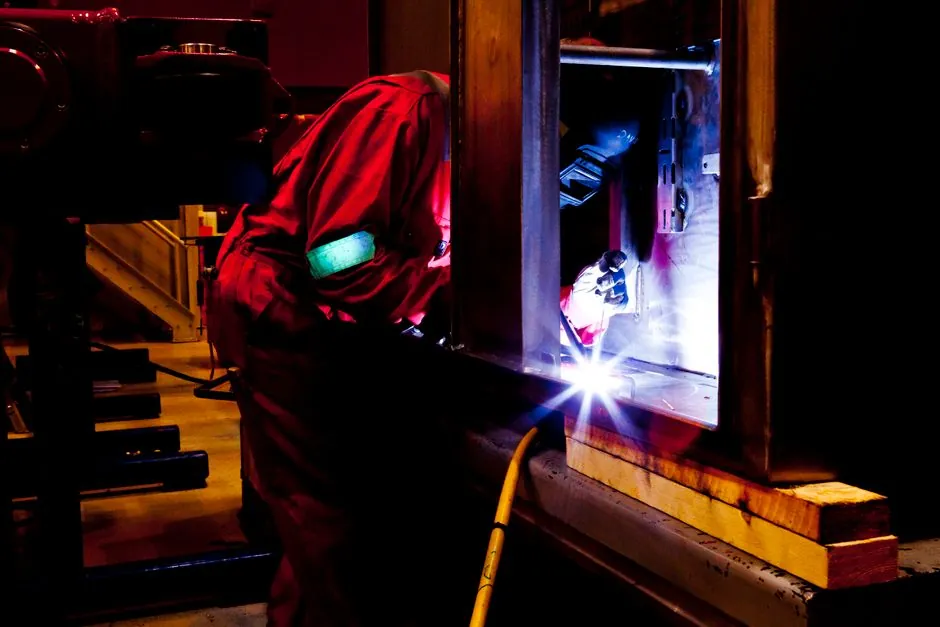
For structural steel construction, the working envelope is a DC or AC/DC inverter TIG power source rated 200–375 A with 40–60% duty cycle at peak output, high-frequency (HF) arc start, and 99.99% argon shielding, sized to plate thickness through the 1 A per 0.001 in. (1 A per 0.025 mm) rule of thumb [S3][S4].
The 2026 industrial and light-fabrication market is covered by three machine classes: DC-only inverters for steel-only shops, AC/DC inverters for mixed steel and aluminum work, and multi-process inverter combos that bundle MIG, TIG, and MMA/stick on a single chassis such as the TELWIN ELECTROMIG 550 SYNERGIC, listed in the 350–550 A bracket with 40–60% duty at peak current for shop-floor use [S4][S7]. For background on the wider welding family and how TIG differs from stick and MIG, the Arc Welding Machine 2026 buying logic walks the same gate-based sizing method used here.
Process Mode and Current Type for Carbon Steel
DC-only TIG at Direct Current Electrode Negative (DCEN) is the cost-effective baseline for mild steel, stainless steel, copper, and brass, because the negatively charged tungsten concentrates heat in the workpiece and yields the smooth, spatter-free arc that structural steel fabricators specify for code welds [S3][S4]. DC-only machines drop to a 95%+ steel/stainless work mix without aluminum in the schedule; below that, AC/DC becomes the rational buy [S3].
AC capability is not required for carbon steel, but the AC half-cycle oxide-cleaning action is what allows a single power source to also weld aluminum and magnesium work, which is why most 2026 multi-process platforms now ship with AC balance and frequency adjustment rather than as DC-only units [S4][S7]. Pulsed TIG layers a low background current under a peak current, concentrating heat input and reducing warpage on thin stainless tube; for plate steel above roughly 3 mm, pulsed output adds cost without measurable benefit, so it is rarely specified on structural steelwork [S4].
Output Amperage, Duty Cycle, and Power Input
Output amperage must clear the thickest plate in the work mix: 22 gauge (0.030 in., 0.76 mm) sheet takes 30–50 A, 1/8 in. (3.2 mm) plate takes 100–130 A, 1/4 in. (6.4 mm) plate takes 180–230 A, and 3/8 in. (9.5 mm) plate takes 280–340 A, which already requires an industrial-class machine rather than a hobbyist inverter [S3][S4].
Duty cycle is where most purchasing specs go wrong: three-phase 350–550 A industrial units are commonly listed at 40–60% duty at peak, while single-phase 200–250 V hobbyist inverters cap at 200 A with only 25–35% duty, and that gap is the single most common spec mismatch flagged on structural-steel shop purchase orders [S4]. Input power is the third gate: 120/240 V single-phase covers entry and mid-range, but 208–575 V three-phase capability is required for sustained industrial output above 250 A and is the default on code-quality machines [S3].
Arc Starting, Shielding Gas, and Tungsten Selection
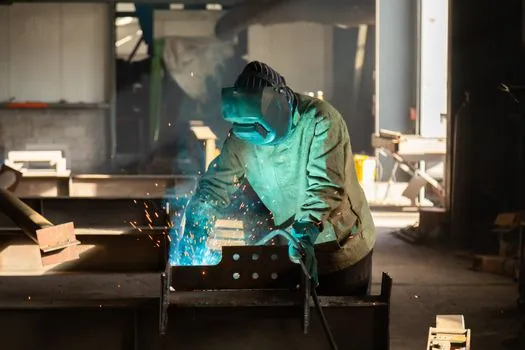
Arc-starting method is a safety gate, not a preference: HF start delivers a non-contact arc strike that prevents tungsten contamination on stainless and titanium, lift-TIG uses a low-amperage contact start that eliminates HF electrical noise near CNC controls, and scratch start is the legacy MMA-style strike rarely specified for new equipment [S4]. For code-quality structural steelwork, HF start is the default; lift-TIG is reserved for EMC-sensitive cells.
Shielding gas for steel and stainless is 99.99% pure argon; argon-helium mixes (75/25) raise arc energy for thick aluminum, while argon-hydrogen (2–5% H₂) accelerates travel on stainless but must never contact titanium, and any machine without an adjustable post-flow timer (typically 5–30 s after arc-off) is automatically disqualified for stainless or titanium because the cooling bead oxidizes without it [S4]. Tungsten electrode selection follows AWS A5.12 classification; the 2% ceriated (WC20) and 2% lanthanated (WL20) grades have become the structural-steel default because they strike at lower voltage than pure tungsten and resist tip erosion under DC welding, as detailed in the TIG welding machine reference page [S5].
Torches, Cooling, and Foot Control
Air-cooled torches cover about 150 A at the WP-17 series and 200 A at the WP-26 series, which handles most manual structural work; above roughly 200 A sustained, or for any mechanized welding, specify a water-cooled torch (250 A at the WP-20 series, 350 A at the WP-18 series, both 100% duty) and a recirculating chiller to keep the torch body below the touch-temperature limit on long seams [S5]. Skipping water cooling above the threshold is the most common cause of torch failure on production floor work.
A foot or finger amperage control is non-negotiable for any TIG work below 200 A: it gives the operator independent control over heat input and filler addition, which is the defining trait of the process and the reason TIG welding machines deliver cosmetic- and code-quality welds that MIG and stick cannot match on thin sections and on non-ferrous alloys [S5]. For structural steel plate above 6 mm, pulse and sequence control add bead-profile repeatability but are not required for ordinary fabrication.
Where TIG Loses to MIG and Stick on Structural Work
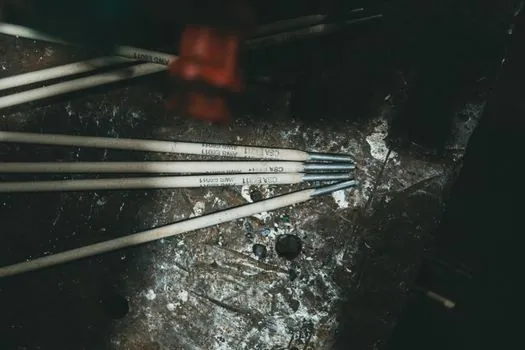
Deposition rate is the headline cost penalty: TIG filler is fed by hand, so a TIG bead deposits a fraction of the metal per minute that a MIG or flux-cored arc welds onto the same joint, and that gap widens as plate thickness increases, which is why structural steel erection crews default to MIG or flux-cored for fillet welds and reserve TIG for root passes, cosmetic cap passes, and code welds on stainless or non-ferrous sections [S6].
Operator burden is the second penalty: TIG requires two-handed coordination (torch in one hand, filler rod in the other) plus foot control, so a structural shop running high-deposition work should treat TIG as a finishing and code-welding tool rather than a primary production process, and size the fleet accordingly, typically one TIG station per two or three MIG stations on mixed fabrication work [S6]. For non-steel, non-precision work such as heavy plate erection, the productivity math points back to a construction machinery and equipment class solution with MIG or stick heads rather than a larger TIG.
Selection Criteria Comparison: DC vs AC/DC vs Multi-Process
Three machine classes cover the 2026 structural-steel market, and the decision is driven by material mix, plate thickness, and duty cycle rather than by brand. The comparison below lines them up against the four gates that matter on a steel-construction purchase order [S3][S4][S7].
DC-only inverter (5–200 A, 25–35% duty, 120/240 V single-phase, $700–$1,200) suits a steel/stainless shop with no aluminum in the work mix; AC/DC inverter (5–280 A, 40–60% duty, 208–240 V single-phase, $1,800–$3,500) is the right long-term buy for mixed steel and aluminum work and covers most code-quality structural fabrication; multi-process inverter combo (5–375 A, 40–60% duty, 208–575 V three-phase, $4,000–$8,500+) such as the TELWIN ELECTROMIG 550 SYNERGIC platform bundles MIG, TIG, and MMA/stick on one chassis and is the default for shop-floor structural work where deposition rate matters as much as weld quality [S3][S4].
Standards, Qualification, and Sourcing Discipline
TIG power sources are specified to IEC 60974-1 for the welding power source rating, tungsten electrodes to AWS A5.12, shielding gases to ISO 14175, and welder qualification to ISO 9606-1, which together define the compliance chain a structural-steel inspector checks before accepting a weld [S5]. Code-quality structural work in pressure vessels and pipe also references ASME Section IX, which governs procedure and performance qualification; a non-certified operator on a code weld is a rejection regardless of machine class.
Stocking discipline is the supply-side gate: distributors carrying only OEM-supported inventory with matched consumables, tungsten, and filler rod reduce the risk of gray-market units that lack certified firmware or replacement parts, which is the single most cited reason for downtime on plant-floor structural-steel fleets [S3]. For deeper context on the equipment family these TIG stations belong to, the welding and cutting tool reference and the construction tools index carry the wider spec map.
Trackable signals for the next purchasing cycle: whether the shop's plate-thickness mix crosses 9.5 mm (3/8 in.), which forces a 280–340 A industrial-class move; whether aluminum work enters the schedule, which forces AC/DC; and whether three-phase power is available on the floor, which forces a re-spec from single-phase hobbyist inverters to 208–575 V industrial units. Each of these is a measurable trigger, not a forecast.