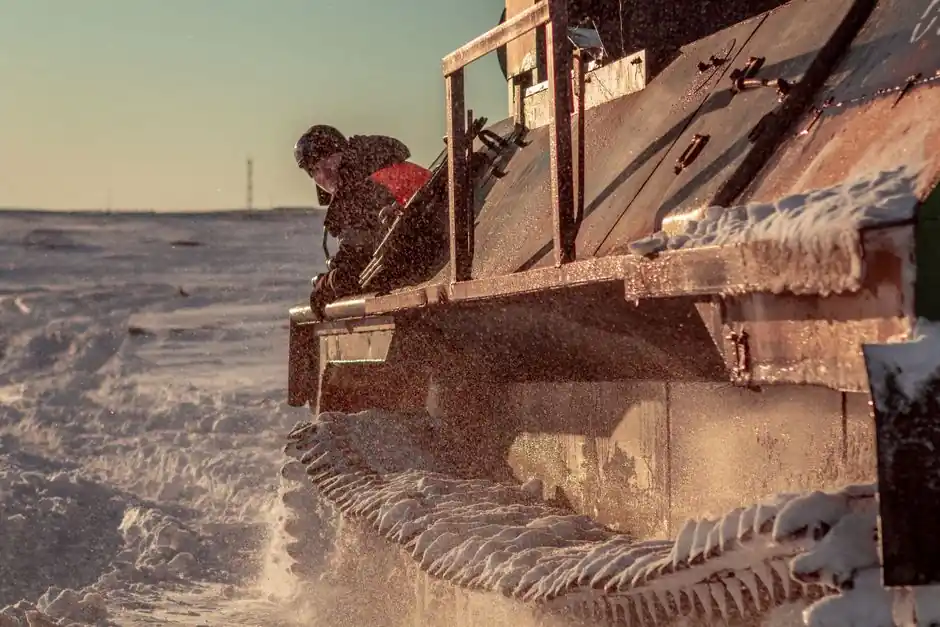
A medium-class tandem road roller in the 10,000–20,000 lb operating-weight band, with 60–84 inch smooth-drum width and 75–100 hp, is the most commonly specified platform for snow compaction, snow-pack driveway basing, and supporting ice-rink grooming on municipal and private roads [S2][S3].
Snow is not the same problem soil is, so the standard roadbuilding selection logic of matching drum type to soil grading curves does not transfer cleanly: cohesion and grain-size distribution govern soil compaction, whereas snow compaction is governed by temperature, density of the underlying base, and whether the operator wants a smooth skating surface or a ridged, tire-traction surface [S3][S4].
Why the Soil Compaction Decision Tree Falls Apart on Snow
Standard road roller selection starts with the soil classification: granular (sand, gravel) wants vibratory smooth-drum or pneumatic-tire machines, while cohesive (clay, silt) wants sheepsfoot or padfoot drums to walk out air voids [S3][S5]. Snow behaves as a bonded, temperature-dependent solid that creeps under sustained load, so vibratory excitation above about 30 Hz often shatters the surface crust rather than densifying it, which is why most snow operators spec static (non-vibratory) smooth-drum machines or, in the lightweight class, simply tow a ballastable garden roller [S4].
Historical equipment parallels this. The horse-drawn "snow rollers" used in New Hampshire towns between roughly the 1880s and 1930s were twin-drum, smooth-surfaced, oak-stave cylinders on a spoked metal axle with a universal joint so each drum could turn independently through a turn, a geometry that maps closely to a modern tandem static roller, except for the steel-drum finish and the diesel engine [S1]. Town records from Madison, NH show two of those rollers purchased at $50 each in 1902 (about $5,000 each in 2018 dollars), a cost ratio that still holds loosely between a hand-towed lawn roller and a ride-on tandem today [S1].
Drum Surface: Smooth for Rinks, Treaded for Driveways
Smooth-drum static rollers produce a glassy, low-friction snow surface ideal for skating rinks, outdoor ice pads, and ski-jump inruns, and they are the historical standard for that reason; tires on a vehicle leave ridges, while a smooth-faced roller does not [S4]. For driveway basing, where the operator wants friction for cars and snowplows, threaded pneumatic-tire rollers or knobby-tread rollers are the working preference, with multiple forum operators reporting that 6 sand-filled car tires welded to a common axle make an effective 6-tire-wide snow packer for residential use [S4].
Material selection on the drum itself matters because wet snow sticks to cold steel. Common shop practice is to grease or oil the drum surface, or weld a scraper bar across the rear face to clear compacted snow before the next pass, an approach documented on residential Ohio Steel 60-inch, 24-inch-diameter rollers originally sold for lawn rolling [S4]. For larger municipal units, factory-applied drum heaters or hydraulic scraper bars are specified, and the rolling resistance differential between a clean drum and a snow-packed drum can be 15–25% on a single pass, based on the qualitative mechanic reports in the operator literature.
Weight, Drum Width, and Horsepower Mapping

Asphalt-roller size classes of under 10,000 lb (small), 10,000–20,000 lb (medium), and over 20,000 lb (large) define the same envelopes used in snow service, with most contractors settling on the medium class because it can be hauled on a standard lowboy without permits in many US jurisdictions and still delivers enough static linear load to compact 4–8 inches of fresh snow in a single pass [S2]. Pneumatic-tire rollers in the snow role are rarer but reach peaks up to 400 hp on the largest machines, an order of magnitude above the typical 100 hp ceiling of a drum roller, which translates to faster ground speeds on long municipal routes [S2].
Drum width drives coverage per pass: 54-inch drums suit residential driveways and sidewalks, 60–66-inch drums suit cul-de-sacs and small parking lots, and 78–84-inch drums suit two-lane roads and runway edges. Horsepower below 50 hp is usually only acceptable on towed units, while self-propelled tandem rollers in snow service typically run 75–100 hp to maintain 3–5 mph ground speed through 4–6 inches of unpacked snow without stalling [S2][S3].
Comparison: Smooth Drum vs. Pneumatic vs. Towed on Snow
Three configurations dominate the snow-roller market: smooth static drum, pneumatic-tire, and towed ballastable drum. On the criterion of finished surface, smooth static produces the slickest, lowest-friction ice, best for rinks; pneumatic tire produces the roughest, highest-traction surface, best for driveways; and towed ballastable smooth drum is a compromise at lowest cost [S4]. On capital cost, towed units and repurposed lawn rollers are typically 5–15% of the cost of a self-propelled pneumatic-tire roller of equivalent width [S2][S4]. On throughput, pneumatic-tire rollers running at 400 hp can cover 4–6 lane-miles per shift on a maintained snow-pack base, while a 75 hp smooth static on a residential driveway covers roughly 0.5–1 lane-mile per shift, and a towed unit behind a compact tractor covers about 0.3 lane-miles per shift [S2].
The selection trade is therefore straightforward: if the application is a skating rink or a ski-inrun, spec smooth static; if it is a long residential or commercial driveway where cars must climb a grade in winter, spec pneumatic or knobby-tread; if it is a small rural drive and capital is constrained, a 60-inch sand-fillable towed drum is the conventional answer and is widely available in the aftermarket as a converted agricultural or lawn roller [S4].
Operating Limits, Failure Modes, and What Not to Do

Three failure modes recur in the operator literature. First, applying vibratory excitation to a frozen snow crust shatters it into ice shards rather than densifying it, so vibratory mode must be locked out on most snow-duty machines; this is a non-obvious rule because vibratory is the default mode on most modern tandem rollers [S3][S4]. Second, leaving water inside a ballastable drum over winter cracks the drum, so operators either drain completely, fill with sand, or fill with a non-corrosive propylene-glycol mix rated to local minimum temperature; this is documented as a recurring DIY failure on converted water-heater rollers [S4].
Third, snow sticking to cold steel drums builds up in layers and lifts off in sheets, leaving a corrugated surface on the next pass; the field fix is a continuous grease film, a hydraulic scraper bar, or, on the smallest units, manual scraping with a flat bar between passes [S4]. Public-road snow-removal work also touches the patent class E01H 5 (Removing snow or ice from roads or like surfaces; Grading or roughening snow or ice), which is the IPC classification covering roller-based snow and ice surface treatment equipment and remains active in 2026 [S6].
Standards, Sourcing, and Adjacent Equipment
No single ISO or ASTM standard governs "snow rollers" as a category, so procurement typically references general roadbuilding standards (ISO 9001:2015 quality systems at the OEM level, for example) and operator manual specs rather than a snow-specific certification [S5]. For ride-on units, OSHA 1926.602 (material-handling equipment) and the local DOT hauling-width and weight-per-axle rules are the binding regulatory layer, not a snow-application standard.
Where a road roller is the wrong tool, a motor grader or a wheel loader with a snow bucket is the conventional alternative for deep, uncompacted snow over 8 inches, and a compact track loader with a snow blower attachment handles the 1–4 inch range on sidewalks. For pre-run inspection and drum/clutch setup on a newly delivered roller, the road roller commissioning checklist covers the static-mode lockout, drum scraper fit, and ballast-fill protocol that a snow-duty unit requires before its first winter pass.
Trackable signals to watch over the next quarter: OEM release of factory drum-heater and hydraulic scraper-bar kits for the 10,000–20,000 lb tandem class, and any new municipal-procurement tender language specifying pneumatic-tire rollers for residential snow-pack basing in cold-climate US and Canadian cities.
For the relevant spec sheets and selection criteria, see roller bearing, and roller chain.