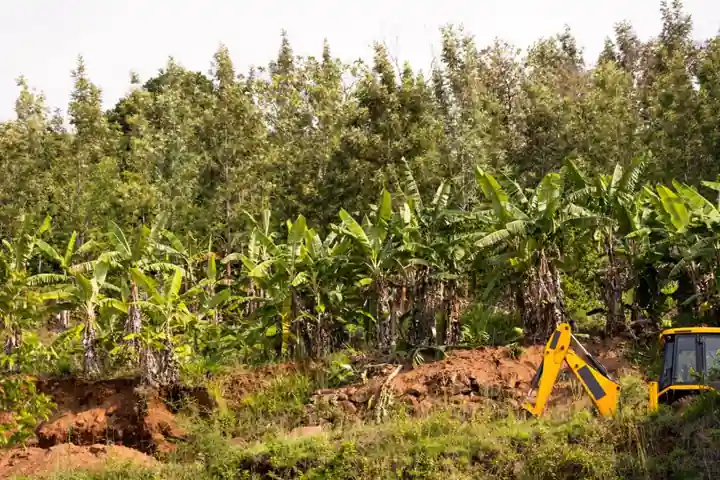
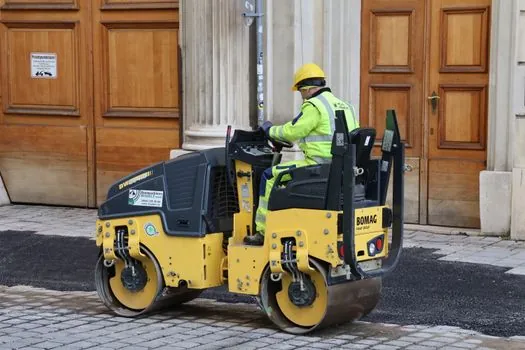
A backhoe loader is a four-wheel-drive machine that pairs a front loader bucket with a rear excavator arm on a single tractor chassis, while a road roller is a dedicated compactor that uses one or two drums (or pneumatic tires) plus vibration to densify soil, aggregate, or asphalt lifts [S1][S5].
The two machines solve different problems: the backhoe loader shapes and moves material, then backfills; the road roller takes whatever has been placed and pushes it to a target density. On a 2026 spec sheet, the decision turns on bucket breakout force and dig depth for the backhoe loader, and on static linear load, dynamic force, frequency, and amplitude for the roller [S2][S5].
Working Principle and Machine Definition
A backhoe loader is a tractor loader backhoe (TLB) class machine, integrating a rear excavator, a front bucket loader, and a center-mount tractor on one articulated chassis with a center pivot for tight-radius work [S5]. Chinese export suppliers such as Shandong Davoo Machinery, Weifang Yishan Heavy Machinery, and Jining China Power Machinery cluster the class between 1.0 m³ loader bucket capacity and 0.3 m³ backhoe bucket, with rear dig depth commonly around 3–4 m on compact units and deeper on larger chassis [S5]. Road travel typically runs 30–40 km/h, enough for short site relocations without a lowboy [S1][S5].
A road roller is a single-purpose compactor built around one or more cylindrical drums (steel, smooth, padfoot, or sheepsfoot) or a set of pneumatic rubber tires. Static weight delivers the baseline compactive effort, and a vibratory mechanism adds dynamic force on most ride-on models. Walk-behind plate compactors start near 100 kg; ride-on tandem rollers commonly land between 1,200 kg and 14,000 kg; large single-drum soil compactors exceed 20,000 kg [S5]. The roller does not move material laterally in any significant volume; it modifies the internal structure of what is already in place [S4].
Decision Criteria: What the Job Actually Requires
Specify a backhoe loader when the work centers on excavation, trenching, loading, backfill, light demolition, and small road repair; the hard spec gates are bucket breakout force, backhoe dig depth, loader lift capacity, and the ability to swap rear attachments such as an auger, breaker, or compactor plate [S2][S5]. The dual-tool layout lets a single operator dig a trench, swing 180°, load the spoil into a truck, then backfill without a machine change [S2].
Specify a road roller when the work is governed by a target density: Proctor or Modified Proctor percentages for sub-base and subgrade, or a specified air-void content on asphalt lifts. The decision gates are drum width, static linear load (kg/cm), dynamic force (kN), frequency (Hz), and amplitude (mm); vibratory frequency typically sits between 25 Hz and 50 Hz depending on lift thickness and material, and cohesive soils call for a padfoot or sheepsfoot drum while granular soils take a smooth drum at higher amplitude [S4][S5].
Comparison Matrix Across Four Buyer Criteria
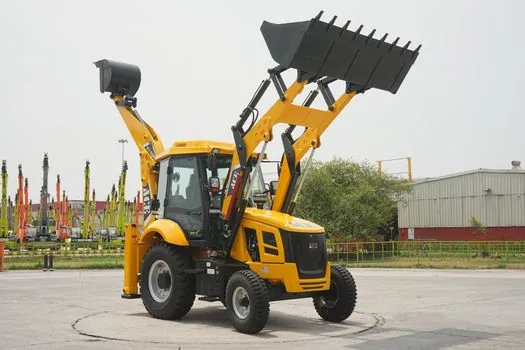
Across four decision criteria the two machines diverge cleanly. Primary function: the backhoe loader moves and shapes material with a compaction byproduct, while the road roller densifies already-placed material with no meaningful digging capability. Operating class: backhoe loaders cluster around 1.0 m³ front bucket and 0.3 m³ rear bucket; road rollers span 100 kg walk-behind plates to 20,000+ kg single-drum soil compactors [S5]. Travel speed: backhoe loaders reach 30–40 km/h for site-to-site moves; rollers run slow and steady in systematic compaction passes [S3][S4]. Spec gates: backhoe loaders are judged on breakout force, dig depth, and lift capacity; rollers are judged on static linear load, kN of dynamic force, Hz, and mm of amplitude [S5].
The two are not substitutes in 2026 buyer guidance; sites that need both functions typically run one backhoe loader plus a dedicated roller rather than trying to use one machine for both jobs [S5].
Real Use Cases and Job-Site Pairings
For utility line installation, foundation dig, and landscaping, the backhoe loader is the right primary tool because the work is dominated by trenching, spoil handling, and backfill rather than by a density target [S2][S5]. Cat's rental line groups backhoe loaders from the 416 for lighter jobs to the 450 for deeper digging and bigger bucket options, while small models serve landscaping and farm work, medium models cover general construction, and large models handle heavy earthmoving [S1][S2].
For road base preparation, asphalt lift compaction, embankment densification, and landfill cover, the road roller is the right primary tool because every pass is measured against a target compaction percentage, not a bucket volume [S4][S5]. A typical small road repair sequence in 2026 practice still uses both machines: the backhoe loader digs and backfills, the roller densifies each lift to spec, and a compactor plate attachment on the backhoe stick handles tight spots the ride-on roller cannot reach [S5].
Limitations, Failure Modes, and Operator Demands
The backhoe loader's main limitation is depth and reach: even on larger chassis the rear arm cannot match a dedicated excavator, and on soft ground the four-wheel-drive tractor loses traction before the loader reaches its full breakout rating. The road roller's main limitation is slope and traction: a vibratory single-drum on a steep grade or a wet clay lift will walk downhill, and over-compaction of a thin lift fractures the aggregate instead of densifying it [S4].
Operator demand differs in kind. A backhoe loader rewards an operator who can swing between front and rear work without repositioning, manage hydraulic flow to two circuits at once, and sequence dig-load-backfill cycles. A roller operator must hold a straight line, maintain consistent speed to keep pass count correct, and watch for visible pumping or weaving that signals the lift is too wet or too thick to densify [S4]. Both machines sit on the same Chinese export channels in 2026 (Shandong Davoo, Massbetter Industrial, Weifang Yishan, Jining China Power), and Massbetter's WG30-25 backhoe loader lists near US$42,000 per unit with 5,000 PCS/year export capacity as a reference price point for the compact 4WD TLB class [S5].
Standards, Sourcing, and 2026 Market Signals
Compaction work is governed by Proctor and Modified Proctor test methods, which set the target density the roller must hit; the backhoe loader has no equivalent density mandate, and its work is governed instead by trench width, depth, and backfill lift thickness rules set in the project specification rather than a single named standard [S4][S5]. For 2026 sourcing, the same Chinese OEM channels stock both machine types, which simplifies parts and service if a fleet runs both, but the two machine classes are bought and spec'd on different sheets and against different acceptance criteria [S5].
For a deeper frame of reference on the backhoe side, the backhoe loader selection guide, which lists five hard cut-offs buyers should enforce walks through the bucket, depth, lift, hydraulic, and attachment gates, while the excavator vs bulldozer spec cut covers the heavier digging and pushing comparison that often sits upstream of a backhoe-vs-roller decision on the same site.
The underlying component specifications are covered under wheel loader.