
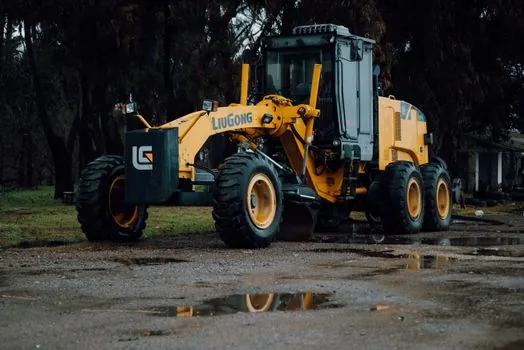
Motor graders and skid steer loaders serve different blades of the earthmoving market, and forcing one to do the other’s job burns fuel, time, and steel [S1]. The motor grader is built around a long drawbar-mounted moldboard (typically 3.7 m / 12 ft on compact units, 4.3 m / 14 ft on mid-size machines) for fine grading of sub-base, gravel, and finished surfaces.
The skid steer loader is a compact, rigid-frame wheel loader using differential steering, with rated operating capacities commonly between 450 kg and 1,500 kg, and a wide hydraulic quick-coupler that accepts buckets, augers, trenchers, brooms, and pallet forks [S3][S5]. Both are common on small-to-medium sites, but they are not interchangeable on a fineness-vs-finish decision.
Core Spec Differences in Plain Numbers
A skid steer loader is dimensionally compact enough to fit a 1.8 m / 6 ft gate and can rotate inside its own wheelbase footprint, which is why it is the default for landscaping, demolition cleanup, and indoor material handling [S3][S5]. A motor grader needs a turning radius closer to 7–8 m on a 14 ft-blade unit, so it cannot operate effectively in a lane narrower than roughly twice its overall length, and it depends on articulated-frame steering plus front and rear wheel lean for blade control [S1].
On finish tolerance, a motor grader’s drawbar circle and blade tilt can hold a tolerance inside roughly plus/minus 10 mm over a pass, the kind of precision that a skid steer blade, even with laser or sonic control, struggles to match over a continuous 50 m run because the short wheelbase amplifies any chassis pitch [S1]. For attachment-driven productivity (digging, augering, sweeping, pallet work), the skid steer loader wins on versatility because it can change tools in under a minute and the hydraulic flow on modern 75–95 hp units is enough to drive a 300 mm auger or a 600 mm trencher.
Decision Criteria: Surface, Area, Tolerance, Cycle
For hard, paved, or compacted surfaces, the wheeled skid steer is typically faster (travel speeds of 12–20 km/h), easier to transport between sites on a standard 3.5 t trailer, and cheaper per hour because tire replacement runs lower than track undercarriage rebuilds [S3][S5]. For soft, muddy, or steep ground, rubber tracks (on a compact track loader variant) spread ground pressure and improve traction, but the core skid-steer-vs-motor-grader decision is rarely about the undercarriage; it is about whether the work is precision grading or multi-task material handling [S2].
Use a motor grader when the work is: (a) road sub-base or base-course finish grading over hundreds of meters, (b) long gravel haul-road maintenance, (c) airfield or large commercial pad work where blade length and repeatability matter, or (d) snow clearance on roads wider than about 4 m where a long moldboard reduces passes [S1]. Use a skid steer when the work is: (a) confined-area earthmoving, (b) landscaping on finished surfaces, (c) attachment-driven utilities (trenching, post-hole augering, stump grinding), or (d) indoor demolition and recycling yards where diesel particulate filters on larger graders are a problem [S3][S5].
Operating Cost and Productivity Math
Skid steer ownership cost is dominated by tires, hydraulic oil, and routine 250-hour services; published guidance indicates lower maintenance and tire-replacement cost than tracked equivalents, and simpler transport between sites [S3][S5]. A typical compact 75 hp skid steer can be hauled behind a 3.5 t pickup on a standard plant trailer without an escort, whereas a motor grader with a 14 ft blade and 165–215 hp drivetrain usually needs a lowboy and, in some jurisdictions, a pilot vehicle for road moves [S1].
On a per-cubic-meter basis, a motor grader does not move dirt fast; its value is in shaping, not excavating. A skid steer can move 30–60 m³ per shift in a hard-dig scenario with a 0.4 m³ bucket, while a motor grader moving the same volume is wasting its design intent [S1]. The cost crossover appears when a job requires more than about 200 m of continuous fine grading, because hand-finishing or skid-steer box-blade work above that distance becomes uneconomical versus a single motor-grader pass with GPS or sonic control.
When the Wrong Machine Costs the Job
Specifying a skid steer where a motor grader belongs shows up as: washboard finish, repeated rework passes, and the need to follow behind with a box blade or a person with a rake [S1]. Specifying a motor grader where a skid steer belongs shows up as: inability to enter the site, slow cycle times in tight loops, and under-utilized horsepower because the operator spends more time maneuvering than cutting [S1].
For mixed fleets, the practical rule used by road contractors is to keep a motor grader for finish work, a wheel loader for stockpile-to-truck loading, and at least one skid steer loader for attachment-driven sub-tasks; each role is well-defined enough that overlap is wasted capacity [S4]. Where a single machine must do both jobs, a compact motor grader with a 3.7 m blade can cover light attachment work via rear ripper scarifier, but it will never match a skid steer on hydraulic attachment speed, and a skid steer with a grading attachment will never match a grader on long-run smoothness.
Related Comparisons Worth Reading
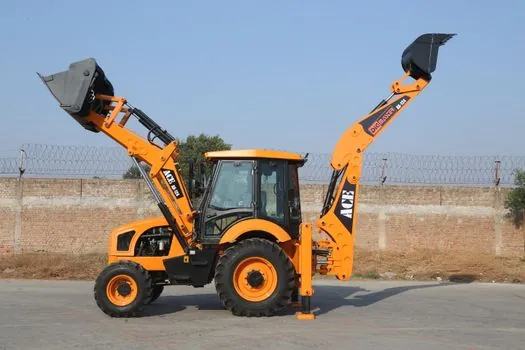
For buyers cross-shopping compact earthmoving equipment, the Motor Grader vs Backhoe Loader spec cut covers the grading-versus-digging trade-off, while the Motor Grader vs Road Roller spec cut addresses finish-grading versus compaction sequencing on the same haul road. For the lower end of the size scale, the Bulldozer vs Skid Steer Loader spec cut is the right read when the decision is between track-push dozing and tire-spin skid-steer site prep. [S1]
The summary decision rule is: ground type and finish tolerance, not brand loyalty, choose between these two machines. Hard surface plus attachment-heavy work points to a skid steer; long, open area plus fine tolerance points to a motor grader. Sourcing signals to track over the rest of 2026 include the rising share of electric compact loaders in rental fleets and the continued drop in GPS/sonic control retrofit prices, both of which are pulling grading capability down into smaller machines and may shift the boundary case over time [S3].