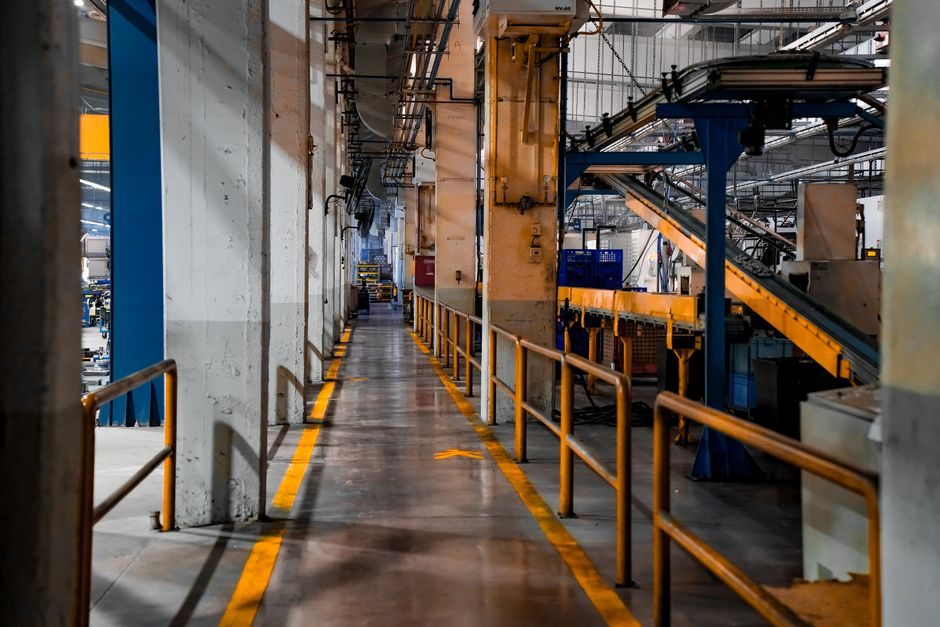
Roller conveyor selection in an automotive parts warehouse or assembly feed line is decided by three coupled numbers: roller diameter (commonly 1.9 in / 2.5 in / 3.5 in per ICC's stocked 1-3/8", 1.9", 2.5", 3.5" roller catalog [S2]), unit-load class (light cartons vs. totes vs. steel-rack dunnage at 50-150 kg/load), and drive topology (gravity, line-shaft, chain-driven live roller CDLR, or motorized drive roller MDR) [S2]. Get any one of these wrong and the line jams, parts get scratched, or the controller fights the operator all shift.
For automotive parts logistics specifically, the working envelope is narrower than general warehousing: parts are usually moved in stackable plastic totes (often 600x400 mm or 400x300 mm footprint), corrugated gaylords, returnable metal racks, or engine/transmission sub-assemblies on dedicated dollies. That range — say 5 kg cartons up to 200 kg powertrain skids — maps cleanly onto ICC's published roller and frame families, which is why roller conveyors remain the dominant accumulation-and-transport workhorse even as AGV and AMR cells grow [S2].
Roller Diameter, Pitch, and Frame: What Actually Sets Capacity
Roller diameter is the first spec an integrator should freeze. ICC stocks 1-3/8" (light carton, typically ≤ 30 kg/m), 1.9" (general light-tote duty), 2.5" (medium duty, the automotive sweet spot for totes and small sub-assemblies), and 3.5" (heavy rack and pallet-adjacent loads) as standard models [S2]. Roller pitch (centre-to-centre) is the next constraint: a common rule of thumb is pitch ≤ 1/3 of the shortest conveyed part length to prevent tipping, with typical 3" / 4.5" / 6" pitches used across the ICC 138/192/196/251/254/297/3530 series [S2].
Frame section height matters more than most buyers realise. A low-profile 125/250/300/400 Series belt conveyor from ICC is specified when operators need to reach across the line [S2]; for gravity roller sections feeding an automotive kitting cell, frame-incline of roughly 3-5° (5/16" to 7/16" per foot) is the working range for polyurethaned steel rollers carrying 30-80 kg totes. Going past ~6° risks tote creep on stop-and-go accumulation without a brake roller. Bearings inside the rollers — covered in detail on the roller bearing encyclopedia page — typically run 6203 / 6204 / 6205 ZZ pressed into a 1.9" / 2.5" / 3.5" tube for these duty cycles.
Drive Topology Compared: Gravity, Line-Shaft, CDLR, MDR
Four drive topologies dominate the automotive-parts conveyor spec sheet, and the choice is a direct cost-vs-control trade-off. A side-by-side comparison, using ICC's published model families as the reference [S2]:
· Gravity (RA/RC/RD/RJ/RU/RCD series) — zero energy, lowest capex, requires 3-5° decline; suitable for end-of-line takeaway and simple accumulation zones, no ZPA control.· Belt-driven live roller / line-shaft (138LR, 196CALR, 196LRC, 196LRCS, 251CALR, 738LS/796LS families) — single 1 HP motor drives many metres via urethane O-rings or shafts; reversible, ZPA-capable with 138VP/196VP/196ZPA modules, good for medium-throughput automotive kitting [S2].· Chain-driven live roller (192CDLR, 192CDLRC, 192CDLRS, 254TCDLRC, 251CDLR, 297CDLR, 3530CDLR) — positive drive per roller via #40/#50/#60 chain, handles oily/greasy underbody and axle parts, higher pull-out torque, more maintenance [S2].· Motorized drive roller / MDR (Urethane O-Ring with Motorized Drive Rollers, Motorized Pulley Belt Conveyor) — 24 VDC or 400 VAC brushless rollers distributed every 1-2 m, PLC-controlled zone-by-zone; highest controllability, ~30% energy saving vs line-shaft at partial load, but vendor-locked on the roller chain and electronics [S2].
For automotive parts logistics specifically, line-shaft (138LRC/196LRC) and CDLR (192/254CDLRC) are the workhorses in body-shop and powertrain feed lines, while MDR is the default in new greenfield parts distribution centres (PDCs) because zone control maps directly to WMS/WCS handshakes.
Selection Criteria for Automotive Parts, Not General Cartons
Five criteria separate a correct spec from a "fits on paper" spec in an automotive-parts environment. First, oil and fluid resistance: underbody, axle, and transmission lines shed cutting fluid, gear oil, and assembly lube; CDLR chains and MDR roller covers must be specified for this — a standard line-shaft with bare urethane O-rings will slip within weeks. Second, ESD: any tote carrying ECUs, sensors, or infotainment PCBAs must run on ESD-rated rollers (typically 10^6 to 10^9 Ω surface resistivity), and the frame must be bonded to a single ground point per IEC 61340-5-1 practice even where a formal certification is not invoked [S2].
Third, accumulation behaviour: zero-pressure-accumulation (ZPA) modules in the 138VP / 196VP / 196ZPA / 796LSZ / SZ196ZPA / SZ251ZPA / SZ192CDA families are what stop a 30-tote backup from crushing the first one against a dead-end; non-ZPA live roller lines should not be specified where totes queue. Fourth, total roller load: a 3.5" roller on a 6" pitch at 1.5 m/s with 100 kg/unit gives roughly a 2-3 kN point load per roller — frame channel and floor anchor spacing should be reviewed against that, not against the catalogue "max load" which usually assumes static, evenly distributed weight. Fifth, controllability hand-off: the conveyor PLC must expose zone-release and jam-bit diagnostics to the upstream WMS via PROFINET, EtherNet/IP, or EtherCAT, otherwise recovery from a single tipped tote becomes a manual reset of an entire 50 m line.
Layout Patterns Used in Automotive Parts Logistics
Three layout patterns cover roughly 80% of new automotive-parts conveyor scopes. Pattern 1 is the "L" — receiving inbound totes on gravity roller (RA/RC series), turning 90° onto a line-shaft or MDR spur that feeds a kitting rack, with a takeaway powered curve into the supermarket aisle [S2]. Pattern 2 is the end-to-end assembly feed: a single CDLR or MDR trunk run of 40-120 m with workstations tapping off each side, sized so that line stop at any one station does not propagate more than 3 zones upstream via ZPA logic [S2].
Pattern 3 is the returnable rack loop: heavy 3.5" roller CDLR (297CDLR, 3530CDLR, 351TCDLRC) carrying empty metal racks back from the assembly line to the PDC, often on an elevated second level above the outbound line. For powertrain sub-assemblies, a fourth pattern — chain-driven roller merging with a tapered roller conveyor infeed from a press or machine shop — is common; here the tapered roller bearing inside each drive roller is what takes the radial+thrust load through index-and-stop cycles. Where the line turns, crossed roller transfer decks or 90° powered-curve modules (196CALR / 251CALR) maintain the same roller diameter and pitch through the arc [S2].
Failure Modes and Limits Buyers Should Price In
Roller conveyor downtime in automotive plants clusters around six failure modes. (1) Urethane O-ring stretch on line-shaft drives — replace at 6-12 month intervals in 3-shift plants; specify 2 O-rings per roller as a maintenance buffer. (2) Chain elongation on CDLR — fit an adjustable take-up idler per 15-20 m run; [S2] lists adjustable cassette take-ups on the 192/254CDLRC frames. (3) MDR electronics — controller cards and 24 VDC bus faults dominate MDR downtime; spec a 10% spare-card float and a documented hot-swap procedure.
(4) Roller bearing seizure in washdown or oily zones — derate the catalogue "max load" by 25-40% in those environments even when sealed-for-life bearings are used. (5) Frame twist from uneven floor — anchor spacing longer than 1.5 m on a non-flat slab will rack the frame and bind rollers; survey the floor before layout sign-off, not after. (6) Tote skew at merges — a single-speed merge with no skewed roller or photo-eye will jam every few hundred cycles; always spec a 30° skewed-roller or right-angle transfers at any merge. None of these are exotic, but each will burn 2-4 hours of line time per week if underspec'd, which on a takt-stamped automotive line is a measurable lost-throughput number.
Standards, Sourcing, and What to Put on the RFQ
Three documents should be referenced on the RFQ even if the line is bought as a turnkey package: ISO 5048 (continuous mechanical handling equipment — belt conveyors; adjacent to roller spec for safety), CEMA B105.1 / ANSI/CEMA standard-duty frames for structural verification, and the manufacturer's own published roller load tables — for ICC, these are tied to the 138 / 192 / 196 / 251 / 254 / 297 / 3530 series frame numbers [S2]. For EU-sourced builds, EN 619 applies to continuous handling equipment and the machinery safety provisions of the Machinery Directive (2006/42/EC) govern the integrated safety stop circuits. For electrical control panels, IEC 60204-1 governs the build, and any ZPA / jam-bit I/O should be wired through a safety PLC where personnel are within the cell.
For sourcing, the practical pool documented in 2026 includes Rollcon Engineers (India, integrated conveyor + bulk-handling systems including roller conveyors) [S1], Innovative Conveyor Concepts / ICC (US, 39,000 stocked sizes with 24-hour shipping, full line of gravity / live-roller / CDLR / MDR / accumulation / pallet-handling) [S2], and Avismatic Solutions (India, Thane, custom belt/roller + bucket elevators for packaging distribution) [S3]. For bearings inside the rollers, the INA brand (part of Schaeffler, founded 1946, Nuremberg) is a common supplier of the drawn-cup and needle bearings used in 1.9"/2.5" conveyor rollers [S4]. A compact RFQ line item for an automotive-parts gravity run therefore reads: "50 m x 600 mm BW gravity roller, 2.5" x 1.9" dia. x 4.5" pitch, 11-gauge galvanized tube, 6203 ZZ bearing, 3-5° incline, frame height 80 mm, ESD-rated, qty 110 rollers" — and the same shape applied to live-roller zones.
Trackable signals for the next design review: (a) whether the new PDC specifies MDR-only or hybrid MDR/CDLR, since that decision locks the controls architecture for 10+ years; (b) the spare-parts kit offered by the integrator — at minimum 2% spare rollers, 5% spare O-rings/chains, 1 spare MDR card per 50 zones; (c) the cycle test certificate on roller bearings (typically L10 life published in hours at a given rpm and radial load) so the maintenance team can plan replacements instead of reacting to seizures. For die-cast or forged automotive components moving upstream of the roller line, the die-casting machine selection for automotive parts spec map is a natural adjacent reference.