
Roller conveyor specification for pharmaceutical distribution is a materials-and-finishes problem first, a drive-selection problem second: cleanroom-rated lines built around stainless or zinc-plated components with documented roller diameters and ZPA accumulation are the dominant pattern in 2026 OEM catalogues [S1][S2].
Current vendor offerings split cleanly into two duty classes — heavy pallet handling at 1,500-4,500 kg loads on S235JR frames with 89 mm rollers at 12 m/min [S1], and lighter carton/case accumulation at 24V drive-roller ZPA on modular stainless or powder-painted C-frames [S2] — and the wrong class picks a frame that cannot be sanitised.
Two pharmaceutical duty classes: pallet handling vs carton/case accumulation
Pallet-handling roller conveyors in pharmaceutical DCs typically run an ANTIPODA-class build: reinforced double-formed 3 mm S235JR side frame powder coated RAL 9006, with zinc-plated rollers in 89 mm x 3 mm or 76 mm x 3 mm diameters, roller lengths 930/1,130/1,330 mm, and 150 mm or 175 mm pitch [S1]. Maximum load spans 1,500-4,500 kg across 1-3 pallets per conveyor, conveyor speed is fixed at 12 m/min (0.2 m/s), and operating temperature is rated 5-50 °C / 41-122 °F [S1].
Carton/case lines for blister packs, vials, and pre-filled syringes take the Insar-class build: C-frame in stainless steel or powder paint, modular construction, with roller executions in galvanized, plastic, PVC-sleeved, or friction/accumulation variants, and conveyor parts from Interroll, Rulmeca, Kraus, or Itoh Denki [S2]. Drive options span gravity, tangential chain, and 24V drive rollers, with ZPA (Zero Pressure Accumulation) logic for back-pressure-free buffering at sortation and order-picking nodes [S2].
Material and finish spec map for pharma-clean environments
Pharmaceutical distribution centres that fall under cleanroom or GMP-adjacent classifications should default to stainless-steel C-frames with documented roller finishes rather than painted mild steel: stainless avoids paint-chip contamination, tolerates aggressive sanitising chemistry, and is the explicit sector tag on Insar-class roller-conveyor builds for the pharmaceutical industry [S2]. ANTIPODA-class pallet frames use powder-coated S235JR with zinc-plated rollers, which is acceptable for non-sterile warehouse zones but is not a cleanroom finish [S1].
Roller-sleeve selection is the second hygiene decision: galvanized rollers suit dry packaging, PVC-sleeved rollers dampen noise and protect carton edges, plastic rollers handle washdown, and friction/accumulation rollers are sized for ZPA logic [S2]. For lines carrying packaged vials or bottled product, conical rollers in 90-degree curves keep transfer geometry tight without exposing the load to flat-belt pinch points [S2].
Drive mechanism and motor selection: 400V gearmotor vs 24V ZPA
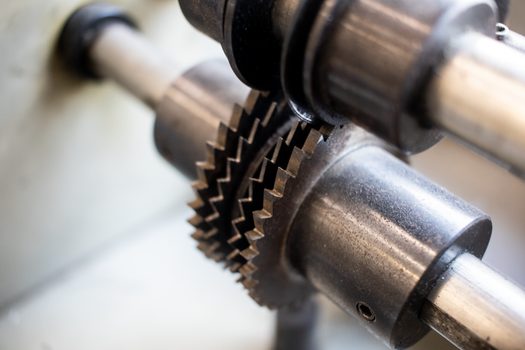
Pallet lines are typically powered by SEW gearmotors in three voltage variants — 230/400V 50Hz 3-phase IP55 CE, 230/460V 60Hz 3-phase IP55 UR, and 330/575V 60Hz 3-phase IP55 CSA — with bidirectional load travel and a fixed 12 m/min speed [S1]. This class of drive is rated for 1,500-4,500 kg loads and continuous pallet transfer; conveyor supports are specified separately from the conveyor itself, which simplifies seismic anchoring and floor-level integration [S1].
Carton/case lines use a fundamentally different drive architecture: 24V DC drive rollers with ZPA logic replace the central gearmotor, allowing each zone to start and stop independently without back-pressure on upstream product [S2]. The trade-off is throughput ceiling — 24V drive rollers are typically spec'd for carton and tray weights, not pallet loads — and the need for distributed control cabinets (commonly mounted as a power distribution box at each zone cluster) to feed the 24V bus. For larger distribution-centre builds, motor control and zone logic are often consolidated into a distribution cabinet per line.
Conveyor roller selection: diameter, pitch, load, and bearing class
Roller diameter and pitch set both load rating and the smallest carton that can be conveyed without sag or tip: 89 mm rollers at 150-175 mm pitch handle the 1,500-4,500 kg pallet class, while 50-60 mm rollers at 75-100 mm pitch are typical for carton accumulation zones [S1][S2]. The roller itself is a precision component — for any line above 12 m/min or with accumulation cycles above 200 starts/hour, roller bearing class (typically 6202-6204 ZZ for light-duty carton rollers, 6205-6206 for pallet rollers) governs service interval more than the roller-tube spec.
Conveyor-roller sourcing in 2026 is dominated by a small set of OEMs — Interroll, Rulmeca, Kraus, and Itoh Denki are explicitly named as build-of-material for pharma-class lines [S2] — and the broader supply base (e.g. Huzhou Jiutong for accumulate-roller series, sprockets, and conveyor parts) covers non-pharma general material handling [S3]. Specifying OEM-roller replacement part numbers at RFQ stage is the cheapest insurance against bearing failure on a validated pharma line.
Selection criteria comparison: pallet line vs carton line vs hybrid
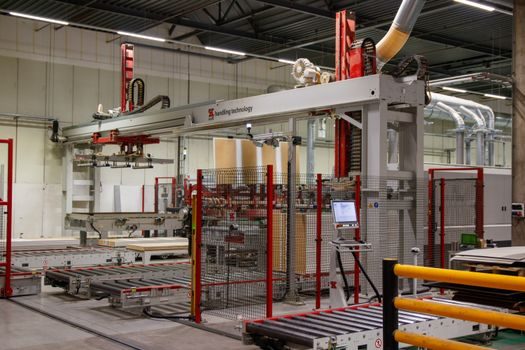
Side-by-side against four procurement criteria: (1) maximum load — pallet line 1,500-4,500 kg, carton line typically ≤100 kg per zone, hybrid requires sectioned drives; (2) frame material — pallet line S235JR powder-coated RAL 9006, carton line stainless or powder-painted C-frame; (3) drive — pallet line SEW gearmotor at 12 m/min fixed, carton line 24V ZPA drive rollers; (4) typical sector fit — pallet line pharmaceutical/automotive/wood, carton line pharmaceutical/food/cleanroom [S1][S2]. The hybrid approach (pallet infeed, case pick, pallet outfeed) is the most common pharma-DC layout, but it requires two separate control architectures on the same line.
For engineers comparing the broader conveyor-equipment ecosystem, the roller conveyor entry covers the underlying technology definitions, while a cold chain roller conveyor spec map is the closer analogue for temperature-controlled pharma (2-8 °C vaccine distribution) than a generic food-and-beverage line. For non-pharma adjacent material-handling specs, the roller conveyor selection for e-commerce fulfillment article covers higher-throughput carton flows with similar ZPA logic.
Use cases, failure modes, and what NOT to specify
Specified-for cases: pallet transfer between stretch-wrap and storage-rack aisles in pharma DCs (ANTIPODA-class 1,500 kg at 12 m/min, 5-50 °C operating envelope) [S1]; carton sortation with ZPA accumulation to order-picking stations in cleanroom-adjacent packaging halls (Insar-class stainless C-frame, 24V drive rollers, Interroll/Rulmeca parts) [S2]; transfer stations and 90-degree curves with conical rollers at line junctions [S2].
Failure modes and mismatches to flag at RFQ: specifying painted S235JR for any washdown or cleanroom zone (paint chips contaminate open product), specifying 24V drive rollers for pallet loads (drive-roller torque ceiling is well below 1,500 kg), specifying 12 m/min for manual pick stations (operators need ≤6 m/min, achievable only with a VFD on the SEW gearmotor), and omitting conveyor supports from the conveyor scope (they are not included by default in ANTIPODA-class builds) [S1][S2]. For hazardous-area pharmaceutical solvent handling, an explosion-proof distribution cabinet is the right motor-control spec rather than a standard distribution cabinet.
Trackable signals over the next procurement cycle: (1) whether pharma-DC RFPs increasingly demand documented cleanroom-class roller bearing seals (2RS-2Z) over open-shield variants, (2) whether 24V ZPA drive-roller suppliers consolidate around the named OEM list (Interroll, Rulmeca, Kraus, Itoh Denki) or broaden to Chinese accumulate-roller OEM series for cost-down builds [S2][S3].