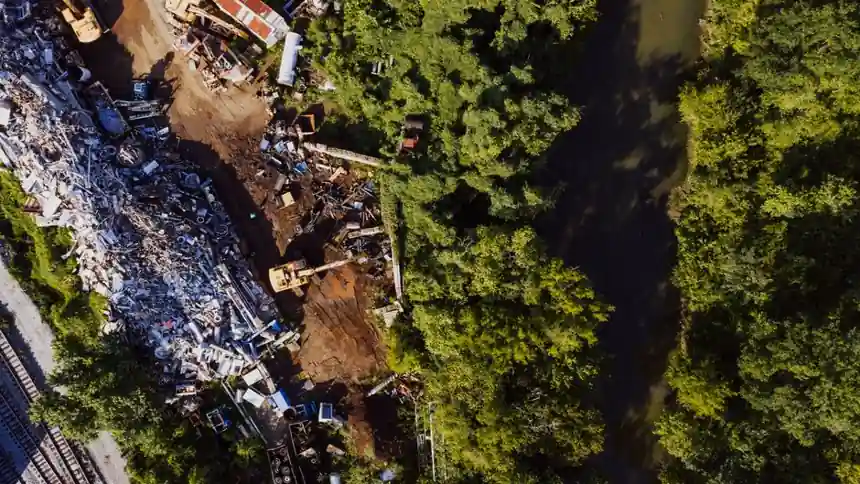
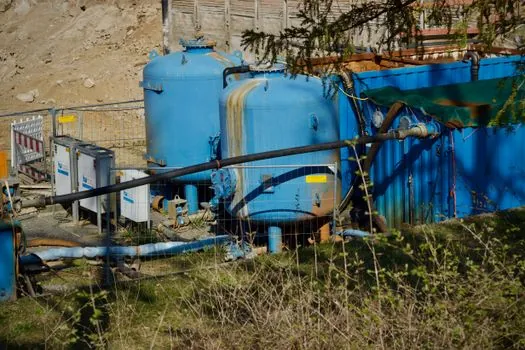
Landfill site tanks store leachate, landfill gas condensate, contaminated stormwater, and chemical dosing fluids, each of which deposits a different residue profile (sludge, scale, biofilm, or hydrocarbon sheen) on internal walls. A tank cleaning machine selected for this duty must therefore clear solids-laden waste, survive corrosive media, and operate under confined-space entry rules.
Selection logic in 2026 splits into four decision axes: pressure class (low-pressure spray 40-150 PSI vs. high-pressure hydro jetting 10,000-40,000 PSI), drive type (electric, pneumatic, hydraulic), coverage mechanism (static spray ball, rotary spray head, rotary jet head), and waste-stream handling (on-site filtration vs. vacuum truck removal) [S6][S2].
Residue profile drives machine class
Leachate tanks typically accumulate a mixed organic-inorganic sludge with total suspended solids in the 2,000-15,000 mg/L range and pH swinging from 4.5 to 8.5 depending on landfill age, which forces operators toward rotary jet heads at 100-200 PSI rather than static spray balls [S2]. Rotary jet heads use concentrated solid streams and a self-driven gear or nozzle-reaction head to throw repeated impact patterns across 360 degrees, cutting cycle time versus static spray balls on tanks above roughly 5 m³ [S3].
Condensate and light-oil separator tanks carry a thinner, hydrocarbon-rich film where low-pressure rotary spray heads (40-100 PSI, free-rotating spinner) deliver adequate clean-in-place performance with lower water and chemical consumption; Alfa Laval cites up to 90% water, energy, and chemical savings when CIP cycles are re-tuned against an existing process [S3]. For hardened scale or polymer buildup, hydroblasting at 10,000-40,000 PSI remains the only mechanical option, but it requires a vacuum truck or slurry pump to manage the resulting waste stream in parallel with the cleaning pass [S6][S4].
Pressure, flow, and coverage: a criteria table
Four cleaning machine classes dominate landfill tank service, and they line up against the four selection criteria that matter on site. The matrix below draws the comparison from public manufacturer guidance [S2][S3][S6][S7].
Static spray ball: low pressure (typically under 50 PSI), high flow (10-150 GPM depending on tank diameter), full 360-degree pattern via fixed orifices, suited to tanks under 5 m³ with light residue and CIP-compatible chemistry. Rotary jet head: medium pressure (100-200 PSI), low-to-moderate flow, indexed multi-nozzle jet pattern that reaches 100% of shadow areas when paired with a wall-mounted device, suited to large process tanks and landfill leachate sumps [S3]. High-pressure hydro jetting lance: 10,000-40,000 PSI, low flow, operator-held or robotic crawler, suited to heavy scale, hardened sludge, and one-off decontamination campaigns [S6].
Who it is FOR and who it is NOT for
Automated rotary jet heads are a fit for landfill operators running continuous leachate treatment, where cycle time between tank fills compresses to under 24 hours and manual entry carries a measurable confined-space incident rate. Automated systems also fit food, pharma, and dairy processing plants, which the broader market report estimates as the second and third largest adopters behind oil and gas (Oil & Gas at 35.2% share, Asia Pacific at 38.5% regional share) [S5].
They are not a fit for one-time sludge removal on a 20-year-old lagoon, for tanks with severe structural corrosion, or for sites without on-site waste-water treatment capacity to handle the cleaning effluent. Manual tank cleaning still anchors the long tail of utility and landfill work because the capital cost of an automated system is only recovered above a sustained cleaning volume [S4]. A paired IBC tank intermediate buffer, or temporary tank container drop, lets the operator drain and clean without shutting the wider leachate handling loop, which is often the deciding factor at small-to-mid landfills.
Cycle time and throughput economics
The case for automation rests on cycle-time compression. Industry research reports that automated tank cleaning cuts a typical 8-12 hour manual cycle down to 2-3 hours, with secondary savings on water, chemical, and labor exposure [S5]. For a landfill running 6-12 leachate tank cleanings per month, that delta is the single largest line item in the payback calculation.
On the other hand, the same automation does not eliminate the vacuum truck, sludge hauling, or confined-space safety setup; it only replaces the wash-down pass. Enviroserve's 2026 utility-sector guide lists six process steps, and only one of them is the actual cleaning pass: assessment, safety setup, sludge and liquid removal, cleaning, waste handling, and final inspection [S4]. Planning a self-cleaning filter upstream of the wash-water return line reduces the solids load that the cleaning machine has to push back through the system, extending nozzle life and cutting downstream filter change-out.
Standards, safety, and deployment constraints
Regulatory pressure cited in the 2025 automated tank cleaning market study includes the U.S. EPA, the EU Pressure Equipment Directive, and ISO 14644 cleanroom standards as drivers pushing operators away from manual wash-down and toward enclosed, instrumented cleaning cycles [S5]. For landfill sites specifically, confined-space entry falls under OSHA 29 CFR 1910.146 in the U.S. and equivalent national rules elsewhere, which means any cleaning machine specified for manual-entry tanks must be compatible with a tripod, winch, and continuous gas monitoring, not just with the wash chemistry.
ATEX or IECEx-rated electric or pneumatic drive is required whenever the tank has held flammable condensate or hydrocarbon residues, and the cleaning machine vendor must supply the zone classification on the nameplate. Specifying a flow meter on the cleaning-fluid supply and a pressure transmitter on the discharge line gives the operator a verifiable record of pressure and volume per cycle, which is increasingly required for environmental compliance reporting on landfill sites.
Failure modes and field limitations
Three failure modes recur in landfill tank cleaning service: nozzle fouling from high-TSS leachate, gearbox seizure in rotary heads after long idle periods in a corrosive atmosphere, and hose rupture in hydro jetting campaigns run above 20,000 PSI without a properly rated whip-check. Spray.com's selection guidance flags that cleaning efficiency is governed as much by impact force and dwell time as by total flow, which is why a 100 GPM rotary jet head at 150 PSI outperforms a 200 GPM static spray ball on a heavy sludge tank [S2].
Field data also shows that operators who skip the pre-removal of free liquids and loose sludge consistently double their cleaning cycle, because the machine spends most of its pass re-suspending material that should have been vacuumed out first [S4]. For landfill cells and capping work where heavy equipment access is part of the same project, the spec map for landfill cell construction equipment asphalt paver selection for landfill cell construction and the wheel loader spec map for transfer stations wheel loader spec map for landfill and transfer station work give the parallel heavy-equipment context, since the same site often shares the contractor pool.
Track next: the next 6 months will surface 2026-vintage OEM application notes on rotary jet head indexing patterns for tanks above 50 m³, and the market research will refresh its 7.4% CAGR baseline against 2025 actuals in the Q1 2027 update [S5].