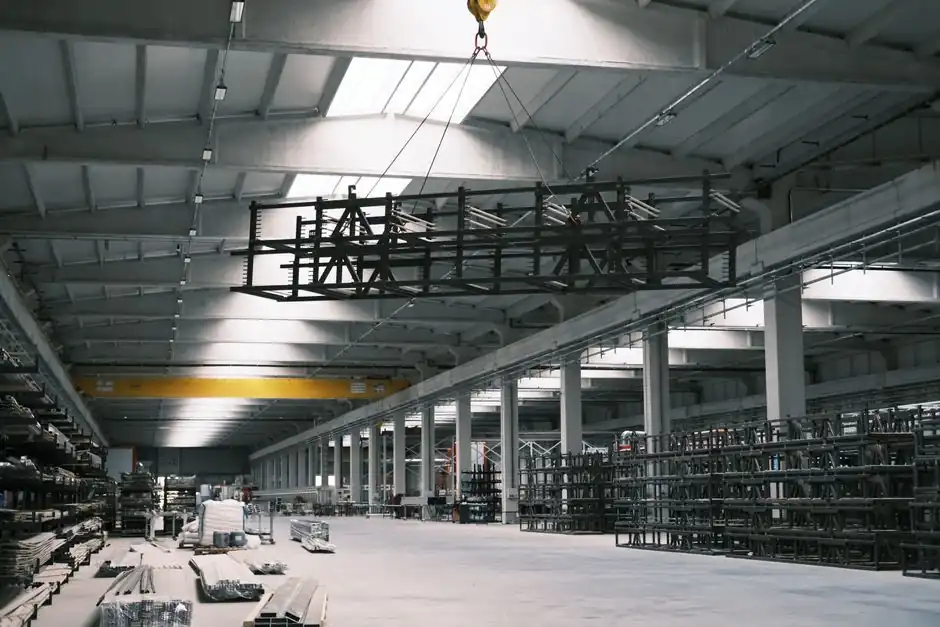
For road construction storage, the rack choice is driven by what gets staged: pipe, rebar, geotextile rolls, sign hardware, drums of asphalt emulsion, and palletized cold patch. A jobsite yard running the GMA-standard 40"x48" pallet, with one to three SKUs per item and steady LIFO rotation, is a textbook selective rack application [S1].
A yard storing long-length material (drainage pipe, guardrail, form lumber) needs cantilever arms, not a beam-and-upright pallet rack at all. Pallet flow or drive-in systems earn their premium only when a single SKU fills four or more deep positions [S1][S2].
Pallet Geometry and Frame Sizing
The 40"x48" GMA pallet is the baseline dimension most selective and drive-in rack beams are designed around, and it remains the default spec for highway and street work consumables like bagged cement, salt, and cold mix [S1]. Rack depth is typically set to either one-pallet (selective) or two- to six-pallet deep (drive-in, pallet flow), and upright heights commonly run 8 to 24 feet depending on how high the contractor's reach truck can place a loaded pallet [S1][S2].
Beam length is selected by pallet count per bay: a single 40"x48" pallet with 4-inch overhang each side calls for a 96-inch beam; double-pallet bays use 192-inch beams in many off-the-shelf systems [S1].
Aisle Width and the Forklift Constraint
Aisle geometry is dictated by the lift truck, and the truck choice, not the rack, is usually the dominant capex item [S2]. Wide aisles measure 156 inches or more and pair with sit-down counterbalance forklifts typical in road-build staging yards receiving full truckloads of aggregate bags or pipe [S2]. Narrow aisles at 108 to 132 inches take reach trucks and are the most common North American warehouse layout [S2]. Very narrow aisles (VNA) at 72 to 78 inches force turret or order selector trucks and impose single-vehicle-per-aisle operation, a poor match for the multi-trade, overlapping shifts common in road construction staging [S2].
The transition math matters: moving from wide to narrow aisle is mostly a truck swap plus re-install, while jumping to VNA changes the operating model, often hurting throughput if the site still needs counterbalance flexibility [S2].
Selective vs Drive-In vs Cantilever vs Pallet Flow
Four rack families cover nearly every road-construction yard scenario, and the selection rule is the SKU-to-position ratio [S1][S2].
Selective pallet rack: one pallet per SKU, full access to every position, lowest cost per position but the highest aisle-to-position ratio. Best for sign hardware, traffic-control devices, and small-parts picking [S1].
Drive-in and drive-through rack: vehicles drive into the rack structure on rails, suiting LIFO (drive-in) or FIFO (drive-through) rotation.
Push-back rack: carts on inclined rails let pallets nest 2 to 6 deep with LIFO rotation and roughly 85% selectivity per bay, a middle ground for asphalt-emulsion drums and bagged product with two to four pallets per SKU [S1].
Cantilever rack: open-front uprights with adjustable arms store long, awkward loads. Guardrail, conduit, PVC pipe, geotextile rolls, and lumber all live here. Standard arm lengths run 24 to 48 inches with load capacities from roughly 1,000 to 5,000 lb per arm pair, depending on column spacing and base-plate anchoring [S1].
Pallet flow rack: gravity-roller or wheel-track lanes deliver strict FIFO rotation. Useful for date-sensitive cold patch or deicing salt when the contractor wants first-in stock leaving first, but it is the most expensive option per position and only pays back when turnover is high and predictable [S1].
Environmental Load: Cold, Dust, and Galvanizing
Road-construction yards are typically outdoor or semi-covered, which changes the rack specification compared to a clean indoor DC. Cold-storage racking is a recognized cost premium, driven by thicker steel sections and often hot-dip galvanizing for de-icing salt or brine exposure [S1].
For salt and brine storage, hot-dip galvanizing to ASTM A123 is the common spec; for general yard duty, powder coating over powder-coated or pre-galvanized steel is typical, and the specifier should confirm the finish matches the stored chemistry [S1].
When Drive-In Beats Selective, and When It Doesn't
Drive-in is the right call only when the same SKU fills the lane from front to back. A 2019 industry white paper notes that single-deep post-and-beam (selective) racks provide the lowest cost per pallet position of any racking option, but only when the bay-fill pattern is shallow; once a single SKU reliably occupies four or more deep positions, the higher-density systems overtake selective on a per-pallet-position basis [S2].
For high-SKU-count contractor yards (sign hardware, fasteners, small tools), that loss of access is unacceptable, and the drive-in savings disappear once you count the extra handling time [S2].
Seismic, Anchoring, and Code Floor Loading
Any rack taller than roughly 12 feet, or any rack carrying aggregate bags in tiers, should be anchored to the slab with the base plate and expansion-bolt pattern the manufacturer publishes, and the slab itself should be verified against the rack's combined live-and-dead load per square foot [S1].
Road-construction yards often pour lightweight slabs designed for the equipment, not for loaded racks; before installing a 24-foot-tall selective system, the contractor should get the slab thickness and reinforcement confirmed by a structural engineer, since a fully loaded pallet position can easily reach 2,500 to 3,000 lb, and a 12-bay run of those becomes a serious point load [S1].
Matching the Rack to the Project Phase
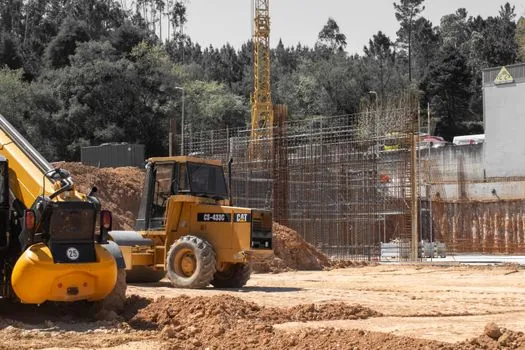
Different road-build phases stress different rack types. Earthwork staging pushes long pipe and geotextile rolls, so cantilever with 36- to 48-inch arms is the workhorse. Base and paving phases stockpile bagged cement, emulsion drums, and cold patch, which lean on selective and push-back depending on SKU count. MOT (maintenance of traffic) hardware, signs, cones, and attenuators are small-parts territory, where bin shelving on selective rack frames or wire-mesh decked shelving dominates [S1].
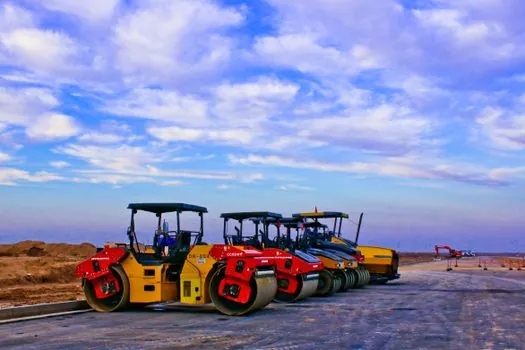
For contractors running multiple active projects, the forestry road roller drum-type and spec map for the equipment side and the asphalt paver tie-in spec map for the paving side both touch the same yard-staging logic: the rack family should match the equipment duty cycle, not just the square footage available.
Track the next two signals: any 2026 update to RMI's MH 16.1 specification for the design, testing, and utilization of industrial storage racks, and any DOT or AASHTO material-handling guidance revisions that would push yard specs toward galvanizing or higher seismic bracing. For equipment-side yard handling, the motor grader selection for ports and terminals reference offers a useful comparison baseline on duty-cycle and wheel-load thinking that maps cleanly onto a yard forklift spec.
For component-level specifications, see storage rack, road roller, and construction tools.