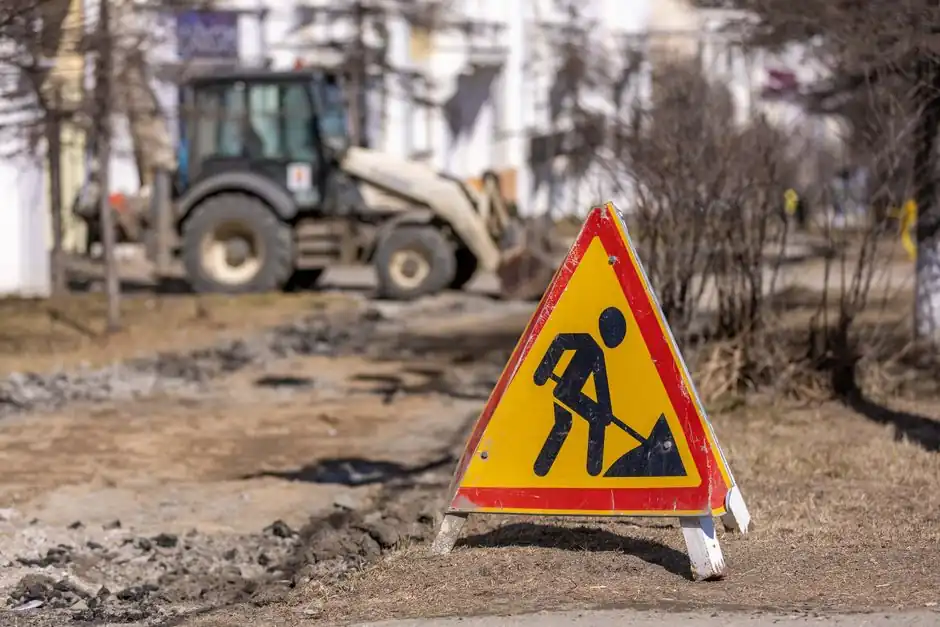
A dual-grade rotary laser with a 0-10% slope range on both X and Y axes is the workhorse instrument for road maintenance crews resurfacing, milling, or re-grading pavement, because most road profiles require cross-fall or crown, not a flat plane [S4].
Working distance on a typical county-road job sits between 200 ft and 2,000 ft, which is firmly in rotary-laser territory; line and dot lasers lose visibility past roughly 100-150 ft even with a green beam [S3][S2].
Why Road Maintenance Is a Rotary-Laser Job, Not a Line-Laser Job
Road maintenance spans four recurring tasks: full-depth reclamation, asphalt overlay, shoulder and ditch grading, and storm-drainage correction. Three of the four require a sloped reference, which only a single-grade or dual-grade rotary laser can project [S4]. For overlay work, the crew typically runs a 1.5-2% cross-fall from centerline to shoulder; if the laser cannot hold that slope in both axes simultaneously, the screed operator is chasing a moving target every pass.
Self-leveling-only rotary lasers (no grade input) are a poor fit for any of these tasks because they project a perfectly horizontal plane, which is wrong for crowned roads and drainage ditches [S4]. Reserve a self-leveling-only unit for flat bridge-deck pours or slab-on-grade work, not for in-service pavement.
Range and Receiver: The 200 ft / 1,000 ft / 2,000 ft Tiers
Engineer Supply's rule of thumb puts plumb and line generators in the 1-150 ft band and rotary lasers at 200 ft and beyond, which maps cleanly onto road maintenance where a milling drum is rarely closer than 50 ft to the laser and a receiver on a 15 ft grade rod may be 800 ft away [S3]. Mid-tier rotary kits such as the Milwaukee 3704-21T and Spectra Precision LL300S-47 advertise 1,000-2,000 ft working diameter with a receiver, and long-range units like the Makita SKR001Z reach 2,600 ft, which covers interchange and runway-scale work without relocating the instrument [S1].
Visible-beam range is much shorter than detector range. Green rotary beams are easier to spot in low light but still wash out in direct sun past about 100 ft, which is why every rotary-laser kit for road work must include a detector and a rod clamp [S5][S1].
Accuracy Bands: ±1/8" at 30 ft vs Millimeter Tolerance Over 100 m

Consumer-grade point and line tools are typically rated ±1/8 in. at 30 ft, which is fine for hanging pictures but three orders of magnitude too loose for pavement [S2]. Road-maintenance specifications call for subbase truing within 12 mm (about 0.5 in.) over a 100 m run, and finished pavement cross-fall within 0.2% of design [S4]. The Klein 93PLL, a 360° interior planar tool, is rated ±4.5 mm per 10 m, which is roughly ±0.45 in. over 100 ft; that is acceptable for interior layout and not for subbase grading on a live road [S1].
For comparison, a typical mid-grade rotary such as the Spectra LL300S-47 or Topcon RL-H5A delivers ±1.5 mm at 30 m (about ±0.06 in. per 100 ft), and dual-grade flagships like the Leica Rugby 840 and Topcon RL-200 2S hold ±1.0 mm at 30 m or tighter, which is what DOT-level overlay specifications require [S4].
IP Rating and Field Survivability on Milling and Paving Sites
IP ratings on a road job should be read as dust survival first, water survival second. Milling machines throw asphalt fines and aggregate dust, and a passing cloud can clog an unsealed housing in minutes. IP54 (splash and dust, like the Klein 93PLL) is the minimum for interior tools and is not adequate for milling or grader work [S1]. IP66, meaning dust-tight and resistant to powerful water jets, is the practical floor for any rotary laser that will live on a milling or paving spread [S6].
Drop and tip-over survivability is the other field reality. A 15 ft grade rod will get knocked over at least once per season, and a rotary laser on a heavy tripod survives a nudge; a line laser on a lightweight pole does not. Self-leveling mechanisms tolerate a 5° tilt during setup but go into a hard shutdown if the housing is inverted, so a stable tripod with a center-pole hook is worth more than another 0.5 mm of accuracy on the spec sheet [S4][S9].
Decision Matrix: Which Laser Matches Which Road Task
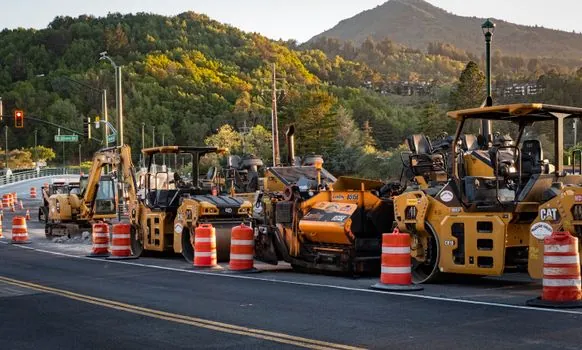
Three criteria separate the rotary options for a maintenance fleet: grade capability, working range, and IP rating. A self-leveling-only rotary with 1,000 ft range and IP66 is the lowest-cost acceptable unit and is suitable for bridge-deck and flat-slab work. Adding single-grade (0-10% on one axis) covers shoulder grading and simple drainage. Dual-grade (±10% on both axes) is required for full road-crown work, parking-lot drainage, and any task where the cross-fall changes along the alignment [S4].
For a 20-30 lane-mile county road crew, the working point is usually a mid-tier dual-grade unit with 2,000 ft receiver range and IP66, paired with a machine-control-compatible receiver if the spread runs a dozer or motor grader. Crews that only do thin overlay and patch work can stay with a self-leveling-only rotary and a handheld receiver, but they should budget for a second instrument the first time they take on a re-crown job. A related spec map on adjacent heavy-civil equipment, including diaphragm wall grab selection for urban infrastructure, follows a similar decision-band pattern: pick by the dominant task and the worst-case tolerance, not by the catalog price.
Receiver, Power, and Crew Workflow on a Live Road
A rotary laser on a road job is only as good as the receiver-rod workflow. The standard pattern is: tripod at a known benchmark, laser self-levels, each rod person extends or retracts the receiver until the unit beeps on grade, and the cut or fill is read directly off the rod in feet-and-inches or millimeters [S5]. Rechargeable Li-ion packs that deliver 9+ hours per shift and charge over USB-C have largely displaced alkaline sleds, because a dead mid-shift battery is a jobsite-standstill event [S1].
Manual leveling is still offered on some economy rotary units, but the time cost on uneven ground makes it a poor fit for road work, where a 5° automatic self-leveling window is the practical minimum [S9]. Slope entry on dual-grade instruments is now done through a panel keypad rather than physical screws, which removes a common source of operator error when a percent grade is misread.
What to Skip, and When to Replace, Not Repair
Line lasers, dot/plumb lasers, and 360° interior planar units should not be deployed on road maintenance regardless of price. Their working range tops out near 100-150 ft and their accuracy is one to two orders of magnitude looser than road tolerances require [S3][S1]. Trying to use them with a detector does not fix the range problem because the visible-beam fan angle is too narrow to be picked up at distance.
On a maintenance fleet, the dominant failure modes are cracked windows from tip-overs, corroded battery contacts from rain, and stripped slope-keypad membranes from glove use. None of these are field-repairable; the instrument should be sent for factory service or retired. If accuracy check on a known 100 ft baseline drifts beyond 3 mm, the unit is no longer a road-survey instrument and should be downgraded to interior use rather than trusted on pavement.
Trackable signals for fleet spec updates: the next refresh of the Spectra LL series and the Leica Rugby 8xx line typically lands in Q3-Q4 with updated Bluetooth slope-entry apps; dual-grade receivers with mm-resolution digital readouts are the next standard accessory, and any new spec on road-maintenance rotary purchases should require a digital readout receiver rather than an analog beeper.
Detailed specification references: laser level, road roller, and laser marker.