
Port and terminal fleets running loose bulk, aggregates, and ore concentrates should anchor the truck choice on three coupled decisions: payload class, axle layout, and body geometry, because each one shifts both operating cost and yard turnaround time.
The reference weight bands used in industry run from Class 4 (14,000-16,000 lb) through Class 8 (>33,000 lb), and most port-applied units sit in the Class 6 (19,501-26,000 lb) to Class 8 range where 6x4 and 8x4 drivelines dominate [S1]. The body choice between rectangular, U-shaped, mining, and side-tipping layouts then determines how cleanly sticky cargo discharges and how much residual weight the truck carries back to the loader [S4].
Axle Configuration and Payload Mapping for Yard Duty
Single-axle 4x2 layouts keep tare weight and fuel burn low but cap payload around the Class 3 envelope (10,001-14,000 lb) and suit only short intra-yard shuttles, per the application breakdown by drive type [S1].
Dual-rear-axle 6x4 trucks cover Class 6 to Class 7 work (19,501-33,000 lb) and are the workhorse of urban construction and mid-sized terminal logistics, pairing a strong load-bearing rear axle set with simpler maintenance than 8x4 [S1]. For port operators running three-axle 8x4 layouts, the extra axle spreads the load footprint and is the typical configuration for large-tonnage mineral, coal, or aggregate movement, with the same OEM guidance calling out multi-axle as the core configuration for compliant heavy transport [S1]. In a comparative sense, 4x2 wins on fuel per trip, 6x4 wins on versatility, and 8x4 wins on payload and pavement preservation; the trade-off is tyre count, brake maintenance, and turning radius in tight container yards. Engineering reference on broader construction machinery and equipment classes sits behind that choice and feeds into a fleet-level duty-cycle audit before any single truck is ordered.
Body Geometry: Rectangular, U-Shaped, Mining, and Side-Tipping
U-shaped buckets deliver up to 40% higher unloading efficiency than rectangular boxes on sticky materials, because the arc floor eliminates dead corners and lets wet sand, clay, sludge, and sticky ores slide toward the rear [S4].
Rectangular bodies carry larger effective internal volume and cost less to fabricate, but their right-angle corners trap material, force manual clean-out, and concentrate stress at welds under long-term heavy service [S4]. Common rectangular dimensions listed for port-scale chassis run 5600 x 2300 x 1500 mm and 7600 x 2300 x 2000 mm, while U-shaped equivalents at the same length tier measure 5200 x 2300 x 1200 mm and 7600 x 2500 x 1800 mm, so the U-shape trades a flatter floor depth for a wider top and a curved side wall [S4]. For dedicated mining dump truck service, the one-piece stamped floor, reinforced front wall, and triangular floor design extend the U-shape into a mining body built to take impact from large shot-rock lumps, which matters when port stockpiles feed bulk carriers from a quarry or pit source.
Selection Criteria Beyond Payload: Multi-Criteria Trade Space

Open-pit selection research groups criteria into four families (technical, technological, environmental, and economic-organisational) and ranks them with the FUCOM multi-criteria method, treating dump-truck hauls as up to 70% of pit operating expense and rising 20-30% per 100 m of depth in deep pits [S2].
For a port application the same logic transfers to truck-shovel cycle cost, with payload per trip, dump-body cycle time, and tyre life on concrete or paver aprons weighing more than headline engine power [S2]. Tier-1 buyers should treat the four-criteria family as a scoring template, not a generic checklist, because the FUCOM weighting shows that operating-condition factors (gradient, ramp geometry, loader match) outrank marketing-driven specs once a fleet exceeds 10 units [S2]. Buyers comparing dump truck candidates should also standardise on a published weight class, a chassis rating, and a body-volume figure before price discussions, since the same nominal "40-ton" rating from two suppliers can differ by 5-8% on allowable payload depending on body steel thickness and tare weight.
Drive Type vs Dumping Mechanism: Where Side-Tipping Wins
Side-dump bodies tilt the body sideways rather than lifting at the front, which lowers the centre of gravity during discharge and reduces rollover risk on uneven ground, an advantage on port aprons with patched concrete or settlement [S3][S4].
End dump and semi-end dump trucks still lead in construction and highway fleets because the front-lift geometry gives higher volumetric capacity per chassis length and works with standard rectangular and U-shaped bodies [S3]. The decision rule, drawn from the body type inventory, is that side-tipping pays off when the haul road is short, the dump point is constrained, and the cargo is free-flowing; rectangular or U-shaped rear dumps remain the default for long-haul, high-volume aggregate and ore movement between stockpile and ship loader [S4]. Off-road port operations in low-infrastructure terminals, including West African bulk berths, lean on the same heavy-duty off-road or port-oriented high-clearance chassis called out for rough-terrain duty, where strong low-end torque and ground clearance are specified over outright top speed [S6].
Operating Cost, Maintenance, and Safety Levers
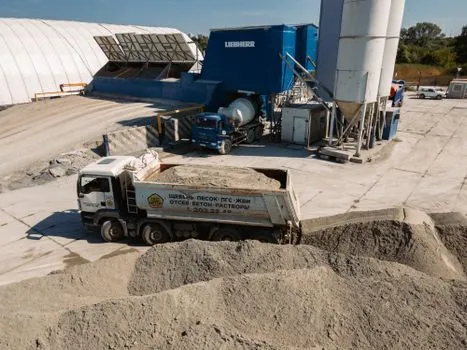
Weld seam cracking, side-panel deformation, and frequent clean-out are the documented failure modes of rectangular bodies under long-term heavy-duty cycles, while U-shaped bodies distribute impact loads more evenly and extend service life [S4].
Standard dump trucks in port construction feed use robust diesel engines with reinforced frames and durable suspension; modern safety packages layer in additionals such as reinforced cab structures and hydraulic system interlocks, per a 2026-03 OEM selection overview that flags reinforced frames, hydraulic lifting systems, and high-tensile steel dump bodies as the baseline spec to demand [S5]. Maintenance cost should be scored against mean cycles between failures: rectangular bodies, by the OEM and operator data summarised in 2026, carry higher clean-out labour hours and a higher weld-repair frequency than U-shaped equivalents, so total cost per ton-km often favours U-shaped once sticky bulk exceeds 30% of annual tonnage [S4][S5].
Sourcing, Standards, and Spec Discipline for Port Buyers
Buyers should anchor the tender on a published weight class, an axle configuration code, a body geometry with stated dimensions, and an operating-cost line per ton-km, then validate against at least two reference fleets in comparable terminals [S1][S2].
The Fortune Business Insights reference value of USD 6.32 billion in 2018 growing to USD 10.83 billion by 2026 at a 7.0% CAGR gives a market-sizing cross-check for fleet expansion budgeting, not a single-vendor claim, and the underlying volume growth tracks rising adoption of higher-payload rigid and articulated units in bulk terminals [S3]. For a broader equipment spec audit, the dump truck reference and the mining dump truck reference define the rigid-frame class envelope, while adjacent selections such as the bulldozer selection for port and terminal operations and port and terminal forklift selection cover the loader-stacker and yard-handling pair that a dump truck feeds and empties into, so fleet planners can keep axle, body, and auxiliary equipment specs aligned on one yard-throughput target.
Trackable signals to watch over the next procurement cycle: confirmed FUCOM-weighted criterion ranks for any new port-tender, U-shaped body adoption among bulk-terminal operators handling wet or sticky ore above 30% of annual tonnage, and any tender award that pairs 8x4 rigid dumps with side-tipping bodies for short-radius stockpile-to-ship loader work.