
An abrasive sander couples a motor to a moving abrasive surface, and the kinematics of that abrasive surface define stock-removal rate, surface finish, and the dust-extraction strategy that follows. Three families dominate industrial and trade use: orbital, rotary, and belt, each with a different contact geometry between grit and workpiece [S1][S2].
Handheld orbital and rotary sanders are typically specified for finishing and detail work, with dust extracted through matching perforations in the abrasive disc and backing pad when a vacuum is plumbed in [S1]. Wide-belt and stationary belt machines move the abrasive linearly across the panel at controlled feed rates, with material handling accessories such as the BTWB3 return conveyor adding down-stroke receiving rollers, motorized side-shift transfer belts, and pass-line height adjustment up to 2 inches to keep panel flow continuous [S3].
Orbital sanders: orbital motion and dust extraction
Orbital sanders drive a rectangular or delta-shaped pad in a tight orbital pattern, typically a few millimetres in diameter, so any single grit particle never follows the same path twice on the workpiece. This random-orbit-like behaviour leaves a swirl-free finish suitable for clear-coat preparation and is paired with hook-and-loop abrasive sheets perforated to match extraction holes in the pad [S1]. Dust is drawn through those holes only when a vacuum is connected; without extraction, fines load the abrasive and shorten sheet life [S1].
For an engineering selection pass, orbital sanders are the right call when finish quality outranks stock-removal rate: cabinet scrapes, between-coat sanding, and edge work on panels up to roughly 0.5 m². They are not the right call for aggressive flattening of twisted boards, where the limited pad travel cannot drive the cut needed.
Rotary sanders: fixed-axis rotation and material removal
Rotary sanders spin a circular abrasive disc on a single axis, with no orbital component, so the grit path traces repeated arcs across the workpiece. That fixed-axis rotation is what gives rotary sanders a higher cut rate than orbital units, at the cost of visible swirl marks that have to be removed by a subsequent random-orbit or finish pass [S1]. Dust extraction on rotary machines is plumbed through a backing pad with a central or peripheral port pattern matched to perforated discs.
Specify a rotary sander when hogging off stock, blending welds on steel, or stripping paint films is the priority, and plan a finishing step after. The same tool that flattens fast will leave a scratch pattern that shows through stain if used as the final step on visible wood.
Belt sanders: continuous-loop abrasive and linear feed
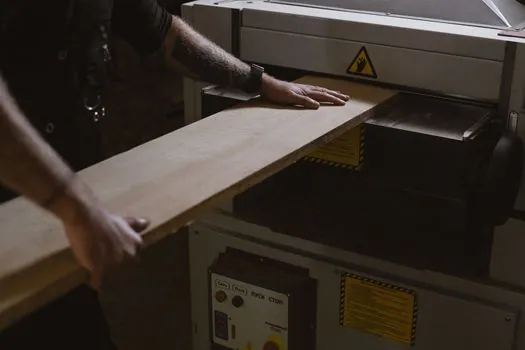
A belt sander uses a motor to spin a pair of drums, with a continuous loop of sandpaper wrapped around them; the belt moves at high speed and the abrasive face grinds the workpiece by linear contact [S2]. Variable speed is standard on most handheld units, because faster belt speeds remove more stock while slower speeds give a finer finish and reduce heat build-up in the workpiece [S2].
Two configurations matter for selection. Handheld belt sanders are portable and used directly on large surfaces such as floors, tabletops, and doors. Stationary belt sanders are bench-mounted, with the workpiece presented to the belt, and are the configuration used for tool sharpening and small-part shaping. Common belt footprints are 3 in × 18 in for light detail work, 3 in × 21 in for general woodworking, and 4 in × 24 in for floor sanding where coverage outweighs control [S2]. Motor power on handheld units typically sits in the 6–12 A range, with stationary machines drawing more [S2].
Comparison of the three families on selection criteria
Reading the three mechanisms against four selection criteria gives a clean pass/fail for shop floor decisions. Cut rate is highest on belt sanders, intermediate on rotary, lowest on orbital, while surface finish out of the tool is best on orbital, intermediate on belt with a fine grit, and worst on rotary. Workpiece size favours belt and wide-belt machines for full panels, rotary for localised steel work, orbital for detail and small areas. Dust extraction is straightforward on all three when the abrasive and pad are matched to a vacuum port, and weakest on belt machines in the field where the extraction hood is often poorly sealed [S1][S2].
For continuous production lines, the wide-belt sander is paired with material-handling accessories. The BTWB3 return conveyor is offered in five roller-length models (BTWB3-24 / 30 / 36 / 48 / 60) and adds a down-stroke receiving roller, motorized side-shift transfer belts, and a pass-line height adjustment of 2 in to match a sander whose table height the operator sets independently [S3]. Standard receiving and return conveyor lengths are 5 ft and 15 ft respectively, with extensions available on both [S3].
Use cases by industry and material

Belt sanders are the standard for surface preparation tasks: removing old paint or finish, levelling warped boards, smoothing rough lumber before staining, deburring metal edges, and shaping curves on wood and other materials [S2]. A less obvious use is sanding down hardwood floors, which requires the larger 4 in × 24 in format and a higher-amperage motor to keep cut rate acceptable across a full room. Stationary belt sanders are also widely used for sharpening edged tools such as chisels and plane irons, where a cooling fluid and a tool rest are added so the abrasive does not draw the temper of the steel.
Wide-belt sanders with return conveyors feed cabinet shops, door manufacturers, and panel processors, where the abrasive belt runs a calibrated grit sequence from 60–80 for calibrating thickness down to 120–180 for pre-finish, with the BTWB3 class of conveyor keeping panel flow continuous between machines [S3]. Rotary and orbital sanders finish that workflow by handling edges, end grain, and detail features that the wide belt cannot reach.
Safety, dust, and failure modes
Belt sanders remove material fast, so the standard safety envelope is eye protection plus a dust mask, fingers kept clear of the moving belt, the workpiece secured on a stationary unit, and no forcing of the tool, since the belt's own weight and speed deliver the cut [S2]. The most common field failure on belt machines is a torn or running-off belt caused by poor tracking adjustment or by a dust-loaded hood that distorts the platen, so dust collection is a maintenance item, not just a cleanliness item.
For related equipment-spec reading, the failure-mode logic for high-speed rotating machinery has parallels with the bearing and seal wear map on industrial power mixers, and the cost-of-ownership framing around abrasive consumption is similar to the consumable-cost breakdown on fiber laser cutting. For plants running a sander line alongside other woodworking machinery, a spec map for storage cages on the parts side is often pulled in the same procurement cycle.
For the relevant spec sheets and selection criteria, see sander, pressure transmitter, and flow meter.