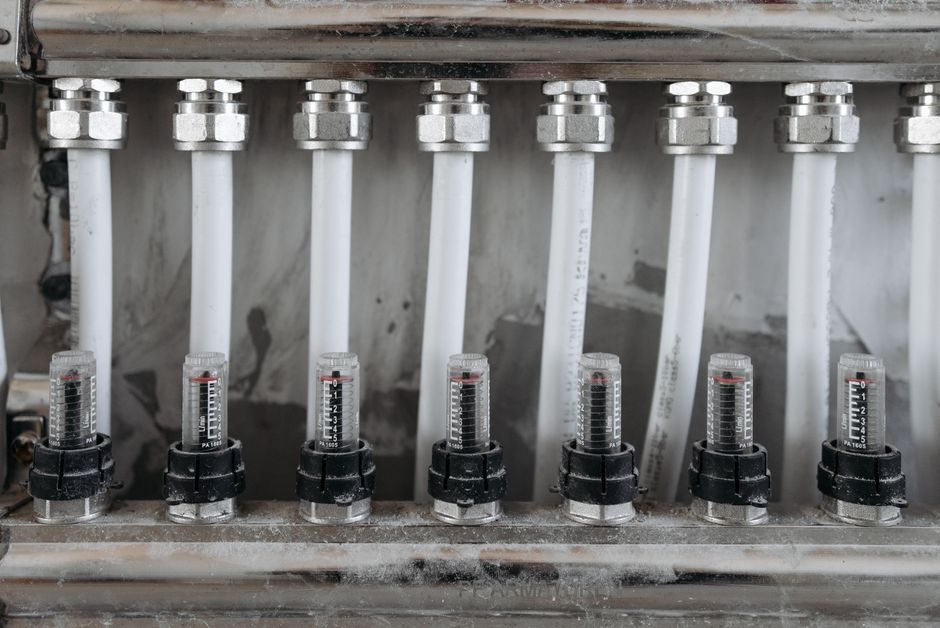
A sanitary process line running 304L stainless tube, ASTM A270-spec seamless, with sanitary ferrule clamp joints and 15 µin Ra ID finish, is the baseline most pharmaceutical, dairy, and beverage plants quote against [S4].
Stainless sanitary pipe and fittings produced for clean service — as listed by manufacturers serving this segment — are typically limited to 304 / 304L and 316 / 316L austenitic grades, in sizes 1/2" through 6" OD, with tube wall thickness meeting ASME B31.3 process piping requirements and finish described as sanitary or high-purity [S4]. The piping decisions in a hygienic skid concentrate on four variables: material grade, dimensional standard, internal surface finish, and joint system. Get any of these wrong and clean-in-place (CIP) chemistry, validation, or mechanical integrity fails long before throughput does.
Material Grade: 304L vs 316L vs Higher Alloys
304L (UNS S30403, ~18% Cr / 8% Ni, ≤ 0.030% C) handles most dairy, beverage, and personal-care process streams where chloride exposure stays below roughly 200 ppm and temperatures remain under 60 °C [S4].
316L (UNS S31603, ~16% Cr / 10% Ni / 2% Mo, ≤ 0.030% C) is the default for pharmaceutical water systems, clean steam, and any CIP loop exposed to chloride-bearing sanitizers — the 2% molybdenum lift raises pitting resistance and pushes the critical pitting temperature above the 304L baseline [S4]. The "L" low-carbon variant is non-negotiable for welded sanitary systems: holding carbon at or below 0.030% prevents chromium-carbide precipitation at the HAZ, which is what causes intergranular corrosion in sensitized 304. For high-purity WFI (water for injection) loops, higher alloys such as 316L with controlled ferrite and electropolished ID, or in extreme cases AL-6XN / alloy 20, are evaluated when chloride plus temperature exceed 316L's comfort zone — the cited sanitary supplier catalog covers this 304L-to-higher-alloy progression explicitly [S4]. For broader context on how 300-series stainless compares to carbon and alloy options in process pipe, the stainless steel pipe reference gives the material property baseline that drives these grade decisions.
Dimensional Standard: ASTM A270 vs A249 vs A269
ASTM A270 is the dedicated standard for sanitary tube used in dairy, food, and pharmaceutical process lines, covering both seamless and welded product with specific surface-finish requirements and dimensional tolerances tighter than commodity pipe [S4].
ASTM A269 covers general seamless and welded austenitic tubing for low- and high-temperature service — it is the fallback for utility and instrument-air lines but lacks the sanitary-specific finish and inspection clauses. ASTM A249 covers welded austenitic tube for boiler, superheater, and heat-exchanger service, where the wall-thickness testing and weld-bead requirements differ from sanitary intent. Commercially available stainless sanitary tube in 1/2"–6" OD is typically dual-certified to A270 and A249 for the larger sizes used in CIP return and product transfer, and dual-certified to A270 and A269 for the smaller instrument and branch sizes [S4]. OD tolerances on A270 are held to within ±0.005" for sizes up to 1-1/2" and ±0.008" beyond, which is what makes a sanitary ferrule clamp seat without gaps. Readers wanting a side-by-side on hygienic tube vs. commodity tube should consult the stainless steel overview, which lays out the broader 300-series family these standards govern.
Surface Finish: Mechanical Polish vs Electropolish, and Ra Targets
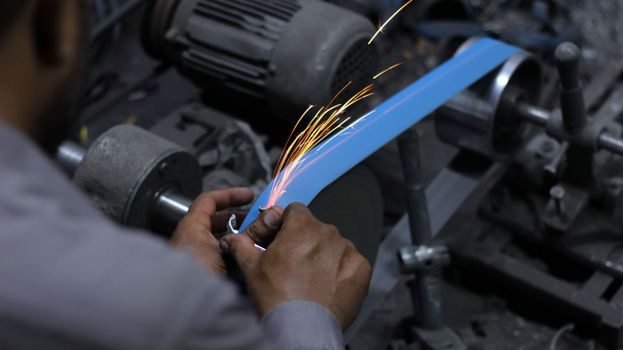
Mechanical polishing in a sanitary line typically delivers 20 µin Ra (0.5 µm Ra) ID on as-produced 304L/316L tube, while electropolishing removes 0.001"–0.002" of surface material and drops the reading to 10–15 µin Ra, with the smoothest sanitary runs reporting sub-10 µin Ra on ultra-high-purity product [S2][S4].
Ra alone is not the full story: the electropolished surface also reduces the number of micro-crevices where biofilm anchors, which is why pharmaceutical WFI and clean-steam loops almost always specify electropolished ID rather than relying on mechanical polish alone [S2]. The fabricating shop's listed capabilities include "polishing to SPEC. RA. finishes, grit, ID and OD, electropolishing" and orbital tube welding for the tube-to-fitting joints that hold the surface at the weld root [S2]. For most food and dairy service, 20 µin Ra mechanical polish is acceptable and cheaper; for injectable pharma, biotech, and semiconductor wet benches, specify 15 µin Ra (or better) electropolished and require a Ra certification per lot, not per heat. The process-engineering tradeoffs that drive this surface-and-skid pairing are covered in the related piece on food processing equipment manufacturing, which addresses matching vessel finish to piping finish across a hygienic skid.
Joint System: Sanitary Tri-Clamp vs Orbital Weld vs Threaded
Sanitary tri-clamp (also called ISO 2852 / DIN 32676 ferrule clamp) joints in 304L or 316L are the default for product-contact lines, available in 1/2"–6" sizes with EPDM, FKM, or PTFE gaskets and an operating envelope of roughly -10 °C to 150 °C at full vacuum to 10 bar depending on clamp size and gasket compound [S4].
Orbital TIG welding is the joining method for any line that cannot have a gasket — clean steam, WFI, and any bioburden-sensitive loop — because it eliminates the gasket as a crevice and a maintenance item; weld procedures are qualified per ASME B31.3, with the fabricator's weld test bench running to "ASME B.P.V.C. SECT. IX and ASTM E Code Section IV" for procedure and welder qualification [S2]. Threaded joints are inappropriate inside the sanitary envelope: threads create crevices, harbor product, and cannot be CIP'd effectively. The orbital weld plus a sanitary ferrule on each instrument branch and CIP connection is the dominant pattern in a current hygienic skid. The logic of which connection belongs in which service — and how the choice cascades into the surrounding process line layout — is the kind of decision a sanitary system designer locks in at the P&ID stage, not in the field.
Selection Criteria: A Quick Comparison
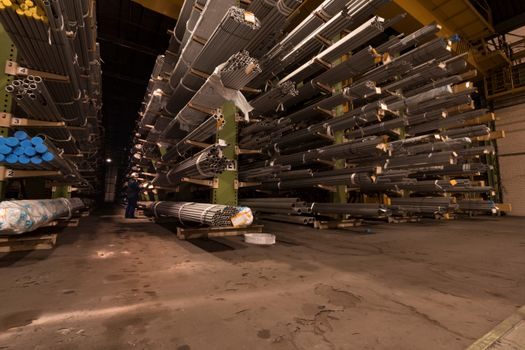
Four realistic piping choices line up against the criteria that actually drive a hygienic system design: 304L sanitary tube is the cheapest and adequate for low-chloride, sub-60 °C service; 316L sanitary tube adds the molybdenum margin that 300-ppm chloride CIP chemistry needs; 316L electropolished is the pharma WFI / clean-steam standard; and higher alloys (AL-6XN, alloy 20) only earn their cost where chloride plus temperature exceed 316L's pitting envelope [S4].
Cost moves roughly 1.0× → 1.4× → 1.8× → 4× from 304L sanitary to higher alloy in the same size and finish, and lead-time stretches in the same direction because the higher-alloy inventory is thinner at most distributors. Corrosion margin against chloride CIP roughly tracks 200 ppm → 500 ppm → 2,000+ ppm → 5,000+ ppm for the four options, and CIP validation effort scales with finish: mechanical-polish validation is the lightest, while sub-15 µin Ra electropolish with per-lot Ra certification is the heaviest. Buyers building a steel pipe comparison should keep in mind that hygienic stainless is its own sub-segment and does not share commodity steel-pipe price points. A reader evaluating hygienic-line adjacency options — for example, when a sight glass competes with a piped sample port — can use the structured framework in stainless steel pipe vs sight glass: cleanability decision map to test which option survives CIP and clean-steam qualification.
Who Should NOT Default to 304L
Anyone running chloride-bearing sanitizers above roughly 200 ppm at elevated CIP return temperatures, or anyone tied to WFI / clean-steam / injectable validation, will be pushed off 304L by either the corrosion or the surface-finish requirement before the project is half-scoped [S4].
Similarly, plants that rely on threaded connections or commodity-grade tube inside the hygienic envelope will fail their first CIP validation: the joint and the surface have to be designed as a single system, not as separate procurement lines. Sanitary specification is also the wrong place to economize when the line carries product above 80 °C continuously — sensitization and stress-corrosion cracking become real risk vectors that the 304L low-carbon buffer alone cannot fully absorb. The presence of orbital-welded joints qualified to ASME B31.3 is the single strongest signal that a fabricator understands the hygienic system, not just the components [S2]. Buyers looking at adjacent hygienic-equipment selection — for example, picking a steam separator for a chemical process skid that ties into the same clean utility network — will find the decision logic tracks closely in steam separator selection criteria for chemical process skids.
Validation, Documentation, and Sourcing
Documentation that a sanitary tube lot must ship with includes the mill test report (MTR / EN 10204 3.1) confirming 304L or 316L chemistry, the A270 dimensional compliance statement, the ID surface-finish Ra reading per lot, and — for pharmaceutical service — the electropolish passivation certificate and the ASME B31.3 weld procedure / welder qualification record covering the orbital TIG procedure used on the job [S2][S4].
The 200-series, 17-4 PH, and 400-series stainless variants that show up in commodity stainless pipe catalogs are not interchangeable with sanitary tube — their metallurgy, surface behavior under electropolish, and weld-HAZ response disqualify them from hygienic service. Stockist and exporter channels serving dairy, pharmaceutical, and chemical-skid builders typically dual-stock 304L and 316L in A270 tube, with 316L electropolished-to-order in sizes through 4" OD, and they hold 304L for non-critical utility branches and instrument-air lines [S1][S4]. When a hygienic system lands at the fabricator, the weld procedure qualification per ASME BPVC Section IX and the orbital-weld coupon record are the documents an inspector will ask for first; the fabricator's "weld test of codes ASME B.P.V.C. SECT. IX and ASTM E Code Section IV" line is exactly that qualification chain [S2].