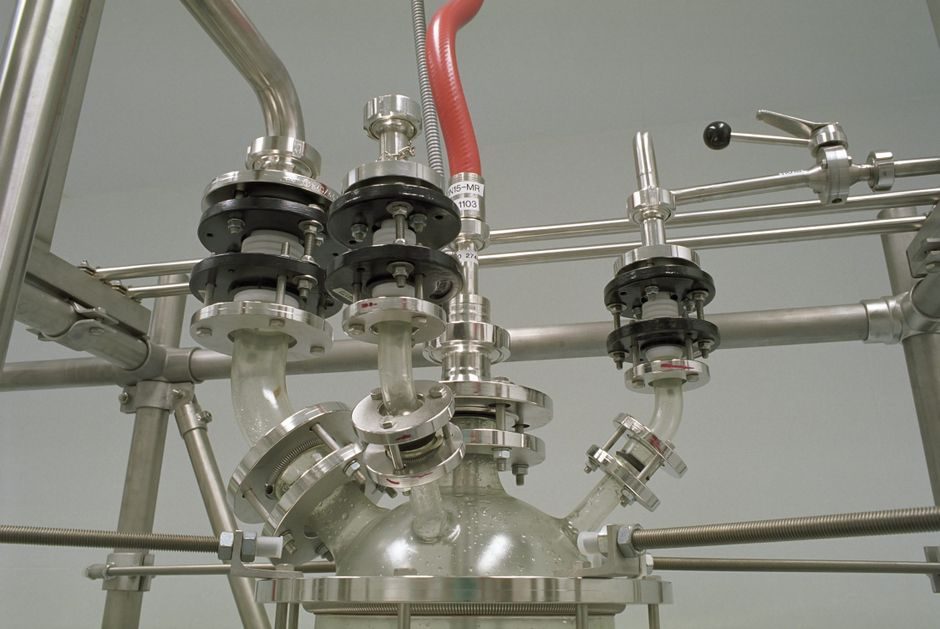
Mott's published skid selection guidance lists six primary inputs: type and size of particles to be removed, chemical compatibility of wetted materials, flow rate, operating pressure, temperature, and available skid footprint [S1].
Carotek's supplier-selection guide (2020) reinforces that the P&ID, not the component cut-sheet, is the controlling document: flow rates, pressures, line sizes, material of construction (304, 316, higher-grade alloys), enclosure rating (NEMA 12), and the HMI/Ethernet protocol define the skid envelope before any filter brand is named [S3].
Particle Cut, Flow, and the Sizing Triangle
Cartridge filters typically deliver absolute ratings from 0.2 µm to 100 µm at flow rates up to ~150 L/min per 10-inch element; bag filters cover 1–200 µm at higher dirt-holding capacity but coarser cut; sintered porous-metal elements span 0.1–500 µm and tolerate temperatures above 800 °C depending on alloy [S1]. Sartorius industrial skid literature shows the same envelope: single-line and twin-line configurations, both built around replaceable cartridges sized to the duty [S4].
For a chemical skid, the working equation is dirt-holding capacity (g) ÷ expected solids loading (ppm) × change-out interval (h) must exceed the design ΔP trip — usually 1.0–1.5 bar end-of-life across most industrial pleated elements [S1]. A sintered 316L element in 5 µm grade commonly holds 5–10× the mass of a 5 µm melt-blown polypropylene cartridge before reaching rated ΔP, but at 3–8× the unit cost, so duty cycle and labour rate dominate the break-even [S1][S4].
Material of Construction and Chemical Compatibility
For halogenated solvents, strong oxidisers, or services above ~80 °C, polypropylene bags and melt-blown PP cartridges are ruled out by chemistry — 316L stainless, Hastelloy C-22, or alloy 20 porous-metal elements are the OEM default per Mott's published guidance [S1]. Wetted O-rings follow the same logic: EPDM to ~150 °C in amines, Viton/FKM to ~200 °C in hydrocarbons, PTFE encapsulated for the halogen/acid envelope [S1][S3].
Anderson Process's published chemical-skid case studies show this pattern: polymer feed skids with Snyder 130-gal poly tanks and Vega radar level sensors run with PP/composite filter media, while adhesive and chemical-distribution skids pair 316L wetted piping with Wilden P1 AODD pumps for chemical transfer under secondary containment [S2]. Carotek's spec checklist explicitly elevates "materials of construction" to the top of the performance-requirements list ahead of brand-level component calls [S3].
Vessel Code, Pressure Rating, and PED/ASME Envelope

Process filter housings on chemical skids are typically designed to ASME BPE or ASME VIII Div 1 for unfired pressure vessels, with a 1.5× design margin on MAWP for cyclic service and full vacuum rated when used upstream of a pump [S3]. Carotek's electrical section requires the skid supplier to declare enclosure rating, sensor type, and operating-temperature minimums/maximums on the P&ID, which drives instrument-side decisions such as NEMA 4 vs NEMA 12 panels [S3].
For a chemical dosing skid, the V-process line typically runs at 3–10 bar with PSV set per ASME Section VIII; filter housings are usually specified one step below the line flange class (150# for 10 bar line, 300# for 20–40 bar) to keep the housing a consumable spares item [S3]. Anderson Process's clean-in-place chemical dosing skids, for instance, use Graco QUANTM electric-operated double-diaphragm pumps selected for reduced pulsation versus pneumatic AODD units — and the filter housing is matched to the pump's NPSH rather than to the line rating alone [S2].
Configuration: Single vs Twin (Duplex) Filtration Lines
Sartorius publishes both single-filtration-line and twin-filtration-line skid configurations; the twin arrangement allows one line online while the other is on standby or being cleaned, which is the typical selection for chemical services where shutdown costs exceed filter cost [S4]. Mott's process-filter range is the same — single housings for batch skids and instrument-quality polish, duplex or multi-element housings for continuous duty on refining and specialty-chemical lines [S1].
Carotek's guidance is direct: specifying components by brand should be limited to what is needed for integration with existing equipment; for the rest, the fabricator's standard on performance basis is acceptable, which keeps the duplex-vs-single decision on the side of continuous-duty service whenever the upstream solids load is non-trivial [S3]. For related pumping-side decisions on chemical skids, the Diaphragm vs Inline Pipeline Pump: Calibration Interval Decision Map covers the AODD-vs-centrifugal trade-off that almost always sits next to a filter vessel in the P&ID.
Filter Media Comparison: Cartridge vs Bag vs Sintered Metal

Across the three mainstream media types, the decision matrix is: (1) Cut precision — sintered metal ≥ pleated cartridge > bag; (2) Chemical compatibility — sintered metal (316L/alloy) > bag (PP/PE) ≥ standard cartridge, with PTFE-membrane cartridges matching sintered metal in halogen service at the cost of thermal ceiling; (3) Temperature — sintered metal to ~800 °C, PTFE-membrane cartridge to ~260 °C, PP bag to ~90 °C; (4) Reusability — sintered metal cleanable 50+ cycles, cartridge single-use, bag single-use [S1][S4].
In our published experience at a chemical distribution skid, AODD pumps (Wilden P1) push cleaning chemicals through 316L bag housings rated for the specific gravity of the fluid, and the filter is always specified one size up from the calculated line so the change-out interval aligns with the maintenance window [S2]. For an adhesive filtration skid on a coating line, a Blackmer gear pump feeding a finer cut (~25 µm) was paired with a higher-surface pleated cartridge to keep ΔP under 0.7 bar at design flow [S2]. Where the industrial filter sits in a multi-stage skid, the next stage downstream is usually a guard filter at 1/5 the micron rating of the primary.
Instrumentation, ΔP Monitoring, and Controls Integration
Most chemical skids in 2026 carry a differential-pressure transmitter across each filter housing, with a high-ΔP alarm at 0.7–1.0 bar and a trip at 1.5 bar — values that match the published change-out recommendations for pleated and bag media under typical chemical-service viscosities [S3][S4]. Carotek's specification list demands sensor type, enclosure rating, HMI requirements, and the Ethernet protocol (EtherNet/IP, PROFINET, Modbus TCP) declared up front so the controls integrator can wire the filter into the skid PLC [S3].
Sartorius skid systems integrate CIP cycles in their semi-automated and fully-automated industrial systems, with filtration treated as a discrete phase in the recipe rather than a passive inline component [S4]. On polymer-feed skids, the same Vega radar level sensor and chemical-tank instrumentation pair with the filter's ΔP switch to drive an interlock that stops the feed pump on high-ΔP — a pattern Anderson Process documents across its custom-skid builds [S2]. For a complementary view on adjacent chemical-skid equipment, the Ball Valve Selection Criteria for Corrosive Chemical Service covers the upstream isolation valves that almost always sit on the filter inlet and outlet.
Who Should Not Specify a Standard Bag Filter

Three duties consistently break a polypropylene bag: continuous service above ~90 °C, halogenated or strong-acid chemistries (HCl, HF, chlorinated solvents), and applications requiring sub-25 µm cut with any meaningful dirt-holding capacity [S1]. In all three, a 316L or higher-alloy sintered element, or a PTFE-membrane pleated cartridge, will out-perform and outlast a bag filter by a wide margin on life-cycle cost despite higher unit price [S1][S4].
Conversely, a sintered-metal housing is the wrong choice for a low-pressure (under 3 bar), low-temperature, water-like batch service: the capital cost is wasted, and the operator loses the convenience of a 30-second bag change-out [S1]. The chemical anchor analogy holds: over-spec the consumable and the skid carries a 3–8× cost penalty that never earns out, under-spec it and the next batch is at risk of particulate breakthrough into the multifunction process calibrator loop or downstream reactor. Track the next published Mott filtration-skid update, any 2026 Sartorius CIP-skid datasheet revision, and Carotek's next guide refresh — these are the three OEM sources that move first when the consensus shifts.